PM E-DRIVE Scheme 2026: Subsidy, Eligibility & How to Apply (India)
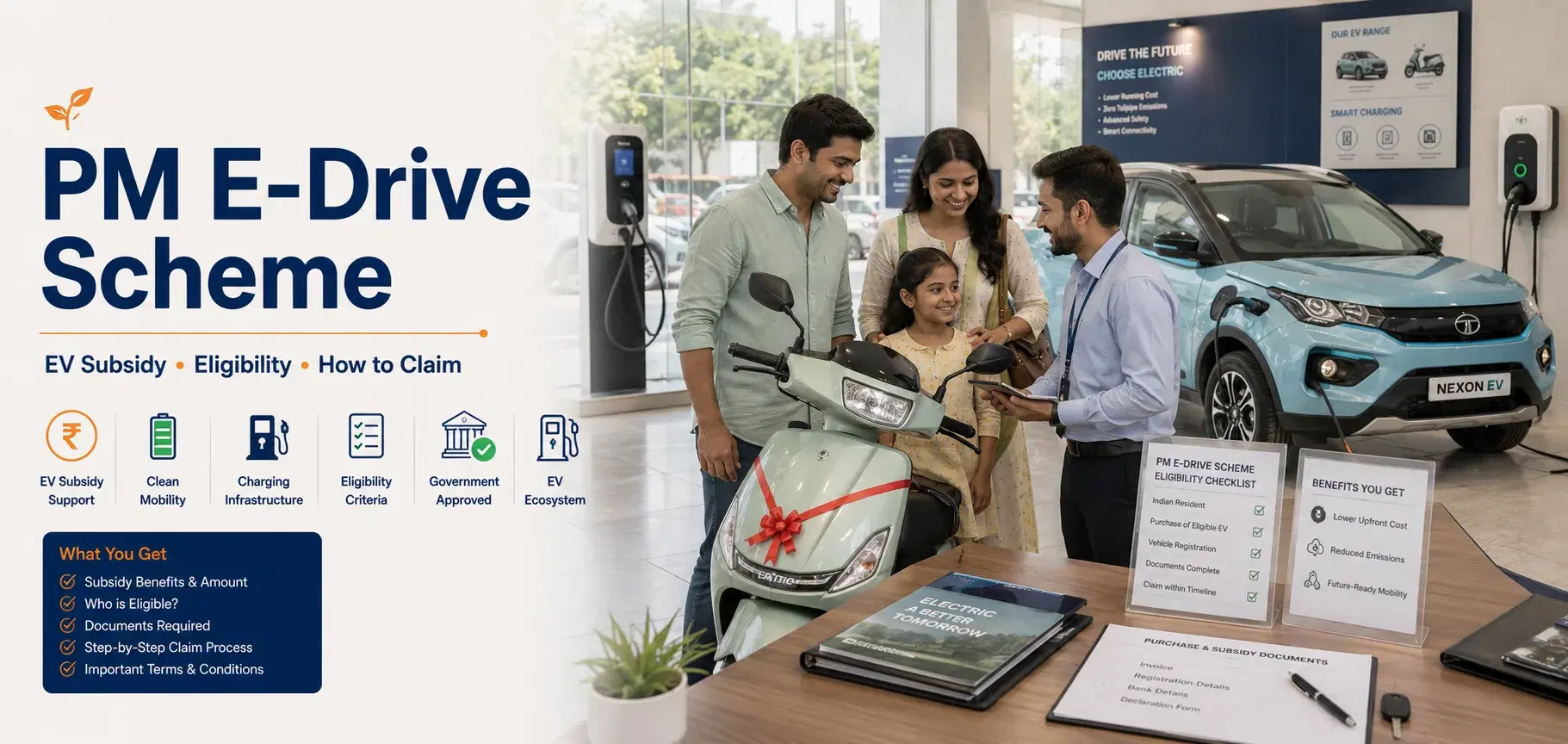
India's flagship EV subsidy programme — the PM Electric Drive Revolution in Innovative Vehicle Enhancement (PM E-Drive) scheme — has already delivered subsidised electric vehicles to over 22 lakh buyers since its launch in October 2024.
Whether you're buying an electric two-wheeler, running a commercial fleet, or planning an EV charging station business, this guide covers everything: subsidy amounts, eligibility rules, the e-voucher claim process, and the latest extension deadlines.
The scheme replaced FAME II with a ₹10,900 crore outlay and a smarter, Aadhaar-linked e-voucher system that puts the subsidy directly in the buyer's hands.
What is the PM E-Drive Scheme?
The PM E-Drive Scheme is a Central Sector Scheme launched by the Ministry of Heavy Industries (MHI) on 1 October 2024 with a total outlay of ₹10,900 crore over two years. It replaced the FAME II scheme and aims to accelerate electric vehicle adoption across India by offering direct demand incentives to buyers through an Aadhaar-authenticated e-voucher system.
The scheme was approved by the Union Cabinet and notified via Gazette notification S.O. 4259(E) on 29 September 2024. It supports a maximum of 28,30,445 vehicles across multiple categories.
Key Components of PM E-Drive
The scheme covers six major vehicle segments plus charging infrastructure:
Electric Two-Wheelers (e-2W): 24,79,120 units — ₹1,772 crore allocated
Electric Three-Wheelers L5 (e-3W): 2,88,809 units — ₹857 crore allocated
E-Rickshaws and E-Carts: 39,034 units — ₹50 crore allocated
Electric Buses (e-buses): 14,028 units — ₹4,391 crore allocated
Electric Ambulances: 3,811 units — ₹500 crore allocated
Electric Trucks (e-trucks): 5,643 units — ₹500 crore allocated
EV Public Charging Infrastructure (EVPCS): ₹2,000 crore allocated
Why PM E-Drive Replaced FAME II
FAME II ran from FY2020 to FY2024 and offered ₹10,000 per kWh as demand incentive. PM E-Drive cut that to ₹5,000 per kWh in FY2024-25 and further to ₹2,500 per kWh in FY2025-26 — yet delivered 1.13 million EVs in its first year, which is 3.4 times the annual volumes achieved under FAME II. This signals a maturing market that needs less subsidy per vehicle.
PM E-Drive vs FAME II: Key Differences at a Glance
PM E-Drive offers a lower per-vehicle subsidy than FAME II (₹2,500/kWh vs ₹10,000/kWh at peak) but covers far more vehicle categories, introduces the Aadhaar-linked e-voucher system, and has a significantly larger total outlay of ₹10,900 crore — making it a broader, more efficient programme.
Feature | FAME II | PM E-Drive (2026) |
|---|---|---|
Launch Year | 2019 | 2024 |
Total Outlay | ₹11,500 crore | ₹10,900 crore |
Incentive Rate (e-2W) | ₹10,000/kWh | ₹2,500/kWh (FY25-26) |
Subsidy Mechanism | Dealer-claimed | Aadhaar e-voucher (buyer-initiated) |
e-Buses Covered | Yes | Yes (14,028 units) |
e-Trucks Covered | Limited | Yes (5,643 units) |
Charging Infrastructure | ₹1,000 crore | ₹2,000 crore |
Price Cap (e-2W) | ₹1.5 lakh | ₹1.5 lakh (ex-factory) |
Aadhaar Authentication | No | Mandatory |
Pro tip: The e-voucher system means the subsidy is now buyer-controlled, not dealer-controlled. You generate the voucher before purchase, which reduces the risk of dealers pocketing the benefit.
Who is Eligible for PM E-Drive Subsidy?
Eligibility for PM E-Drive subsidy depends on the vehicle type you're buying. Individual Indian citizens purchasing registered e-2Ws or e-rickshaws qualify, as do commercial fleet operators buying e-3Ws and e-trucks. All applicants must have a valid Aadhaar number for e-voucher generation. There's no income cap for individual buyers.
Eligibility by Vehicle Category
Electric Two-Wheelers (e-2W): Any individual Indian citizen buying a new e-2W from a registered OEM (Original Equipment Manufacturer) listed on the PM E-Drive portal. The vehicle's ex-factory price must not exceed ₹1.5 lakh.
E-Rickshaws and E-Carts: Individual buyers and small operators. Ex-factory price cap: ₹2.5 lakh.
Electric Three-Wheelers (L5 category): Commercial operators. Note: This category closed on 26 December 2025 after hitting its 2,88,809-unit target.
E-Trucks: Goods transport fleet operators transitioning to electric vehicles.
E-Buses: State Transport Undertakings (STUs) and city bus operators in cities with population above 4 million — including Bengaluru, Delhi, Mumbai, Hyderabad, Ahmedabad, Pune, and Surat.
EV Charging Station Operators: Businesses and entrepreneurs applying through DISCOMs or State Nodal Agencies.
How to Check PM E-Drive Eligibility Online
Visit the official portal at pmedrive.heavyindustries.gov.in and check whether your chosen vehicle model is listed under registered OEMs. You'll need your Aadhaar number to proceed with e-voucher generation. If your vehicle model isn't listed, it doesn't qualify — contact the manufacturer to confirm their registration status.
PM E-Drive Subsidy Amounts: How Much Can You Get?
The PM E-Drive subsidy amount depends on your vehicle's battery capacity (kWh) and ex-factory price. For FY2025-26, the incentive is ₹2,500 per kWh for e-2Ws and e-3Ws, capped at 15% of the ex-factory price or the per-kWh amount — whichever is lower.
Vehicle Category | Incentive Rate | Price Cap | Max Subsidy (Approx.) |
|---|---|---|---|
Electric Two-Wheeler (e-2W) | ₹2,500/kWh | ₹1.5 lakh (ex-factory) | ~₹5,000–₹10,000 |
E-Rickshaw / E-Cart | ₹2,500/kWh | ₹2.5 lakh (ex-factory) | ~₹10,000–₹15,000 |
E-Truck | Fixed per vehicle | No standard cap | Up to ₹50,000+ |
E-Bus | Fixed per bus | Tendered rate | ₹20–₹40 lakh per bus |
Important: The incentive is capped at 15% of the ex-factory price or the per-kWh amount, whichever is lower. A vehicle with a 2 kWh battery gets a maximum of ₹5,000 at the current rate. As of 31 December 2025, ₹1,703 crore had already been reimbursed to OEMs for e-2W and e-3W buyers.
The demand-incentive tapering is intentional policy design. As Charith Konda, Energy Specialist at IEEFA, notes: "The government should continue offering purchase subsidies to sustain momentum but clearly communicate a phased-down trajectory for a longer term."
How to Claim PM E-Drive Subsidy: Step-by-Step e-Voucher Process
To claim the PM E-Drive subsidy, you generate an Aadhaar-authenticated e-voucher on the official portal before purchasing your EV, then present it to the registered dealer at the time of purchase. The dealer submits it to the OEM, who claims reimbursement from MHI. The subsidy is deducted from your invoice price upfront.
Step-by-Step Claim Process
Check vehicle eligibility: Visit pmedrive.heavyindustries.gov.in and confirm your chosen model is listed under a registered OEM.
Generate your e-voucher: Log in with your Aadhaar number. Complete OTP-based authentication. The portal generates a unique e-voucher with a reference number — this is your Customer ID in the PM E-Drive scheme.
Visit a registered dealer: Take your e-voucher (digital or printed) to an authorised dealership of the OEM.
Subsidy applied at point of sale: The dealer enters your e-voucher reference into their system. The subsidy amount is deducted directly from your invoice — you pay the net price.
OEM claims reimbursement: The dealer reports the sale to the OEM, who then claims the demand incentive from MHI through the official portal.
What is Customer ID in PM E-Drive?
Your Customer ID is the unique reference number generated when you create your e-voucher on the PM E-Drive portal. Keep this number safe — you'll need it to track your subsidy claim status and for any grievance redressal.
Pro tip: Don't visit the dealer before generating your e-voucher. Some dealers may try to process the sale without it, which means you'd lose the subsidy benefit entirely.
How to Check PM E-Drive Subsidy Status Online
You can check your PM E-Drive subsidy status by logging into pmedrive.heavyindustries.gov.in using your Aadhaar number and entering your Customer ID (e-voucher reference number). The dashboard shows whether your claim is pending, approved, or reimbursed to the OEM.
Tracking Your Claim
Step 1: Go to the official PM E-Drive portal dashboard.
Step 2: Log in with your Aadhaar-linked mobile OTP.
Step 3: Enter your Customer ID / e-voucher reference number.
Step 4: View claim status — typically updates within 7–15 working days after vehicle purchase.
What to Do If Status Shows 'Pending' or 'Rejected'
If your status is stuck on 'Pending' for more than 30 days, contact the OEM's customer service first — the issue is usually at the dealer-to-OEM reporting stage, not with MHI. If your claim is 'Rejected', common reasons include:
Vehicle model not registered under the scheme at time of purchase
Aadhaar mismatch between e-voucher and vehicle registration
Dealer didn't submit the e-voucher reference correctly
For grievance redressal, contact MHI directly through the portal's helpdesk or write to the Ministry of Heavy Industries, New Delhi.
PM E-Drive Scheme Extension and Last Date 2026: Latest Updates
The PM E-Drive scheme has been extended beyond its original two-year window. As of the March 2026 MHI amendment notification, e-2W incentives run until 31 July 2026, and e-rickshaw/e-cart incentives run until 31 March 2028. The L5 e-3W category closed on 26 December 2025 after exhausting its unit target.
Current Deadlines at a Glance
Vehicle Category | Last Date to Claim |
|---|---|
Electric Two-Wheeler (e-2W) | 31 July 2026 |
E-Rickshaw / E-Cart | 31 March 2028 |
L5 Electric Three-Wheeler | CLOSED (26 Dec 2025) |
E-Buses | Ongoing (tender-based) |
Important: The scheme is fund-limited, not just time-limited. Once the ₹10,900 crore outlay is exhausted, no further subsidies will be issued — even before the deadline. With 22.12 lakh EVs already sold under the scheme as of January 2026, the e-2W allocation is being consumed rapidly. Don't wait until July 2026 to act.
PM E-Drive for EV Charging Stations: Business Opportunity
Under PM E-Drive's EVPCS (EV Public Charging Station) component, ₹2,000 crore is allocated for public charging infrastructure. Businesses, DISCOMs, and oil marketing companies can apply for subsidised charger installation. As of May 2026, 4,874 public EV chargers have been approved with ₹503.86 crore in funding.
Who Can Apply for Charging Station Subsidy?
Oil Marketing Companies (HPCL, IOCL, BPCL)
State governments and DISCOMs
Private entrepreneurs through State Nodal Agencies
Eight states currently approved: Rajasthan, Andhra Pradesh, UP, Gujarat, Kerala, Telangana, Karnataka, Tamil Nadu
How to Apply: Step-by-Step
Prepare documents: Business registration, land ownership/lease proof, electricity connection details, and project proposal.
Approach the right authority: Contact your State Nodal Agency or DISCOM. They aggregate proposals and submit to MHI.
Submit through EVPCS portal: Track your application via the BHEL-managed EVPCS dashboard at evcsmhi.bhel.in.
Await approval and disbursement: Approved projects receive funding tranches linked to installation milestones.
India currently has 27,737 public chargers installed against a target of 72,000+ — there's significant room for new entrants in this space.
State-Wise EV Benefits That Stack With PM E-Drive
Several Indian states offer additional EV subsidies and tax exemptions on top of the central PM E-Drive incentive. Karnataka, Maharashtra, Tamil Nadu, Delhi, and Gujarat have active state EV policies that can significantly reduce your total cost of ownership.
Key State Benefits
Karnataka: Road tax and registration fee waiver on EVs. The state doesn't levy road tax on electric vehicles, making EVs effectively tax-free at registration. Karnataka is also among the eight states approved for EVPCS charger funding under PM E-Drive.
Maharashtra: Additional subsidy of up to ₹10,000 on electric two-wheelers under the Maharashtra EV Policy 2021. Buyers in Mumbai, Pune, and Nashik benefit most.
Tamil Nadu: The Tamil Nadu EV Policy 2023 offers 100% road tax exemption and registration fee waiver through 2026, plus capital subsidies for EV manufacturers.
Delhi: Subsidy of ₹5,000 per kWh (up to ₹30,000) on e-2Ws under Delhi EV Policy, stackable with PM E-Drive benefits.
Gujarat: Road tax exemption and additional purchase incentive for e-2Ws and e-4Ws.
Pro tip: Stack your state subsidy with the PM E-Drive e-voucher for maximum savings. A Delhi buyer of an e-2W could potentially save ₹35,000–₹40,000 in combined central and state incentives.
PM E-Drive Scheme: Key Facts for UPSC and Competitive Exams
For UPSC and state competitive exams, PM E-Drive is a high-frequency current affairs topic. Key facts: launched 1 October 2024 by the Ministry of Heavy Industries; ₹10,900 crore outlay; replaced FAME II; covers 28.3 lakh vehicles; uses Aadhaar-linked e-voucher mechanism; managed via pmedrive.heavyindustries.gov.in.
Quick-Reference Fact Sheet
Full Name: PM Electric Drive Revolution in Innovative Vehicle Enhancement
Launched by: Ministry of Heavy Industries (MHI), Government of India
Launch Date: 1 October 2024
Total Outlay: ₹10,900 crore
Duration: Two years (extended for select categories)
Predecessor: FAME II Scheme
Nodal Ministry: Ministry of Heavy Industries
Gazette Notification: S.O. 4259(E), dated 29 September 2024
EVs Sold (as of Jan 2026): 22.12 lakh
Significance: India's EV penetration reached 7.49% in FY25 with ~1.96 million units sold — 15x growth since FY20
As CEEW Fellow Karthik Ganesan notes: "The shift from FAME II to PM E-Drive marks an important inflexion in India's EV policy — delivering 1.13 million electric vehicles with lower per-unit incentives suggests that parts of the market are beginning to stand on their own."
Conclusion
The PM E-Drive scheme is India's most ambitious EV push yet — and it's working. With 22.12 lakh EVs already sold, ₹1,703 crore disbursed, and 4,874 public chargers approved, the programme has outpaced FAME II on every efficiency metric. If you're buying an electric two-wheeler before 31 July 2026, generate your e-voucher on pmedrive.heavyindustries.gov.in before stepping into a dealership.
Stack your central subsidy with your state's road tax waiver for maximum savings. And if you're eyeing a charging station business, the ₹2,000 crore EVPCS allocation still has significant room — contact your State Nodal Agency now. The subsidy window is open, but it's fund-limited. Don't wait.
Frequently Asked Questions
Based on 1 rating

Tanushree (Author)
Tanushree is a dynamic business strategist with a knack for driving innovation in startups, especially in Fintech and Edtech. With 9 years of work-ex, an IT engineer from MIT Pune, & a MBA from IIM Bangalore (Marketing & Business Strategy), she’s got the mix of analytical and creative problem-solving.
Read more
Related Blogs
Popular articles are selected from the same backend blog feed.

Patna Traffic Fines in 2026: Helmet, PUC, Triple Riding and E-Challan Rules
Patna traffic fines for helmets, triple riding, PUC and more, with Bihar's 2024 PUC slabs, e-challan steps and the 2026 Lok Adalat settlement scheme.

Fancy Number Plate in Punjab: Price List, E-Auction Steps and Rules
Punjab fancy number plates are sold in weekly Parivahan e-auctions. See reserve prices up to ₹5 lakh, fees, EMD, the weekly calendar and recent Ludhiana bids.

Fancy Number Plate in Tamil Nadu: Current Fees, How to Apply and What Is Changing
Tamil Nadu fancy number plate: current RTO fees, how to apply, what the Oct 2025 e-bidding rule and June 2026 fee draft mean, and HSRP plate rules.

Fancy Number Plates in India: How the Parivahan E-Auction, Reserve Prices and State Rules Work
How fancy number plates work in India: the Parivahan e-auction steps, reserve-price examples, validity deadlines, the residency rule and HSRP norms.
Fancy Number Plate in Delhi: Price List, E-Auction Steps and Rules (2026)
Delhi fancy number reserve prices from ₹5 lakh for 0001 to ₹20,000+ for choice numbers, plus how the e-auction, 90-day allotment and HSRP rules work.

Fancy Number Plate in Odisha: Base Prices, E-Auction and How to Book (2026)
Odisha fancy number base prices from ₹10,000 to ₹1 lakh, the choice-number fee, how to book on Parivahan and the 30-day rule. Checked 12 Oct 2026.
%20-%20Address%2C%20Timings%20%26%20Services.webp&w=3840&q=75)
TN-01 Ayanavaram RTO (Chennai Central): Address, Services, Licence Test and Road Tax
Find the TN-01 Ayanavaram RTO address, how to get a learner licence and book a driving test, TN road tax rates and EV exemption, as of October 2026.

Fancy Number Plate in Assam: How to Book a VIP Number Online
Book a fancy number plate in Assam via the Parivahan e-auction. See how bidding, deposits and registration work, and why reserve prices need a live check.