Premium Petrol vs Normal Petrol: The Complete 2026 Guide for Indian Cars
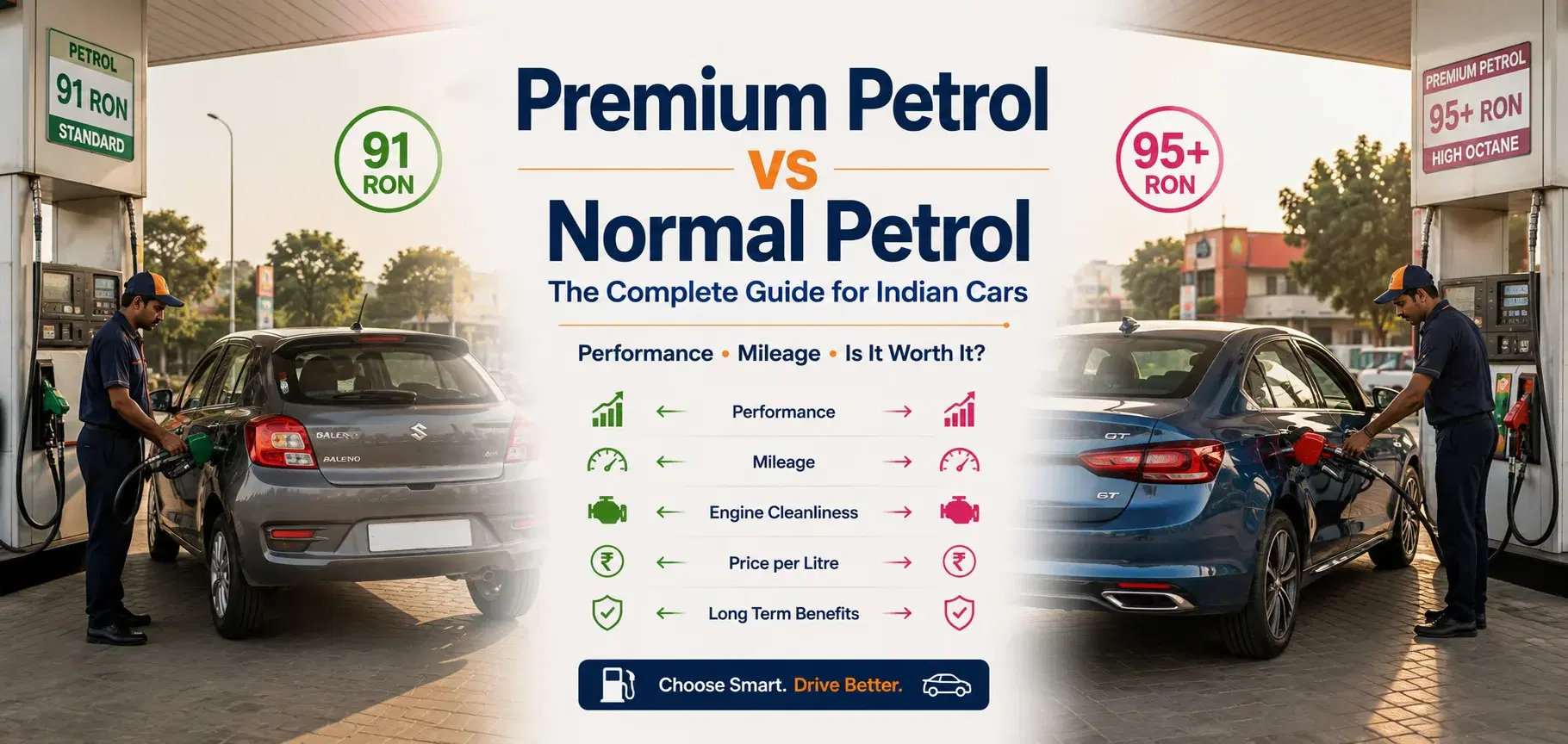
You're at the fuel station, and the attendant asks: 'Regular or premium?' Most Indian drivers hesitate. Is premium petrol actually worth the extra ₹15–₹20 per litre? Or is it just clever marketing? This guide cuts through the noise.
We'll compare XP95, Power 95, Speed 97, and Power99 side by side — covering octane ratings, real-world mileage, current 2026 prices, ethanol blending, and exactly when premium fuel makes sense for your car. Whether you drive a Maruti Swift or a Hyundai Creta, you'll find a clear, honest answer here.
What Is Premium Petrol? (And How It Differs from Normal Petrol)
Premium petrol is a high-octane fuel rated at 95 or above, designed for high-compression engines. Normal petrol in India carries an octane rating of around 87–91. The key differences lie in octane number, fuel additives, and engine compatibility — not just price. Premium petrol resists engine knocking better and burns more cleanly due to added detergents.
Engine knocking (also called pinging) happens when fuel ignites prematurely inside the cylinder. Higher octane fuel withstands this pressure better, which is why performance cars and SUVs with turbocharged engines specifically benefit from it.
Octane Rating Simplified: 87 vs 91 vs 95 vs 99
Here's how India's fuel grades stack up:
87–91 octane: Regular petrol sold at most Indian Oil, BPCL, and HPCL pumps
95 octane: XP95 (IndianOil), Power 95 (HPCL), Speed (BPCL)
97 octane: Speed 97 (BPCL select outlets)
99 octane: Power99 (HPCL) — currently India's highest-rated petrol
Higher octane doesn't mean more energy per litre. It means the fuel is more resistant to premature ignition — a critical factor only for engines designed to exploit it.
Additives and Detergents: What Makes It 'Premium'?
Premium petrol contains Multi-Functional Additives (MFA) that:
Clean fuel injectors and intake valves
Reduce carbon deposits over time
Improve combustion efficiency
Lower harmful emissions
IndianOil's XP95 officially claims a 3.95% improvement in fuel economy, up to 44% lower carbon monoxide, and a 4% increase in engine power. These are manufacturer claims and real-world results will vary by vehicle and driving conditions.
Premium Petrol Brands in India Compared: XP95, Power, Speed, and Power99
India has four major premium petrol options in 2026: IndianOil's XP95, HPCL's Power 95 and Power99, and BPCL's Speed range. Each differs in octane rating, additive formulation, price, and availability. Choosing the right one depends on your engine's compression ratio and where you refuel most often.
Brand-by-Brand Comparison Table
Brand | OMC | Octane Rating | Approx. Price (Delhi, 2026) | Best For |
|---|---|---|---|---|
XP95 | IndianOil | 95 | ₹113–₹115/litre | Turbo petrol, high-compression engines |
Power 95 | HPCL | 95 | ₹113–₹115/litre | Daily drivers with modern engines |
Power99 | HPCL | 99 | ₹120–₹125/litre | Performance cars, sports vehicles |
Speed (95+) | BPCL | 95+ | ₹113–₹115/litre | City and highway driving |
Regular Petrol | All OMCs | 87–91 | ₹97–₹99/litre | Standard engines |
Prices updated post the May 2026 ₹3/litre hike across all variants
IndianOil XP95: Features and Mileage Claims
XP95 is India's most widely available 95-octane petrol, sold across IndianOil's network of 35,000+ outlets. It uses a proprietary additive package and is the go-to choice for Hyundai, Kia, and MG owners with turbocharged engines.
HP Power & Power99: What's the Difference?
HPCL's Power 95 is their standard premium offering. Power99, at 99 octane, is India's highest-rated retail petrol — ideal for performance vehicles like the Hyundai i20 N Line or Tata Nexon turbo. It's available at select HPCL outlets in metro cities.
Pro tip: Power99 is overkill for most standard hatchbacks. It delivers maximum benefit only in engines tuned for 97+ octane fuel.
BPCL Speed: Is It Worth the Cost?
BPCL's Speed range (95+ octane) is enriched with advanced MFA and is a strong alternative to XP95. It's widely available across BPCL's urban pump network and performs comparably to XP95 in real-world conditions.
Will Premium Petrol Increase Mileage and Engine Life?
Premium petrol can improve mileage by 3–5% in engines specifically designed for high-octane fuel. For standard engines running on 87–91 octane regular petrol, the mileage gain is minimal to negligible. Engine life benefits are real but gradual — cleaner combustion reduces carbon buildup over thousands of kilometres.
MIT researchers found that vehicles running on higher-octane fuel are 3–4.5% more fuel-efficient when engines are designed to use it. Raymond Speth, Research Scientist at MIT, explains: "If manufacturers know the gasoline is higher-octane, they can design engines to have a higher compression ratio, which would make the engine smaller and more efficient."
Mileage Myths vs Facts
Myth: Premium petrol always gives better mileage
Fact: Mileage improves only if your engine has a compression ratio above 10:1 or a turbocharger
Myth: Filling premium once will clean your engine instantly
Fact: Detergent benefits accumulate over multiple fill-ups
Myth: Power99 gives 99% more power
Fact: The number refers to octane rating, not power percentage
Does Premium Petrol Clean Your Engine Better?
Yes — but gradually. The detergent additives in XP95, Power, and Speed fuels reduce carbon deposits on fuel injectors and intake valves. Over 10,000–15,000 km of consistent use, this can translate to smoother idling and better throttle response.
Long-Term Impact on Engine Wear
For turbocharged engines like those in the Tata Nexon Turbo or Hyundai Venue Turbo, using the manufacturer-recommended 95-octane fuel consistently does reduce wear caused by engine knocking. For naturally aspirated engines in cars like the Maruti Wagon R or Alto, the difference is negligible.
Premium Petrol vs Normal Petrol: Price Analysis and Cost-Effectiveness
In Delhi as of mid-2026, regular petrol costs approximately ₹97.77/litre while premium variants like XP95 and Power 95 cost around ₹113–₹115/litre — a gap of ₹15–₹17 per litre. For most Indian drivers filling 40 litres per week, that's an extra ₹600–₹680 per fill-up.
In March 2026, India's OMCs raised premium petrol prices by ₹2.09–₹2.35 per litre, followed by a further ₹3/litre hike in May 2026 across all variants.
When Premium Fuel Saves You Money (Or Doesn't)
It makes financial sense if:
Your car manufacturer recommends 95+ octane (check your owner's manual)
You drive a turbocharged or high-compression engine
You cover 1,500+ km per month on highways
It doesn't make sense if:
Your car runs a standard naturally aspirated engine (Maruti, entry-level Hyundai)
You drive mostly in stop-and-go city traffic
Your engine's compression ratio is below 10:1
Key point: A 3.95% mileage improvement on a car averaging 15 km/litre saves roughly 0.6 km/litre. At ₹97/litre regular vs ₹114/litre premium, you'd need to drive over 2,800 km per month just to break even on fuel cost alone.
Can I Mix Premium Petrol with Normal Petrol?
Yes, you can safely mix premium and normal petrol in India. Mixing 95-octane premium with 87–91 octane regular petrol results in a blended octane somewhere in between — it won't damage your engine. The fuel system simply burns the blend without any harmful chemical reaction.
This is a common scenario when you're on a highway and only a regular pump is available, or vice versa.
Mixing 95 and 91 Octane: Will It Harm Your Engine?
No. Modern engines with knock sensors (most cars made after 2015) automatically adjust ignition timing to suit the fuel's octane level. So if you mix 95 and 91 octane, the engine management system compensates. You won't get the full performance benefit of premium, but there's zero engine damage risk.
Safe Refueling Practices for Premium Users
Don't mix more than two grades at a time
Avoid mixing premium petrol with diesel — that's a serious mistake
If switching from regular to premium, a full tank transition is fine
Don't mix different brands of premium petrol unnecessarily — additive packages may differ, though it's not harmful
Important: Never mix petrol with diesel, regardless of grade. That causes real engine damage and requires a full fuel system flush.
Ethanol Blending in Premium Petrol: E20, Power Petrol, and the Facts
Power petrol and E20 are NOT the same thing. E20 refers to regular petrol blended with 20% ethanol under India's National Biofuel Policy. Premium petrol brands like XP95, Power 95, and Speed are high-octane fuels with performance additives — they may contain some ethanol, but they're not classified as E20 fuel.
India's government has been rolling out E20 (20% ethanol blend) across regular petrol pumps as part of its 2025 ethanol blending target. This is separate from the premium fuel category.
Is Power Petrol E20? Understanding Ethanol Content
No. Power petrol (HPCL's brand name for its premium range) is a high-octane, additive-enriched fuel. While it may contain a small percentage of ethanol as part of the base fuel blend, it's not marketed or formulated as an E20 product.
Does XP95 Have 20% Ethanol?
IndianOil hasn't officially confirmed XP95's exact ethanol content. However, given that India's standard petrol already contains 10–12% ethanol (E10–E12) as of 2026, XP95 likely contains a similar or slightly lower ethanol percentage to maintain its octane performance.
Can E20 Damage Engines?
E20 is safe for vehicles manufactured after 2023 that are E20-compatible. Older vehicles (pre-2017) with rubber fuel lines and carburettors may experience seal degradation over time with high-ethanol blends. Check your owner's manual for ethanol compatibility before switching.
Disadvantages of Power Petrol: What They Don't Tell You
The main disadvantages of power petrol are its higher cost, limited rural availability, and zero benefit for standard engines. If your car doesn't require 95+ octane fuel, you're paying ₹15–₹17 extra per litre for no measurable performance gain. That's the honest truth most fuel brand ads won't say.
When Premium Fuel Is a Waste of Money
Premium petrol is genuinely wasteful if:
Your engine compression ratio is below 10:1
Your car manufacturer specifies regular petrol (check the fuel cap or owner's manual)
You drive a two-wheeler — most Indian bikes run perfectly on regular petrol
You're doing short city trips under 10 km where the engine doesn't reach optimal temperature
Compatibility Issues with Older Cars
Cars older than 2010 with carburettor-based engines don't benefit from premium fuel's additive package. The detergents are designed for fuel-injected engines. Plus, older rubber fuel components may react poorly to high-ethanol blends sometimes found in premium variants.
Limited Availability in Rural Areas
This is a practical problem. XP95, Power99, and Speed 97 are primarily available at urban and highway pumps. If you're travelling through rural Rajasthan or Chhattisgarh, you may not find a premium pump for 100+ km. Relying exclusively on premium petrol for long rural drives isn't always practical.
India's premium fuel market is growing — the high-octane fuel segment is expanding at a 4.6% CAGR in India — but rural availability remains a genuine gap.
Conclusion
Here's the bottom line: premium petrol is genuinely worth it if your car has a turbocharged or high-compression engine that recommends 95+ octane fuel. For standard hatchbacks and entry-level sedans, it's an unnecessary expense. XP95 and Power 95 are your best everyday premium options — widely available, competitively priced, and backed by real additive technology. Power99 is for performance enthusiasts only.
You can safely mix premium and regular petrol without engine damage. And no, power petrol isn't E20 — they're completely different products. Check your owner's manual, know your engine's requirements, and make the fuel choice that actually fits your car and your budget.
Frequently Asked Questions
Based on 0 ratings

Tanushree (Author)
Tanushree is a dynamic business strategist with a knack for driving innovation in startups, especially in Fintech and Edtech. With 9 years of work-ex, an IT engineer from MIT Pune, & a MBA from IIM Bangalore (Marketing & Business Strategy), she’s got the mix of analytical and creative problem-solving.
Read more
Related Blogs
Popular articles are selected from the same backend blog feed.


Best Bikes Under 1 Lakh in India: Price, Mileage & Low-Maintenance Commuters
Compare the best bikes under ₹1 lakh in India by price, real-world mileage, maintenance and safety — from sub-₹60k commuters to 125cc options near ₹1 lakh.

Best Bikes Under 2 Lakh in India: Streetfighters, Cruisers & All-Rounders
Compare the best bikes under ₹2 lakh in India: verified ex-showroom prices, real-world mileage, ABS and hardware, and which model fits your budget.
Best Sports Bikes Under 5 Lakh in India: Track Bikes, Supersports & Top Speed Comparison
Compare the best sports bikes under ₹5 lakh in India by 0–100 km/h, GPS top speed, track ability, electronics, mileage and ownership costs.

Best 110cc–125cc Family Commuter Scooters in India: Mileage, Comfort & Price Comparison
Compare the best 110cc and 125cc scooters in India by price, real-world mileage, comfort, storage, braking, running cost and the value of upgrading to 125cc.

Best 150cc–160cc Bikes in India: Mileage, Price, Specs & Performance
Compare India's best 150cc–160cc bikes on mileage, price, power, braking and comfort — Pulsar N160, Apache RTR 160 4V, Xtreme 160R, FZ-S and more.
Best 200cc–250cc Performance Bikes in India: Power, Mileage & Highway Cruising
Compare India's best 200cc–250cc bikes on power-to-weight, real-world mileage, highway cruising and price, with the 200cc and 250cc classes covered together.
Best 350cc–500cc Bikes in India: Royal Enfield, Triumph & Mid-Capacity Classics
Compare Royal Enfield, Triumph, Harley-Davidson, KTM and Bajaj bikes from 349cc to 452cc on real price, power, mileage and highway comfort in India.

Best Electric Scooters Under 1 Lakh in India: Real-World Range, Subsidy & Price List
Compare the best electric scooters under ₹1 lakh by real-world range, battery size, charging, PM E-DRIVE benefits, running cost, build quality and family practi