Best EV Home Charger in India: Brands, Prices & Installation Guide
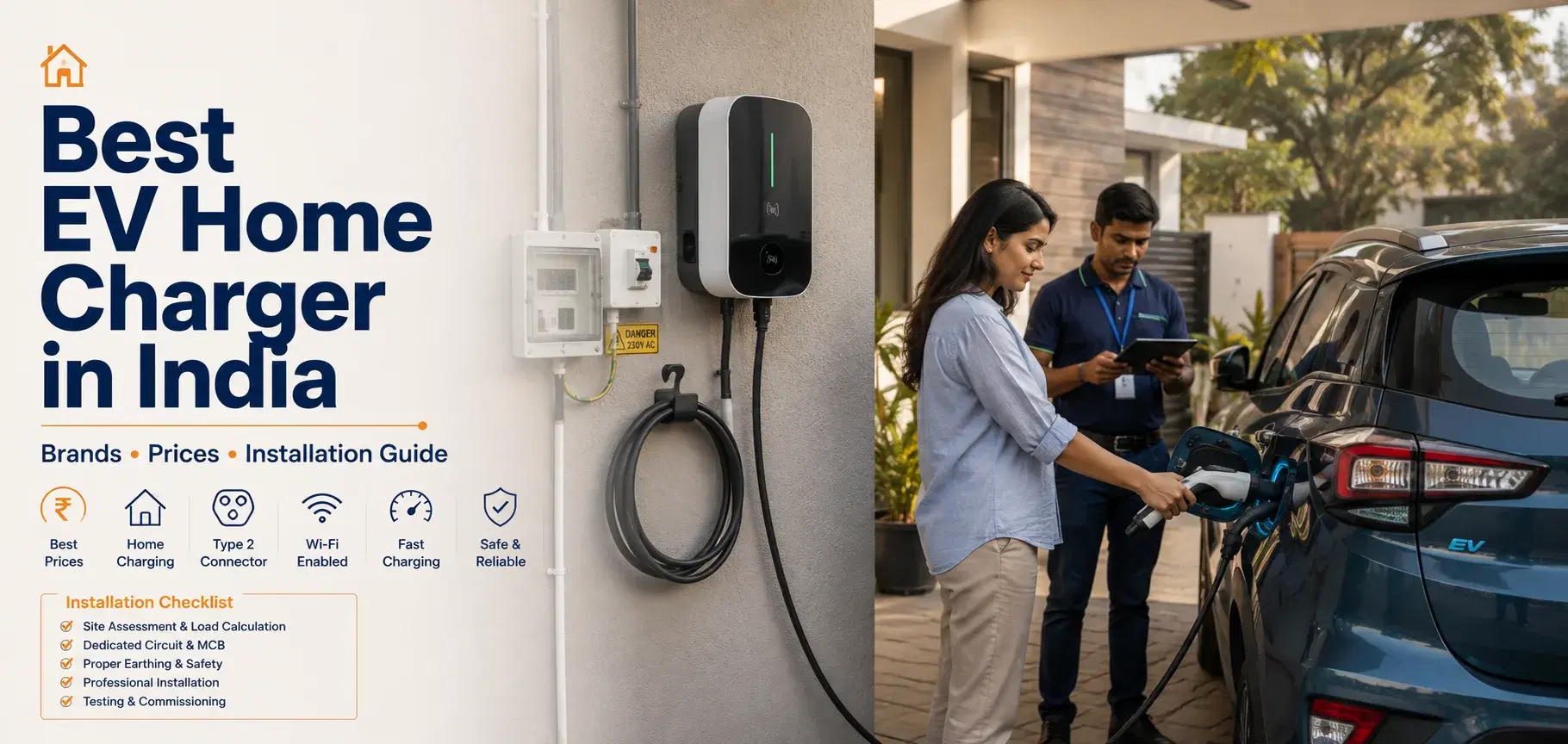
India's EV revolution is accelerating fast — and your home is where most of the charging happens. Residential users already account for 67.41% of India's EV charging infrastructure, yet only about 55% of Indian EV owners currently have private access to a home charger. That gap represents a massive opportunity — and a real problem if you've just bought a Tata Nexon EV, MG ZS EV, or Hyundai Ioniq and don't know where to start.
This guide cuts through the noise. You'll find an unbiased comparison of the best home EV charger brands in India, a plain-English breakdown of power ratings, a step-by-step installation checklist, and honest answers to the charging habit questions that affect your battery's long-term health. No brand bias. No jargon. Just the information you need to make a smart decision.
Best EV Home Chargers in India 2026: Top Picks
The best home EV chargers in India in 2026 come from Statiq (Nectar), Exicom, Tata Power EZ Charge, Servotech, Zeon, and Bolt.Earth. These brands offer reliable AC wall-box chargers ranging from 3.3kW to 22kW, with smart features like RFID access, OCPP compatibility, and app-based monitoring — all suited to Indian home electrical setups.
Here's a quick comparison of the top home EV charger brands available in India:
Brand | Model | Power Rating | Key Features | Approx. Price (₹) |
|---|---|---|---|---|
Statiq | Nectar | 7.4kW / 11kW / 22kW | Smart app, RFID, OCPP, portable option | ₹25,000–₹55,000 |
Exicom | Home Charger | 7.4kW / 11kW / 22kW | Solar-ready, Type 2, smart features | ₹22,000–₹50,000 |
Tata Power | EZ Charge | 7.2kW | Tata EV compatible, easy install | ₹25,000–₹35,000 |
Servotech | Home AC Charger | 3.3kW / 7.4kW | Budget-friendly, basic smart features | ₹20,000–₹40,000 |
Zeon | Home AC Charger | 7.4kW / 11kW | Compatible with Tata, MG, Hyundai | ₹22,000–₹45,000 |
Bolt.Earth | Wall Box | 7.4kW / 11kW | RFID, OCPP, fleet-ready | ₹24,000–₹48,000 |
RIOD | AC Charger | 3.3kW–22kW | Type 2, OCPP, 2-year warranty | ₹20,000–₹52,000 |
Pro tip: The Statiq Nectar consistently receives strong reviews from Indian EV owners for its build quality and app reliability. Exicom is a strong runner-up with its solar-ready design — ideal if you're planning rooftop solar.
All major brands support Type 2 connectors, which are compatible with most Indian four-wheeler EVs including Tata, MG, Hyundai, and Mahindra models.
What Power Rating Do You Need? 3.3kW vs 7.4kW vs 11kW vs 22kW
Your ideal home EV charger power rating depends on your car's onboard charger capacity and your home's electrical connection. Single-phase homes (most Indian residences) are limited to 7.4kW. Three-phase connections support 11kW or 22kW. For most Indian EV owners, a 7.4kW charger is the sweet spot — fast enough to fully charge overnight, affordable, and compatible with single-phase supply.
Here's a breakdown to help you choose:
3.3kW Charger
Best for: Two-wheelers, small EVs, or as a backup charger
Charging time: 8–10 hours for a 30kWh battery
Connection: Single-phase
Who it suits: Budget buyers or those with limited sanctioned load
7.4kW Charger
Best for: Most Indian four-wheeler EVs (Tata Nexon EV, MG ZS EV, Hyundai Ioniq 5)
Charging time: ~4–6 hours for a 40kWh battery
Connection: Single-phase (32A)
Who it suits: The majority of Indian homeowners — this is the most popular choice
11kW Charger
Best for: EVs with larger batteries (Hyundai Ioniq 6, Kia EV6)
Charging time: 3–4 hours for a 40kWh battery
Connection: Three-phase required
Who it suits: Homes with three-phase supply and a higher sanctioned load
22kW Charger
Best for: Fleet operators, luxury EVs, or future-proofing
Charging time: 1.5–2 hours for a 40kWh battery
Connection: Three-phase (mandatory)
Who it suits: Very few residential users — it's rarely worth the cost for a single car
Important: Check your home's sanctioned load before buying. Most urban apartments in cities like Mumbai, Bengaluru, and Delhi have a 5–10kW sanctioned load. Adding a 7.4kW charger may require you to upgrade your load with your DISCOM (electricity distribution company).
Home EV Charger Installation: Step-by-Step Process, Costs & Permits
Installing a home EV charger in India involves a site survey, electrical upgrades if needed, RWA NOC (for apartments), dedicated wiring, earthing, and a certified electrician. The total cost — charger plus installation — typically ranges from ₹25,000 to ₹80,000 depending on your charger type and home setup.
Here's the complete installation process:
Site Survey: A technician visits your home to assess your electrical panel, available space, and distance from the meter to the parking spot. Tata Power EZ Charge and Statiq both offer free site surveys.
Check Sanctioned Load: Confirm your home's sanctioned load with your DISCOM. A 7.4kW charger needs at least a 32A dedicated circuit. You may need to apply for a load enhancement — this can take 2–4 weeks in most Indian cities.
RWA NOC (Apartments Only): If you live in a housing society in cities like Pune, Hyderabad, or Chennai, you'll need a No Objection Certificate from your Resident Welfare Association. This is a common hurdle — get it in writing before ordering your charger.
Dedicated Wiring & Earthing: A licensed electrician runs a dedicated circuit from your electrical panel to the parking spot. Proper earthing is non-negotiable for safety — don't skip this step.
Charger Installation & Testing: The wall box is mounted, connected, and tested. Most installations take 3–5 hours.
Typical Cost Breakdown:
Charger unit: ₹20,000–₹55,000
Wiring and conduit: ₹3,000–₹8,000
Electrician charges: ₹2,000–₹5,000
Load enhancement (if needed): ₹1,000–₹3,000
Total: ₹26,000–₹71,000
For Tata EV owners, dial 1800 209 8989 to learn about Tata.ev's home charger installation support.
Top EV Charging Companies in India for Home Chargers
The leading EV charging companies in India for home chargers include Statiq, Tata Power EZ Charge, Exicom, Servotech, Zeon Charging, Bolt.Earth, Delta Electronics, and RIOD. These companies manufacture and install AC wall-box chargers and also operate public charging networks across Indian cities.
Here's a quick profile of each:
Statiq: One of India's fastest-growing EV charging networks. Their Nectar home charger is available in 7.4kW, 11kW, and 22kW variants with a portable 3.3kW option. Strong app ecosystem.
Tata Power EZ Charge: Backed by the Tata Group, EZ Charge offers home installation support for housing societies and individual homeowners. Trusted brand with wide service network.
Exicom: A well-established manufacturer offering solar-ready home chargers. Popular among homeowners who want to pair their EV charger with rooftop solar panels — a growing trend in cities like Ahmedabad and Jaipur.
Servotech: Budget-friendly option with chargers starting around ₹20,000. Good for cost-conscious buyers who don't need advanced smart features.
Zeon Charging: Compatible with all major Indian EV brands including Tata, MG, and Hyundai. Offers a clean, straightforward wall-box design.
Bolt.Earth: India's largest EV charger provider by network size. Their wall-mounted chargers support RFID and OCPP, making them suitable for both home and small commercial use.
Delta Electronics India: A global brand with a strong presence in India. Their chargers are known for build quality and reliability.
RIOD: An online-first brand offering chargers from 3.3kW to 22kW with a 2-year warranty and Type 2 connectors.
India's EV charging market is projected to grow from USD 348.5 million in 2024 to USD 1,652.2 million by 2030 at a 27.67% CAGR, making this a sector worth watching for franchise opportunities too.
Home EV Charger Price in India: Cost Breakdown & Budgeting
Home EV charger prices in India range from ₹20,000 to ₹75,000 for the unit alone, with installation adding ₹5,000–₹16,000 more. A 7.4kW smart wall-box charger — the most popular choice — typically costs ₹25,000–₹40,000 installed. Budget buyers can start with a basic 3.3kW unit for under ₹22,000.
According to Servotech, EV car charger prices start from ₹20,000 and go up to ₹75,000, which aligns with what you'll find across major Indian e-commerce platforms and brand websites.
Price by Power Rating:
3.3kW portable charger: ₹15,000–₹22,000
7.4kW wall-box charger: ₹22,000–₹40,000
11kW wall-box charger: ₹35,000–₹55,000
22kW wall-box charger: ₹50,000–₹75,000
What about the Tata 7.2kW charger price? Tata Power's EZ Charge 7.2kW home charger is priced in the ₹25,000–₹35,000 range, with installation costs additional. Contact Tata Power directly for the latest pricing in your city.
Is home charging cheaper than public charging? Yes — significantly. Home electricity tariffs in most Indian cities range from ₹5–₹9 per unit (kWh). Charging a 40kWh battery at home costs roughly ₹200–₹360. Public fast chargers typically charge ₹15–₹25 per unit, making the same charge cost ₹600–₹1,000. Over a year, home charging can save you ₹30,000–₹50,000 depending on your usage.
The global residential EV charger market is growing at a 26.35% CAGR, reaching USD 12.23 billion in 2026 — meaning prices are becoming more competitive every year.
EV Charging Best Practices: Battery Health, Overnight Charging & Safety
For best battery health, charge your EV to 80% daily and use 100% only before long trips. Overnight charging with a smart charger set to stop at 80% is safe and recommended. Leaving your EV plugged in for a week is generally fine if your charger has auto-cutoff — but avoid doing this repeatedly at 100% state of charge.
Globally, 86% of typical EV charging happens at home, and Indian EV owners are no different. Here's what the data and experts say about smart charging habits:
Should you charge to 100% every night? No — most EV manufacturers recommend keeping your battery between 20% and 80% for daily use. Charging to 100% regularly accelerates battery degradation. Use your car's built-in charging limit setting or your smart charger's app to cap charging at 80%.
Is overnight charging safe? Yes, with a proper wall-box charger that has auto-cutoff and overcharge protection. A 7.4kW charger will fully charge most Indian EVs in 4–6 hours, so it'll be done well before morning. Team-BHP's community guide confirms overnight charging is the best approach for most users.
Is it bad to leave your EV plugged in for a week? Generally no, if your charger has smart auto-cutoff. Modern EVs manage their own battery management systems (BMS) to prevent overcharging. However, don't make a habit of leaving it at 100% for extended periods.
Key point: As J.D. Power's Brent Gruber notes, only about 20% of EV owners receive home-charging education from their dealer. Don't rely on your showroom — do your research upfront.
What's the lifespan of a home EV charger? A quality home EV charger from brands like Exicom, Statiq, or Bolt.Earth typically lasts 8–12 years with normal use. Most brands offer a 2–3 year warranty. Avoid cheap uncertified chargers — they're a fire risk and won't last.
Conclusion
Choosing the right EV home charger in India doesn't have to be complicated. For most homeowners, a 7.4kW AC wall-box charger from Statiq, Exicom, or Tata Power hits the sweet spot of speed, cost, and compatibility. Budget around ₹30,000–₹50,000 all-in for a quality charger with professional installation. Don't skip the site survey, check your sanctioned load, and get your RWA NOC sorted early if you're in an apartment.
Once installed, let your smart charger do the work — set it to charge to 80% overnight and you'll protect your battery and keep electricity costs low. With residential users accounting for 67.41% of India's EV charging infrastructure and the market growing rapidly, investing in a home charger today is one of the smartest decisions an EV owner can make.
Frequently Asked Questions
Based on 0 ratings

Najmus (Author)
Najmus leads content and SEO at Ecozaar, building trustworthy guides on electric two-wheelers, RTO processes, and green finance in India. With 8+ years in technical and editorial SEO, he turns complex regulations and specs into practical, citation-backed explainers. His work combines schema, CWV, and clear sourcing to help readers make confident, real-world decisions.
Read more
Related Blogs
Popular articles are selected from the same backend blog feed.


Best Bikes Under 1 Lakh in India: Price, Mileage & Low-Maintenance Commuters
Compare the best bikes under ₹1 lakh in India by price, real-world mileage, maintenance and safety — from sub-₹60k commuters to 125cc options near ₹1 lakh.

Best Bikes Under 2 Lakh in India: Streetfighters, Cruisers & All-Rounders
Compare the best bikes under ₹2 lakh in India: verified ex-showroom prices, real-world mileage, ABS and hardware, and which model fits your budget.
Best Sports Bikes Under 5 Lakh in India: Track Bikes, Supersports & Top Speed Comparison
Compare the best sports bikes under ₹5 lakh in India by 0–100 km/h, GPS top speed, track ability, electronics, mileage and ownership costs.

Best Electric Scooters Under 1 Lakh in India: Real-World Range, Subsidy & Price List
Compare the best electric scooters under ₹1 lakh by real-world range, battery size, charging, PM E-DRIVE benefits, running cost, build quality and family practi
Best Low-Cost Electric Scooters Under ₹40,000–₹50,000: Non-RTO & Budget Commuters
Compare low-cost electric scooters under ₹40,000–50,000 by price, range, battery type, charging, non-RTO rules, running cost and practical ownership risks.
Best 110cc–125cc Family Commuter Scooters in India: Mileage, Comfort & Price Comparison
Compare the best 110cc and 125cc scooters in India by price, real-world mileage, comfort, storage, braking, running cost and the value of upgrading to 125cc.

Best 150cc–160cc Bikes in India: Mileage, Price, Specs & Performance
Compare India's best 150cc–160cc bikes on mileage, price, power, braking and comfort — Pulsar N160, Apache RTR 160 4V, Xtreme 160R, FZ-S and more.

Best 200cc–250cc Performance Bikes in India: Power, Mileage & Highway Cruising
Compare India's best 200cc–250cc bikes on power-to-weight, real-world mileage, highway cruising and price, with the 200cc and 250cc classes covered together.