Ex-Showroom Price in India: Meaning, GST & On-Road Cost
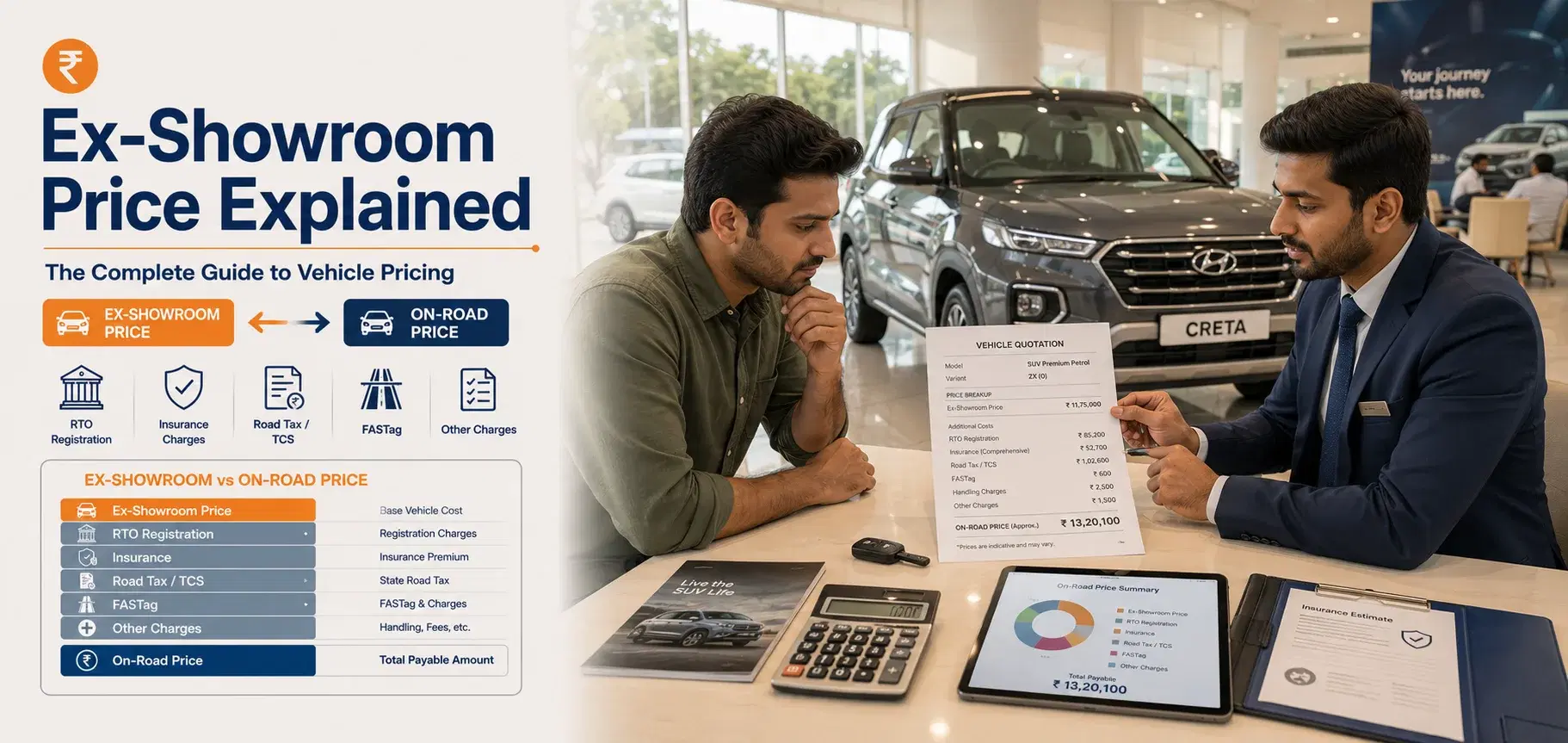
You've spotted a Maruti Swift advertised at ₹7.77 lakh. You walk into the showroom excited — and the dealer quotes ₹9.2 lakh. What just happened?
That gap between the advertised number and what you actually pay is the difference between the ex-showroom price and the on-road price — and it's one of the most misunderstood concepts in Indian vehicle buying.
This guide breaks down exactly what ex-showroom price means, what it includes, what it doesn't, how GST fits in, and how to calculate your real on-road cost before you step into any dealership. Whether you're buying a Maruti Suzuki, Hyundai, Hero MotoCorp bike, or a Bajaj Auto scooter — this is the only guide you'll need.
What Is Ex-Showroom Price? (Definition and Components)
Ex-showroom price is the manufacturer-fixed price of a vehicle at the dealership. It includes the factory production cost, GST, and the dealer's profit margin — but excludes registration fees, road tax, insurance, and handling charges.
Think of it as the price of the vehicle itself, before the government and the RTO get involved.
What's Included in the Ex-Showroom Price?
Factory/manufacturing cost — the cost to build the vehicle
Logistics and transportation — cost to move the vehicle from plant to dealership
Dealer margin — yes, the dealer's profit is already baked in
GST — the biggest component; more on this below
What's NOT Included?
Road tax (state-dependent, can be 6–15%)
RTO registration fees
Mandatory third-party insurance
Handling and pre-delivery inspection (PDI) charges
Hypothecation charges (if taking a loan)
Fastag and number plate charges
Pro tip: The ex-showroom price is the right number to use when comparing two vehicles. But never budget based on it — always ask for the on-road price quote in writing.
Why Is It Called 'Ex-Showroom' Price?
The word 'ex' comes from Latin, meaning 'from' or 'out of.' Ex-showroom price literally means the price of the vehicle as it leaves the showroom — before any government charges are added for road use.
This terminology is used across India's automotive industry to create a legal and tax distinction. The manufacturer sets a uniform ex-showroom price across a state (sometimes across India), but road tax and registration fees vary by state — so the on-road price differs from city to city.
For example, the same Hyundai Creta might have an identical ex-showroom price in Bengaluru and Chennai, but the on-road price in Karnataka will be higher because Karnataka charges one of India's highest road taxes — up to 15% of the ex-showroom price.
This is also why you'll see car advertisements always quote ex-showroom prices — it's the only number the manufacturer can control uniformly.
Ex-Showroom Price vs On-Road Price: Complete Comparison
The on-road price is the total amount you actually pay to legally drive a vehicle on Indian roads. It's always higher than the ex-showroom price — typically by 10–20% for cars and 15–20% for bikes.
Here's a side-by-side breakdown:
Cost Component | Ex-Showroom Price | On-Road Price |
|---|---|---|
Manufacturing cost | ✅ Included | ✅ Included |
GST | ✅ Included | ✅ Included |
Dealer margin | ✅ Included | ✅ Included |
Road tax | ❌ Not included | ✅ Included |
RTO registration | ❌ Not included | ✅ Included |
Third-party insurance | ❌ Not included | ✅ Included |
Handling charges | ❌ Not included | ✅ Included |
Fastag / number plate | ❌ Not included | ✅ Included |
Which price should you use for comparison? Use ex-showroom price to compare two vehicles fairly. Use on-road price to plan your actual budget and loan amount.
On average, there's roughly a 10% gap between a car's ex-showroom and on-road price in India [1]. For bikes, this gap can reach 15–20% due to proportionally higher insurance costs relative to vehicle price.
How to Calculate On-Road Price from Ex-Showroom Price
To calculate on-road price, add road tax, RTO registration fees, insurance premium, and handling charges to the ex-showroom price. The total is typically 10–15% higher for cars and 15–20% higher for bikes.
The Formula
On-Road Price = Ex-Showroom Price + Road Tax + RTO Registration + Insurance + Handling Charges + Fastag
Worked Example: ₹8 Lakh Car in Three Cities
Charge | Delhi | Mumbai | Bengaluru |
|---|---|---|---|
Ex-Showroom Price | ₹8,00,000 | ₹8,00,000 | ₹8,00,000 |
Road Tax (10% Delhi, 13% Mumbai, 14% Bengaluru) | ₹80,000 | ₹1,04,000 | ₹1,12,000 |
RTO Registration | ₹5,000 | ₹5,000 | ₹5,000 |
Insurance (3-year TP + 1-year OD) | ₹35,000 | ₹35,000 | ₹35,000 |
Handling + Fastag | ₹8,000 | ₹8,000 | ₹8,000 |
Estimated On-Road Price | ₹9,28,000 | ₹9,52,000 | ₹9,60,000 |
Notice how the same car costs about ₹32,000 more in Bengaluru than in Delhi — purely because of state road tax differences. This is why you should always get an on-road price quote specific to your city.
Important: These are estimates. Always ask your dealer for a written, itemised on-road price quotation before signing anything.
How Much GST Is Included in Ex-Showroom Price?
GST is already embedded in the ex-showroom price — you don't pay it separately. Under GST 2.0 (effective September 22, 2025), small cars attract 18% GST while large cars and SUVs attract a flat 40%.
This was a major reform. Before September 2025, small cars paid 28% plus cess (effectively 29–31%), and large cars paid 28% plus up to 22% cess (effectively 43–50%). The GST 2.0 rationalisation improved ex-showroom affordability by an estimated 6–10% depending on segment.
GST Slab Quick Reference (Post-September 2025)
Vehicle Type | GST Rate | Example |
|---|---|---|
Small/sub-4m petrol cars | 18% | Maruti Alto K10, WagonR |
Small/sub-4m diesel cars | 18% | Maruti Swift Dzire |
Large cars, sedans, SUVs | 40% (flat) | Hyundai Creta, Tata Nexon |
Electric vehicles | 5% | Tata Tiago EV |
Two-wheelers (>350cc) | 28% | Royal Enfield |
Two-wheelers (≤350cc) | 28% | Hero Splendor, Honda Activa |
Nomura estimated that the GST cut saved buyers approximately ₹60,000 on the Maruti WagonR, ₹75,000 on the Maruti Baleno, and up to ₹1.15 lakh on the Mahindra XUV700 — with monthly EMIs falling by ₹600–₹2,000.
Key point: You can't negotiate GST — it's fixed by the government and already part of the ex-showroom price you see advertised.
Why Is the On-Road Price So High? Hidden Charges Exposed
The on-road price is high because it includes multiple mandatory government charges — road tax, RTO registration, and insurance — that can add 10–20% over the ex-showroom price. Dealers also add handling and logistics charges that aren't always disclosed upfront.
Here's what drives the gap:
Road tax — The single biggest add-on. Karnataka charges up to 15%, Maharashtra around 13%, and Delhi around 10% for petrol cars under ₹10 lakh.
RTO registration — A one-time fee paid to your state's Regional Transport Office to get a permanent registration number.
Third-party insurance — Mandatory by law under the Motor Vehicles Act. For a new car, you need a 3-year third-party policy upfront.
Own damage insurance — Technically optional but strongly recommended; dealers often bundle it.
Handling and PDI charges — Covers pre-delivery inspection, cleaning, and logistics from the port/plant to the showroom. Often ₹5,000–₹15,000.
Fastag — Mandatory for all new vehicles; typically ₹500–₹600.
Hypothecation fee — If you're taking a car loan, the bank's name is added to the RC, which costs extra.
India's passenger vehicle sales hit a record 4,38,854 units in May 2026 (+27.3% year-on-year), partly because lower ex-showroom prices post-GST 2.0 made the total on-road cost more manageable.
Can You Buy a Vehicle at Ex-Showroom Price Without RTO Registration?
Technically, you can pay only the ex-showroom price and take delivery of a vehicle — but you cannot legally drive it on any public road in India without completing RTO registration. Driving an unregistered vehicle is a punishable offence under the Motor Vehicles Act.
Here's the practical reality:
New vehicles get a temporary registration (TR) valid for 30 days, allowing you to drive while the permanent RC is being processed. This is included in the on-road price.
Without even temporary registration, you can only transport the vehicle on a trailer or flatbed — not drive it.
If caught driving without registration, you face fines starting at ₹5,000 under the amended Motor Vehicles Act.
For bike buyers specifically: the same rule applies. You can't ride a new Hero Splendor or Honda Activa on the road without registration, even if you've paid the full ex-showroom price. Some buyers in rural areas try to skip RTO — don't. The risk isn't worth it.
Bottom line: Always budget for the full on-road price. The ex-showroom price is the starting point, not the finish line.
Ex-Showroom Price for Cars vs Bikes: Key Differences
For two-wheelers, the gap between ex-showroom and on-road price is proportionally larger than for cars — typically 15–20% — because insurance costs are higher relative to the vehicle price, and road tax percentages are similar.
Hero Splendor+ Example (Approximate 2026 Figures)
Charge | Amount |
|---|---|
Ex-Showroom Price (Delhi) | ₹75,000 |
Road Tax (10%) | ₹7,500 |
RTO Registration | ₹1,500 |
5-year Third-Party Insurance | ₹8,000 |
Handling charges | ₹2,000 |
On-Road Price | ₹94,000 |
That's nearly a 25% jump from ex-showroom to on-road for an entry-level bike. For a ₹10 lakh car, the same jump is closer to 12–15%.
The key difference: insurance for two-wheelers is a larger percentage of the vehicle cost, and the mandatory 5-year third-party insurance for new bikes (introduced in 2018) adds a significant lump sum upfront.
Conclusion
The ex-showroom price is just the starting point of your vehicle purchase — not the finish line. It covers the factory cost, GST, and dealer margin, but leaves out road tax, RTO registration, insurance, and handling charges that can add 10–20% to your final bill.
Here's what to remember:
Compare vehicles using ex-showroom price
Budget and plan loans using on-road price
GST is already included in the ex-showroom price you see advertised
You can't legally drive without completing RTO registration, regardless of what you've paid
Bengaluru and Maharashtra buyers pay more than Delhi buyers for the same car, purely due to road tax
India's automobile market hit record sales of 46.43 lakh passenger vehicles in FY 2025-26 (+7.9%), driven partly by improved ex-showroom affordability after GST 2.0 reforms. It's a great time to buy — as long as you know exactly what you're paying for.
Always ask your dealer for a written, itemised on-road price quotation. Don't let the gap between the advertised number and the actual bill surprise you on delivery day.
Frequently Asked Questions
Based on 2 ratings

Najmus (Author)
Najmus leads content and SEO at Ecozaar, building trustworthy guides on electric two-wheelers, RTO processes, and green finance in India. With 8+ years in technical and editorial SEO, he turns complex regulations and specs into practical, citation-backed explainers. His work combines schema, CWV, and clear sourcing to help readers make confident, real-world decisions.
Read more
Related Blogs
Popular articles are selected from the same backend blog feed.


Best Bikes Under 1 Lakh in India: Price, Mileage & Low-Maintenance Commuters
Compare the best bikes under ₹1 lakh in India by price, real-world mileage, maintenance and safety — from sub-₹60k commuters to 125cc options near ₹1 lakh.
Best Bikes Under 2 Lakh in India: Streetfighters, Cruisers & All-Rounders
Compare the best bikes under ₹2 lakh in India: verified ex-showroom prices, real-world mileage, ABS and hardware, and which model fits your budget.
Best Sports Bikes Under 5 Lakh in India: Track Bikes, Supersports & Top Speed Comparison
Compare the best sports bikes under ₹5 lakh in India by 0–100 km/h, GPS top speed, track ability, electronics, mileage and ownership costs.
Best Electric Scooters Under 1 Lakh in India: Real-World Range, Subsidy & Price List
Compare the best electric scooters under ₹1 lakh by real-world range, battery size, charging, PM E-DRIVE benefits, running cost, build quality and family practi
Best Low-Cost Electric Scooters Under ₹40,000–₹50,000: Non-RTO & Budget Commuters
Compare low-cost electric scooters under ₹40,000–50,000 by price, range, battery type, charging, non-RTO rules, running cost and practical ownership risks.
Best 110cc–125cc Family Commuter Scooters in India: Mileage, Comfort & Price Comparison
Compare the best 110cc and 125cc scooters in India by price, real-world mileage, comfort, storage, braking, running cost and the value of upgrading to 125cc.
Best 150cc–160cc Bikes in India: Mileage, Price, Specs & Performance
Compare India's best 150cc–160cc bikes on mileage, price, power, braking and comfort — Pulsar N160, Apache RTR 160 4V, Xtreme 160R, FZ-S and more.
Best 200cc–250cc Performance Bikes in India: Power, Mileage & Highway Cruising
Compare India's best 200cc–250cc bikes on power-to-weight, real-world mileage, highway cruising and price, with the 200cc and 250cc classes covered together.