Vehicle Fitness Certificate in India: Fees, Rules & Online Apply
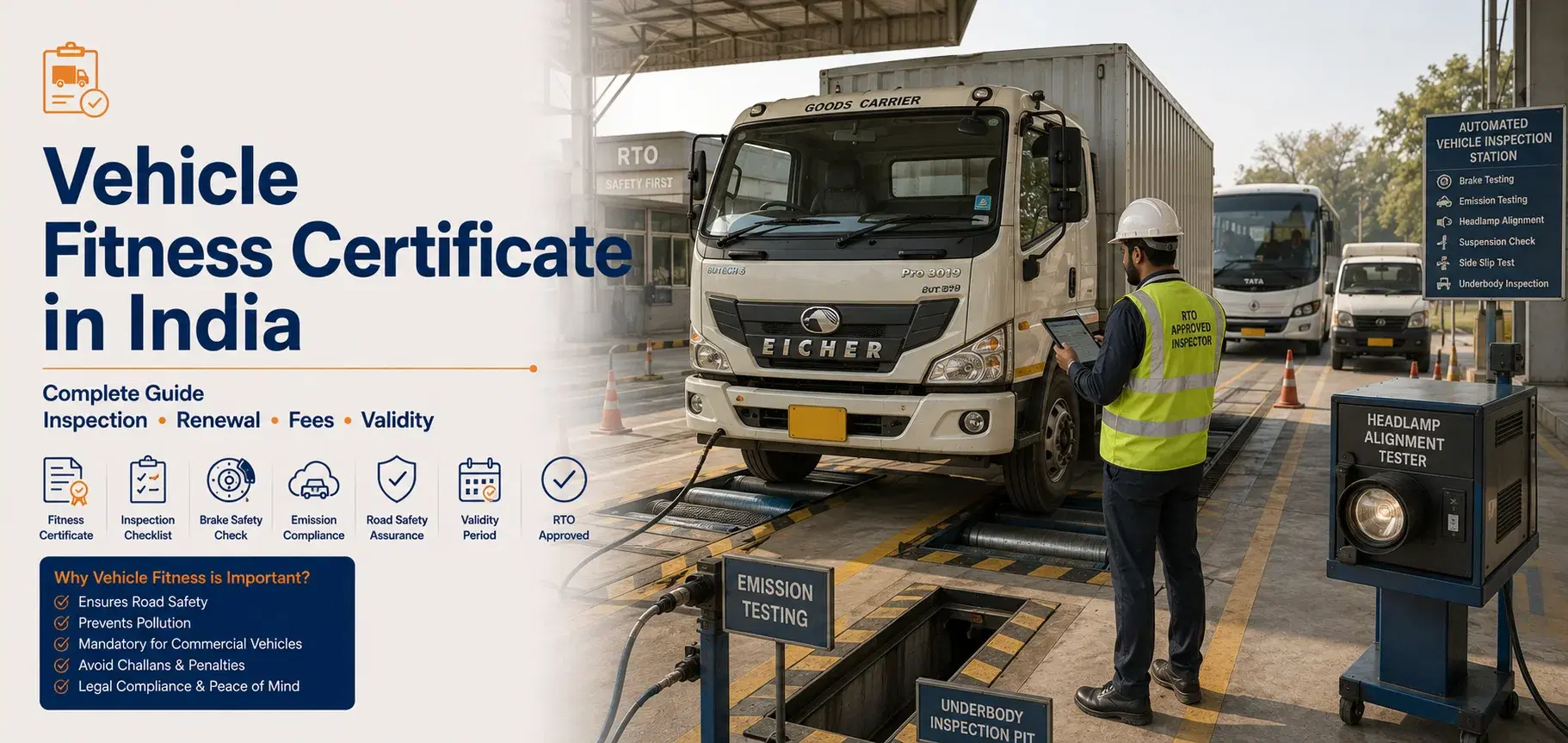
India recorded over 1.77 lakh road accident deaths in 2024 — 485 every single day. An unfit vehicle on the road isn't just a legal problem — it's a public safety crisis.
A vehicle fitness certificate (FC) is the government's primary tool to keep unsafe vehicles off Indian roads. Whether you own a private car crossing 15 years or operate a commercial fleet, this guide covers everything: what the FC is, how to apply online via Parivahan, how to download the PDF, state-wise fees, validity rules, penalties for expiry, and what happens to your insurance claim if your FC lapses.
What is a Vehicle Fitness Certificate?
A vehicle fitness certificate (FC) is a mandatory government-issued document that certifies a vehicle is roadworthy, mechanically safe, and compliant with emission norms under the Motor Vehicles Act, 1988. It's issued by the Regional Transport Office (RTO) or an Automated Testing Station (ATS) after a physical inspection. Without a valid FC, a vehicle cannot legally operate on Indian roads.
The FC isn't just paperwork. It's a legal declaration that your vehicle's brakes, lights, steering, tyres, emissions, and structural integrity meet the standards set by the Ministry of Road Transport and Highways (MoRTH). Section 56 of the Motor Vehicles Act makes it compulsory for transport vehicles, while the Vehicle Scrappage Policy (S.O. 3192(E), 2022) extended mandatory fitness testing to private vehicles older than 15 years.
India's Automated Testing Station (ATS) network has expanded rapidly — 160 ATS are now operational across 19 States/UTs as of December 2025, up from just 92 in December 2024. Monthly testing volumes surged 540% from ~5,600 tests/month in FY23-24 to 30,000 in FY24-25.
Pro tip: An ATS uses automated sensors and cameras to test your vehicle — it's faster, more objective, and increasingly mandatory for commercial vehicles.
Who Needs a Fitness Certificate? Private vs. Commercial Vehicles
Private vehicle owners need an FC once their vehicle turns 15 years old, then every 5 years after that. Commercial vehicle operators — trucks, buses, taxis, and autos — need an FC from the second year of registration, renewed annually. All FC renewals are mandatory regardless of how well the vehicle appears to run.
Here's a clear breakdown by vehicle type:
Vehicle Type | First FC Required | Renewal Frequency |
|---|---|---|
Private Car / Bike | After 15 years | Every 5 years |
New Commercial Vehicle | After 2 years | Every 1 year |
Older Commercial Vehicle | Immediately | Every 1 year |
Three-Wheeler (Commercial) | After 2 years | Every 1 year |
About 3.4 crore vehicles in India crossed the 15-year mark by end-2025, but only ~38 lakh had undergone fitness testing under the Scrappage Policy — a massive compliance gap.
Nearly 40% of India's 1.94 lakh road fatalities in FY 2022-23 involved commercial vehicles — over 70,000 deaths — with a Raahat Foundation study finding unfit vehicles receiving certificates without proper inspection.
"Unfit commercial vehicles have become a significant factor in road accidents, turning the vehicle fitness certification process into a multi-billion dollar corruption industry," said Dr. Kamal Soi, Chairman, Raahat Foundation.
How to Apply for a Vehicle Fitness Certificate Online (Parivahan & Vahan)
You can apply for a new or renewal vehicle fitness certificate online via the Parivahan portal (parivahan.gov.in). The online process covers form submission, document upload, fee payment, and inspection slot booking — but your vehicle must still appear physically for inspection at the RTO or ATS.
Here's the step-by-step process:
Visit parivahan.gov.in and click 'Online Services' → 'Vehicle Related Services'
Select your State and RTO from the dropdown
Enter your vehicle registration number and click 'Proceed'
Select the service: 'Application for Fitness Certificate' (new) or 'Renewal of Fitness Certificate'
Fill in vehicle details and upload required documents
Pay the fee online via net banking, UPI, or debit card
Book an inspection slot at your nearest RTO or ATS
Take your vehicle for physical inspection on the booked date
If the vehicle passes, download your FC from the Parivahan portal
Documents you'll need:
Valid Registration Certificate (RC)
Valid Motor Insurance Certificate
Valid Pollution Under Control (PUC) Certificate
Road Tax payment receipt
Identity proof of owner
Vehicle Location Tracking device certificate (for commercial vehicles)
Important: If the Parivahan portal is down, visit your nearest RTO directly with the same documents and fill Form 38A offline. Most RTOs in cities like Bengaluru, Mumbai, and Chennai also accept walk-in applications.
How to Download Vehicle Fitness Certificate PDF from Parivahan
You can download your vehicle fitness certificate as a PDF from the Parivahan portal (vahan.parivahan.gov.in) using your vehicle registration number and chassis number — no login required. The mParivahan app also stores a valid digital copy accepted at traffic checkpoints.
Follow these steps to download your FC:
Go to vahan.parivahan.gov.in/vahanservice
Click 'Online Services' → 'Print Fitness Certificate'
Enter your vehicle registration number (e.g., KA-01-AB-1234)
Enter the last 5 digits of your chassis number
Click 'Search' — your FC details will appear
Click 'Print/Download' to save the PDF
Alternative: mParivahan App
Download the mParivahan app from Google Play or App Store
Enter your registration number
Your FC, RC, and insurance details appear as a digital DigiLocker-linked document
Troubleshooting common errors:
'FC not found': Your FC may not yet be updated on Vahan. Wait 24–48 hours after inspection and try again.
Wrong chassis number: Check your RC book — the chassis number is printed on the front page.
Portal error: Try during off-peak hours (early morning or late evening) or use the mParivahan app instead.
Pro tip: Save the PDF to your phone's DigiLocker. Traffic police across India accept DigiLocker documents as valid originals under the IT Act.
Vehicle Fitness Certificate Cost: State-wise Fee Breakdown
FC fees vary by vehicle type, age, and testing mode (manual RTO vs. Automated Testing Station). As of November 2025, MoRTH significantly hiked fees for older vehicles — heavy trucks over 20 years now pay ₹25,000, up from ₹3,500.
Here's a state-wise and vehicle-type fee comparison:
Vehicle Type / Age | Karnataka (ATS) | Kerala (RTO) | Delhi (RTO) | MoRTH Revised (>20 yrs) |
|---|---|---|---|---|
Private Car (15–20 yrs) | ₹400–₹600 | ₹300–₹500 | ₹400–₹600 | ₹15,000 |
Two-Wheeler (>20 yrs) | ₹200–₹400 | ₹200–₹300 | ₹200–₹300 | ₹2,000 |
Light Commercial Vehicle | ₹600–₹800 | ₹500–₹700 | ₹600–₹800 | ₹20,000 |
Heavy Truck/Bus (>20 yrs) | ₹1,500+ | ₹1,200+ | ₹1,500+ | ₹25,000 |
Key changes from November 2025:
Higher fee slabs now kick in at 10 years for commercial vehicles (previously 15 years)
Fees for vehicles over 20 years are 7–10x higher than before
These hikes are designed to push older, polluting vehicles toward the scrappage programme
For Karnataka specifically, the Seva Sindhu portal (sevasindhu.karnataka.gov.in) handles FC renewal applications. Karnataka is also rolling out 13 ATS centres on a DBFOT model across the state.
Important: Always check your state RTO's official portal for the most current fee schedule before applying, as fees can change with new notifications.
What to Do if Your FC is Expired? Penalties and Renewal Steps
If your fitness certificate has expired, don't drive the vehicle. Penalties range from ₹2,000 to ₹10,000 for first and repeat offences, plus a late fee of ₹50 per day. A vehicle in West Bengal that was one year overdue on FC renewal accumulated ₹18,000 in late fees alone.
Penalty structure for expired FC:
First offence: ₹2,000–₹5,000 fine
Repeat offence: Up to ₹10,000 fine + possible imprisonment
Late renewal fee: ₹50 per day after grace period
Vehicle may be seized and impounded
Steps to renew an expired FC:
Check your vehicle's current FC status on vahan.parivahan.gov.in or the mParivahan app
Ensure your RC, insurance, and PUC certificate are all valid — you can't renew FC without these
Apply online via Parivahan or visit your RTO with Form 38A
Pay the renewal fee plus any applicable late charges
Book and attend the physical inspection
Download the renewed FC once issued
What if the vehicle fails the test? You typically get a 7-day window to fix the defects and return for a re-test. The re-test fee is lower than the original application fee. Don't ignore a failed inspection — driving a vehicle that failed its fitness test is a serious offence.
"A vehicle fitness inspection is not merely a paperwork exercise but a critical process directly linked to the safety of passengers and every road user," said Pratap Sarnaik, Maharashtra's Minister of Transport.
Can I Drive My Car After 15 Years in India? RC and FC Rules Explained
Yes, you can drive a private car after 15 years in India — but only if you've obtained a valid fitness certificate and renewed your Registration Certificate (RC). Without both, the vehicle is illegal to operate. In Delhi and some NCR areas, additional NGT restrictions may apply to petrol and diesel vehicles.
Here's what the 15-year rule actually means:
Your vehicle's RC is valid for 15 years from the date of first registration
At 15 years, you must renew the RC (valid for 5 more years) AND obtain an FC
After that, FC renewal is required every 5 years for private vehicles
In Delhi, petrol vehicles over 15 years and diesel vehicles over 10 years are banned from operating under NGT orders — even with a valid FC
RC renewal process (Karnataka example):
RC renewal fee in Karnataka: approximately ₹5,000 for 5 years, plus pending road tax
Additional charges: smart card fee, postal delivery, and late fines if applicable
Apply via Parivahan portal or visit your RTO with Form 25
What happens if RC is expired? An expired RC means your vehicle isn't legally registered. You can't renew the FC without a valid RC. Driving with an expired RC attracts fines and can lead to vehicle seizure. Always renew RC before applying for FC.
Important: Only ~38 lakh of the 3.4 crore vehicles that crossed the 15-year mark have undergone fitness testing — most owners don't realise the FC requirement kicks in at this milestone.
Is Insurance Valid Without a Fitness Certificate?
If your vehicle's fitness certificate has expired, your motor insurance claim can be rejected — even if the policy is active. Insurers treat an expired FC as a material breach of policy conditions, particularly for commercial vehicles. For private vehicles, claim rejection is more likely in third-party liability cases.
Here's how the FC-insurance link works in practice:
Own-damage claims: Insurers may reject or reduce settlement if the vehicle didn't have a valid FC at the time of the accident
Third-party claims: An expired FC is considered negligence, which can void third-party liability coverage
Commercial vehicles: The risk is highest — an unfit commercial vehicle involved in an accident can lead to full claim rejection and personal liability for the owner
IRDAI guidelines require that a vehicle must be roadworthy and legally compliant for insurance coverage to apply. An expired FC directly undermines this condition.
Pre-inspection checklist to pass your FC in the first attempt:
Check all lights (headlights, indicators, brake lights, reverse lights)
Test brakes — both foot brake and handbrake
Ensure tyres have adequate tread depth (no bald tyres)
Horn must be functional and within decibel limits
Number plates must be HSRPs (High Security Registration Plates) — standard in most states
Valid PUC certificate (emissions within norms)
Windshield must be crack-free with functional wipers
All documents in order: RC, insurance, PUC, road tax receipt
Pro tip: Get a pre-inspection check done at a trusted local garage (like a Maruti Suzuki True Value or Tata Motors authorised service centre) before your RTO visit to avoid a failed test.
Conclusion
A vehicle fitness certificate isn't a bureaucratic formality — it's your vehicle's legal licence to be on the road. With 160 Automated Testing Stations now operational across India and fees for older vehicles rising sharply, the government is making it harder to ignore FC compliance.
The good news: the entire process — from application to download — can now be done via Parivahan or mParivahan without multiple RTO visits. Check your FC status today on vahan.parivahan.gov.in, book your inspection slot, and keep your vehicle, your passengers, and your insurance coverage protected. Don't wait for a traffic stop or an accident to find out your FC has lapsed.
Frequently Asked Questions
Based on 0 ratings

Najmus (Author)
Najmus leads content and SEO at Ecozaar, building trustworthy guides on electric two-wheelers, RTO processes, and green finance in India. With 8+ years in technical and editorial SEO, he turns complex regulations and specs into practical, citation-backed explainers. His work combines schema, CWV, and clear sourcing to help readers make confident, real-world decisions.
Read more
Related Blogs
Popular articles are selected from the same backend blog feed.


Best Bikes Under 1 Lakh in India: Price, Mileage & Low-Maintenance Commuters
Compare the best bikes under ₹1 lakh in India by price, real-world mileage, maintenance and safety — from sub-₹60k commuters to 125cc options near ₹1 lakh.
Best Bikes Under 2 Lakh in India: Streetfighters, Cruisers & All-Rounders
Compare the best bikes under ₹2 lakh in India: verified ex-showroom prices, real-world mileage, ABS and hardware, and which model fits your budget.

Best Sports Bikes Under 5 Lakh in India: Track Bikes, Supersports & Top Speed Comparison
Compare the best sports bikes under ₹5 lakh in India by 0–100 km/h, GPS top speed, track ability, electronics, mileage and ownership costs.

Best Electric Scooters Under 1 Lakh in India: Real-World Range, Subsidy & Price List
Compare the best electric scooters under ₹1 lakh by real-world range, battery size, charging, PM E-DRIVE benefits, running cost, build quality and family practi
Best Low-Cost Electric Scooters Under ₹40,000–₹50,000: Non-RTO & Budget Commuters
Compare low-cost electric scooters under ₹40,000–50,000 by price, range, battery type, charging, non-RTO rules, running cost and practical ownership risks.
Best 110cc–125cc Family Commuter Scooters in India: Mileage, Comfort & Price Comparison
Compare the best 110cc and 125cc scooters in India by price, real-world mileage, comfort, storage, braking, running cost and the value of upgrading to 125cc.

Best 150cc–160cc Bikes in India: Mileage, Price, Specs & Performance
Compare India's best 150cc–160cc bikes on mileage, price, power, braking and comfort — Pulsar N160, Apache RTR 160 4V, Xtreme 160R, FZ-S and more.
Best 200cc–250cc Performance Bikes in India: Power, Mileage & Highway Cruising
Compare India's best 200cc–250cc bikes on power-to-weight, real-world mileage, highway cruising and price, with the 200cc and 250cc classes covered together.