Batteries Used in Electric Vehicles in India: Costs and Lifespan
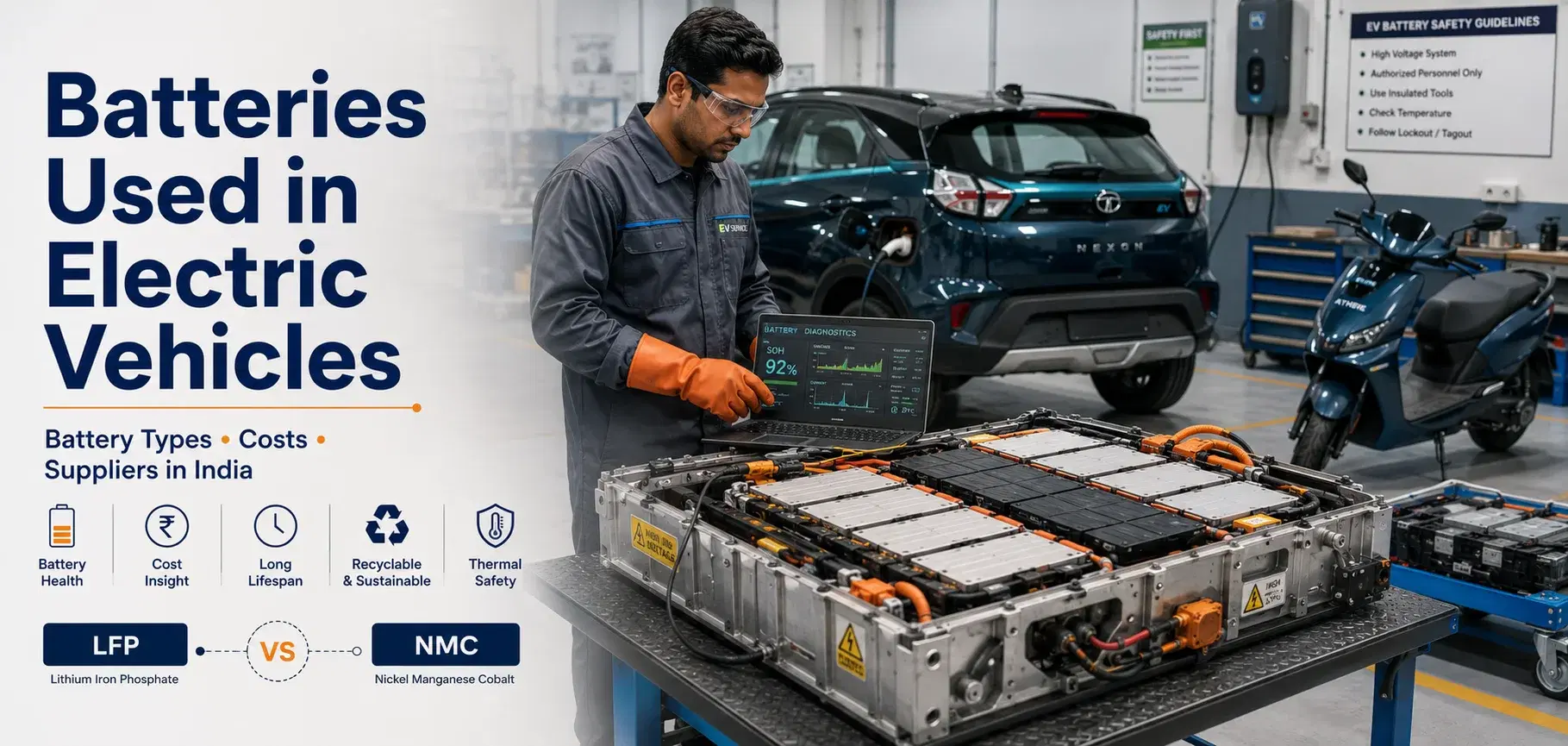
India's electric vehicle revolution is accelerating fast. EV sales crossed 1.9 million units in FY2024, and the number keeps climbing. But here's the thing — the battery is the single most important component in any EV. It determines range, charging speed, safety, and total ownership cost. Whether you're eyeing an Ola S1 Pro, a Tata Nexon EV, or an MG ZS EV, understanding the types of batteries used in electric vehicles helps you make a smarter buying decision.
The global EV battery market was valued at USD 61.31 billion in 2024 and is projected to grow at a CAGR of 22.2% through 2030. Lithium-ion batteries dominate with a projected 97.38% market share in 2026. This guide covers every major battery chemistry — LFP, NMC, NCA, NiMH, lead-acid, and solid-state — plus India-specific model mappings, real costs, and a clear LFP vs NMC comparison.
Types of Batteries Used in Electric Vehicles
Electric vehicles use six main battery chemistries: Lithium Iron Phosphate (LFP), Nickel Manganese Cobalt (NMC), Nickel Cobalt Aluminum (NCA), Nickel-Metal Hydride (NiMH), Lead-Acid, and Solid-State. Each differs in energy density, cost, safety, and ideal use case.
Here's a breakdown of each type:
Lithium Iron Phosphate (LFP)
LFP batteries are the fastest-growing chemistry globally. In 2025, LFP accounted for over 55% of all EV batteries deployed worldwide. They're known for excellent thermal stability, long cycle life (2,000–4,000 cycles), and lower cost. The trade-off? Lower energy density (120–160 Wh/kg) compared to NMC.
Best for: Budget EVs, city commuters, two-wheelers. Used in: Tata Nexon EV (select variants), many Ola Electric models.
Nickel Manganese Cobalt (NMC)
NMC batteries offer higher energy density (150–220 Wh/kg), making them ideal for longer-range four-wheelers. They're the go-to choice for premium EVs. However, they cost more and require careful thermal management.
Best for: Long-range cars, premium segments. Used in: MG ZS EV, Hyundai Kona Electric.
Nickel Cobalt Aluminum (NCA)
NCA batteries deliver very high energy density (200–260 Wh/kg) and are used in high-performance EVs. They're less common in India's mass market due to higher cost and complex battery management system (BMS) requirements.
Nickel-Metal Hydride (NiMH)
NiMH batteries are mature, proven technology used primarily in hybrid electric vehicles (HEVs). They're safer than lithium-ion but have lower energy density (60–120 Wh/kg). You'll find them in older Toyota Prius models and some hybrid variants sold in India.
Lead-Acid Battery
The lead-acid battery for electric vehicles is the oldest and cheapest option. It's still used in low-speed electric vehicles (LSEVs), e-rickshaws, and entry-level electric scooters across India. Energy density is low (30–50 Wh/kg), and cycle life is short (300–500 cycles), but the upfront cost is very affordable — often ₹8,000–₹15,000 per unit.
Solid-State Batteries
Solid-state batteries replace the liquid electrolyte with a solid material, promising higher energy density, faster charging, and better safety. They're still in prototype and early production phases. According to GreenCars, automakers like Toyota and Hyundai are targeting limited commercial deployment between 2026 and 2028. Expect them in India's premium segment post-2028.
EV Battery Comparison Table: All Major Chemistries
Use this table to compare the batteries used in electric vehicles side by side. It's the fastest way to understand which chemistry suits your needs.
Battery Type | Energy Density | Cycle Life | Approx. Cost (₹/kWh) | Safety | Best For |
|---|---|---|---|---|---|
LFP (Lithium Iron Phosphate) | 120–160 Wh/kg | 2,000–4,000 | ₹8,000–₹12,000 | Excellent | City EVs, two-wheelers, budget cars |
NMC (Nickel Manganese Cobalt) | 150–220 Wh/kg | 1,000–2,000 | ₹12,000–₹18,000 | Good | Long-range cars, premium EVs |
NCA (Nickel Cobalt Aluminum) | 200–260 Wh/kg | 500–1,500 | ₹15,000–₹22,000 | Moderate | High-performance EVs |
NiMH (Nickel-Metal Hydride) | 60–120 Wh/kg | 1,000–1,500 | ₹6,000–₹10,000 | Very Good | Hybrid vehicles (HEVs) |
Lead-Acid | 30–50 Wh/kg | 300–500 | ₹2,500–₹5,000 | Good | E-rickshaws, LSEVs, entry scooters |
Solid-State | 300–400 Wh/kg (projected) | 5,000+ (projected) | Not yet commercial | Excellent | Future premium EVs |
Pro tip: For most Indian buyers choosing between a city commuter and a highway-capable EV, LFP and NMC are the two chemistries that matter most right now.
LFP vs NMC: Which Battery is Better for You?
LFP batteries are better for safety, cost, and longevity, while NMC batteries are better for range and performance. For most Indian city drivers, LFP wins. For highway-heavy users who need maximum range, NMC is the stronger choice.
Here's the head-to-head breakdown:
Cost: LFP costs roughly ₹8,000–₹12,000/kWh vs NMC at ₹12,000–₹18,000/kWh
Range: NMC's higher energy density gives 10–30% more range per charge
Safety: LFP has superior thermal stability — it doesn't overheat as easily, which matters in India's hot climate
Cycle life: LFP lasts 2,000–4,000 cycles vs NMC's 1,000–2,000 cycles
Charging: Both support fast charging, but LFP can handle 100% charge regularly without significant degradation
Decision matrix:
Choose LFP if: You drive mostly in cities, want lower replacement costs, prioritise safety, or own a two-wheeler EV
Choose NMC if: You need 400+ km range, drive on highways frequently, or are buying a premium four-wheeler
The average EV retains 97% of its range after 3 years and 95% after 5 years, so both chemistries hold up well over time with proper care.
EV Batteries in India: Popular Models and Their Battery Types
India's top-selling EVs use a mix of LFP and NMC chemistries. Tata Motors sources batteries from multiple suppliers including CATL and Tata AutoComp, while Ola Electric uses LFP cells in its S1 series.
Here's a quick model-to-battery mapping for popular Indian EVs:
EV Model | Battery Type | Battery Supplier | Approx. Pack Size |
|---|---|---|---|
Tata Nexon EV | LFP | Tata AutoComp / CATL | 30.2 kWh / 40.5 kWh |
Ola S1 Pro | LFP | Ola's in-house + partners | 3.97 kWh (S1 Air: 2.5 kWh) |
MG ZS EV | NMC | CATL | 50.3 kWh |
Mahindra XUV400 | NMC | LG Energy Solution | 39.4 kWh |
Ather 450X | NMC (pouch cells) | LG Energy Solution | 2.9 kWh |
Who supplies EV batteries to Tata Motors?
Tata Motors works with CATL (the world's largest battery maker) and its own subsidiary Tata AutoComp Systems for battery packs. This dual-sourcing strategy helps keep costs competitive.
Which battery is used in Ola EV?
Ola Electric uses Lithium Iron Phosphate (LFP) cells in its S1 series scooters. The company is also building its own Gigafactory in Tamil Nadu to manufacture cells domestically, which should reduce costs significantly by 2026–27.
Cost of EV Batteries in India
EV battery replacement costs in India range from ₹25,000 for small two-wheeler packs to over ₹8 lakh for large four-wheeler packs, depending on chemistry and capacity.
Here's what you can expect to pay:
Ola S1 Air (2.5 kWh LFP pack): Approximately ₹25,000–₹35,000 for replacement
Ola S1 Pro (3.97 kWh pack): Approximately ₹40,000–₹55,000
Tata Nexon EV (30.2 kWh pack): Approximately ₹3.5–₹5 lakh
MG ZS EV (50.3 kWh pack): Approximately ₹6–₹8 lakh
What is the cost of an Ola 3kW battery? A 3 kWh LFP battery pack for Ola Electric scooters is estimated at ₹30,000–₹45,000 for out-of-warranty replacement. Prices vary by service centre and whether you opt for an OEM or third-party pack.
Global EV battery deployment reached 1.2 TWh — nearly 30% higher than 2024. As production scales up, per-kWh costs are expected to fall further, making EV ownership more affordable for Indian buyers.
Important: Battery warranties in India typically cover 8 years or 1.6 lakh km, whichever comes first. Always check the warranty terms before purchasing.
Battery Types for Two-Wheelers vs Four-Wheelers in India
Two-wheeler EVs in India predominantly use LFP or NMC batteries in the 1.5–5 kWh range, while four-wheeler EVs use larger NMC or LFP packs ranging from 30–80 kWh.
Two-Wheeler EV Batteries
Most electric scooters and bikes in India — including Ola S1, Ather 450X, TVS iQube, and Bajaj Chetak — use compact lithium-ion packs. LFP is preferred for its safety and lower cost. NMC is used where higher range is needed in a smaller form factor.
Typical pack size: 1.5–5 kWh
Common chemistry: LFP, NMC
Charging time: 4–6 hours (standard), under 2 hours (fast charge)
Four-Wheeler EV Batteries
Cars like the Tata Nexon EV, MG ZS EV, and Mahindra XUV400 need much larger packs for highway-capable range. NMC dominates the premium segment; LFP is gaining ground in mid-range models.
Typical pack size: 30–80 kWh
Common chemistry: NMC, LFP
Charging time: 8–12 hours (AC), 30–60 minutes (DC fast charge)
Key point: For Indian two-wheeler buyers, LFP is the safer, more cost-effective choice. For four-wheeler buyers who need 400+ km range, NMC still has the edge.
The Four Types of EVs and Their Battery Needs
The four main types of electric vehicles are Battery Electric Vehicles (BEV), Plug-in Hybrid Electric Vehicles (PHEV), Hybrid Electric Vehicles (HEV), and Fuel Cell Electric Vehicles (FCEV). Each has different battery requirements.
BEV (Battery Electric Vehicle): Runs entirely on electricity. Needs the largest battery pack (30–100+ kWh). Uses LFP or NMC. Examples: Tata Nexon EV, MG ZS EV.
PHEV (Plug-in Hybrid): Has both an electric motor and a combustion engine. Uses a smaller battery (8–20 kWh), typically NMC. Can be charged via plug or engine.
HEV (Hybrid Electric Vehicle): The battery charges through regenerative braking — you can't plug it in. Uses NiMH or small lithium-ion packs (1–5 kWh). Example: Toyota Camry Hybrid sold in India.
FCEV (Fuel Cell Electric Vehicle): Uses hydrogen to generate electricity. Has a small buffer battery. Extremely rare in India currently.
Public charging networks grew 28% in 2025, reaching 6.7 million connectors globally, which primarily benefits BEV owners who rely on public infrastructure.
Common Myths About EV Batteries
Myth 1: EV batteries lose range rapidly and need replacement within 3–4 years. This isn't true. Research from Recurrent Auto (2026) shows the average EV retains 97% of its range after 3 years and 95% after 5 years. Modern battery management systems (BMS) actively protect cells from overcharging and overheating, dramatically extending lifespan.
Myth 2: All EV batteries are the same — just lithium-ion. Actually, 'lithium-ion' is a family of chemistries, not a single battery type. LFP, NMC, and NCA are all lithium-ion but differ significantly in energy density, cost, thermal stability, and cycle life. Choosing the right chemistry matters as much as choosing the right EV.
Myth 3: Lead-acid batteries can't power real EVs. Lead-acid batteries still power millions of e-rickshaws and low-speed electric vehicles across India. They're not suitable for high-performance EVs, but they remain a practical, affordable option for last-mile urban transport — especially in Tier 2 and Tier 3 cities.
Conclusion
The battery is the heart of every electric vehicle — and choosing the right one can save you lakhs over the ownership period. For most Indian buyers, LFP batteries offer the best combination of safety, cost, and longevity, especially for two-wheelers and city-use four-wheelers.
NMC remains the top pick for long-range highway driving. As India's EV ecosystem matures — with Tata, Ola, and MG all scaling up — battery costs will keep falling, and solid-state technology will eventually reshape the market entirely.
The key takeaway: don't just look at the EV's sticker price. Check the battery chemistry, pack size, warranty terms, and supplier. That's where the real value — or risk — lies. India's EV future is electric, and now you know exactly what's powering it.
References
https://www.grandviewresearch.com/industry-analysis/electric-vehicle-battery-market
https://www.fortunebusinessinsights.com/industry-reports/electric-vehicle-battery-market-101700
https://www.iea.org/reports/global-ev-outlook-2026/electric-vehicle-batteries
https://www.greencars.com/greencars-101/the-future-of-ev-batteries
https://www.recurrentauto.com/research/new-ev-market-trends-report
https://about.bnef.com/insights/clean-transport/electric-vehicle-outlook/
Frequently Asked Questions
Based on 1 rating

Tanushree (Author)
Tanushree is a dynamic business strategist with a knack for driving innovation in startups, especially in Fintech and Edtech. With 9 years of work-ex, an IT engineer from MIT Pune, & a MBA from IIM Bangalore (Marketing & Business Strategy), she’s got the mix of analytical and creative problem-solving.
Read more
Related Blogs
Popular articles are selected from the same backend blog feed.


MH-03 Wadala RTO (Mumbai East): Address, Timings, Phone & Services
MH-03 Wadala RTO: verified address, phone numbers, office timings, jurisdiction and online options for Mumbai (East) Regional Transport Office.
Best EV Home Charger in India: Brands, Prices & Installation Guide
Find the best EV home charger for you: top 7.4kW picks from Statiq, Exicom and Tata Power, with price ranges, installation costs and battery tips.
Renew Your Driving Licence Online: State-Wise Parivahan Steps
You risk a ₹5,000 fine if your licence expires. Renew your driving licence online via Parivahan to avoid late fees and re-tests before the grace period ends.
EV Charging Station Franchise in India 2026: Cost, Profit & How to Apply
Compare Tata Power, ChargeZone, Statiq and ZEON EV charging station franchise costs from ₹15 lakh, plus realistic earnings and PM E-DRIVE subsidies.
PM E-DRIVE Scheme 2026: Subsidy, Eligibility & How to Apply (India)
PM E-Drive e-2W subsidies end 31 July 2026 and the fund is limited. Check eligibility, subsidy amounts, and claim steps before the deadline.
Ex-Showroom Price in India: Meaning, GST & On-Road Cost
What is ex-showroom price? Learn what it includes, GST rules, road tax, RTO, insurance and how to calculate your vehicle's on-road price in India.
Vehicle Fitness Certificate in India: Fees, Rules & Online Apply
Vehicle Fitness Certificate (FC) in India: Learn how to apply online, download your FC, check fees, validity, renewal rules and penalties for expired certificat
Premium Petrol vs Normal Petrol: The Complete 2026 Guide for Indian Cars
Premium petrol costs ₹15–₹17 more per litre but boosts mileage 3–5% in engines designed for high octane. XP95, Power 95, Power99, and E20 explained.