Understanding IDV for Two-Wheelers: Value, Premium & Claim
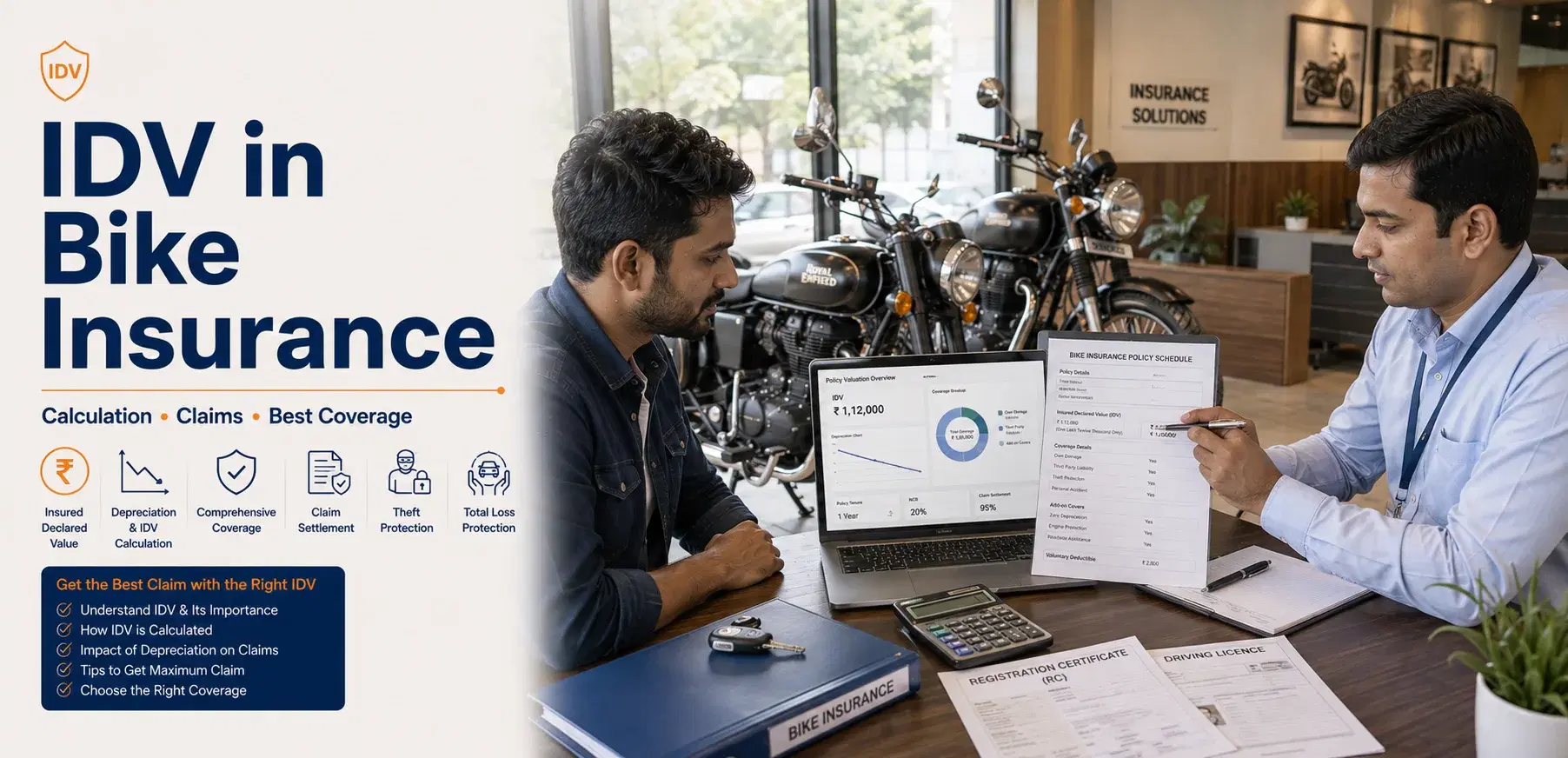
Every bike owner in India has seen the term IDV on their insurance documents — but most people don't fully understand what it means until they actually need to file a claim. IDV, or Insured Declared Value, is the single most important number in your bike insurance policy. It determines how much money you'll receive if your bike is stolen or declared a total loss. Get it wrong, and you could end up with a payout that doesn't cover your actual loss.
India recorded over 21.71 million two-wheeler sales in 2025-26, and with over 60% of bike insurance purchases now happening online, understanding IDV has never been more critical. This guide covers everything — from the IDV full form in insurance to how depreciation works, how to negotiate your IDV, and what happens when you set it too high or too low.
What is IDV in Bike Insurance?
IDV stands for Insured Declared Value — it's the current market value of your bike after accounting for depreciation, and it represents the maximum amount your insurer will pay in case of theft or total loss. Think of it as your bike's 'insured price tag' for that policy year.
IDV is NOT the same as your bike's resale value or the price you paid for it. It's calculated based on the manufacturer's listed selling price minus standard depreciation. The older your bike, the lower its IDV — and the lower your potential claim payout.
Key point: IDV applies only to comprehensive bike insurance policies. If you have a third-party only policy (which is the minimum legal requirement in India), IDV doesn't come into play at all.
Here's why this matters: if your Honda Activa worth ₹75,000 today gets stolen, your insurer pays you the IDV — not what you originally paid for it. So setting the right IDV is critical for adequate financial protection.
How is IDV Calculated? (With Real Examples)
IDV is calculated using a simple formula: IDV = Manufacturer's Listed Selling Price − Depreciation. Registration costs and insurance premiums are excluded from this calculation.
The IDV Formula
IDV = (Manufacturer's Listed Selling Price) − (Depreciation based on bike age)
If your bike has accessories not covered by the manufacturer (like custom alloy wheels), their IDV is calculated separately after deducting depreciation on those parts.
Real Example: Royal Enfield Classic 350
Let's say you bought a Royal Enfield Classic 350 for ₹1,95,000 (ex-showroom). After 2 years, the standard depreciation rate is 20% (cumulative).
Ex-showroom price: ₹1,95,000
Depreciation (20%): ₹39,000
IDV: ₹1,56,000
This ₹1,56,000 is the maximum your insurer will pay if the bike is stolen or totalled in year 2.
Pro tip: Use an IDV calculator bike India tool (available on insurer websites like HDFC Ergo, SBI General, and Policybazaar) to get an instant estimate without manual math.
IDV Depreciation Schedule: How Your Bike's Value Drops Each Year
Depreciation is the biggest factor reducing your bike's IDV every year. IRDAI sets standard depreciation rates for two-wheelers, and your insurer must follow these guidelines.
According to IRDAI-mandated rates, here's how IDV drops over time:
Bike Age | Depreciation Rate | IDV Retained |
|---|---|---|
Less than 6 months | 5% | 95% |
6 months to 1 year | 15% | 85% |
1 to 2 years | 20% | 80% |
2 to 3 years | 30% | 70% |
3 to 4 years | 40% | 60% |
4 to 5 years | 50% | 50% |
More than 5 years | Mutual agreement | Varies |
So a bike that cost ₹1,00,000 new will have an IDV of just ₹50,000 after 5 years — a 50% drop.
What is depreciated IDV in bike insurance?
It simply refers to the IDV after applying these standard depreciation percentages. Every year at renewal, your IDV automatically decreases unless you actively negotiate it.
Important: This depreciation is separate from the zero depreciation add-on, which we'll cover later.
Why is IDV Important in Bike Insurance?
IDV directly controls two things: how much premium you pay and how much you receive in a claim. Getting the IDV right is the difference between being fully covered and being left short-changed.
Here's the real impact of IDV on your insurance:
Premium calculation: A higher IDV means a higher premium. Premiums typically range between 2%–3% of the IDV amount. The average comprehensive bike insurance premium in India is around ₹5,000.
Theft claims: If your bike is stolen, the insurer pays you the IDV — nothing more. A low IDV means a low payout.
Total loss claims: If repair costs exceed 75% of the IDV, the insurer declares it a total loss and pays the IDV.
Resale value benchmark: IDV gives you a realistic sense of your bike's current worth.
As Siddarth Khandelwal, Insurance Expert at Insure24, puts it: "Understanding IDV is essential for every bike owner as it directly impacts your claim amount and premium costs."
High vs. Low IDV: Which One Should You Choose?
There's no single 'correct' IDV — but there is a sweet spot. Setting IDV too low saves premium but leaves you underinsured; setting it too high wastes money on inflated premiums.
What Happens If IDV is Too Low?
If your bike is stolen with a low IDV, you'll receive less than its actual market value. For example, if your Bajaj Pulsar 150 is worth ₹80,000 in the market but you've declared an IDV of ₹60,000, you'll only get ₹60,000 — a ₹20,000 shortfall you'll have to cover yourself.
What Happens If IDV is Too High?
You'll pay a higher premium every year. Since premiums are 2%–3% of IDV, an inflated IDV of ₹1,20,000 vs. the actual ₹1,00,000 means you're paying extra premium on ₹20,000 of 'phantom value' — money you'll never actually recover.
The Ideal IDV Range
New bike (0–1 year): Set IDV close to the manufacturer's listed price
1–3 years: Match IDV to current market resale value
3–5 years: Don't go below 85%–90% of the standard depreciated IDV
5+ years: Negotiate based on actual condition and local market rates
Key point: The best IDV is one that closely mirrors your bike's actual current market value — not artificially inflated or deflated.
How to Decide the Right IDV for Your Bike
The right IDV for your bike is the one that matches its current market value — factoring in age, model, condition, and local resale prices.
Here's a practical checklist to decide your IDV:
Check current resale listings — Search OLX or Droom for your bike's make, model, and year to see what similar bikes sell for in your city.
Use an IDV calculator — Insurers like SBI General Insurance, ICICI Lombard, and HDFC Ergo offer free online IDV calculators.
Factor in bike condition — A well-maintained bike may justify a slightly higher IDV than the standard depreciated value.
Consider your location — Bikes in high-theft cities like Delhi or Mumbai may warrant a higher IDV for better theft protection.
Don't go below the insurer's minimum — IRDAI guidelines set a floor; you can't declare an IDV lower than the minimum allowed.
Pro tip: The average IDV for two-wheelers in India after two years is approximately ₹70,000. Use this as a rough benchmark for mid-range bikes.
IDV and Other Bike Insurance Terms: NCB, Zero Depreciation Explained
IDV works alongside other key insurance terms — understanding how they interact helps you build the best possible coverage for your bike.
IDV vs. NCB (No Claim Bonus)
NCB (No Claim Bonus) is a discount on your premium for every claim-free year — it can go up to 50% after five consecutive claim-free years. Here's the catch: NCB reduces your premium but doesn't change your IDV. So you can enjoy lower premiums while still maintaining a healthy IDV.
IDV vs. Zero Depreciation Add-On
Zero Depreciation (also called Nil Depreciation) is an add-on cover that ensures you receive the full cost of parts replacement without any depreciation deduction during a claim — but it doesn't affect your IDV directly. Your IDV still determines the maximum payout for total loss or theft.
Feature | IDV | NCB | Zero Depreciation |
|---|---|---|---|
What it affects | Max claim payout | Premium discount | Parts claim payout |
Changes annually | Yes (decreases) | Yes (increases) | No |
Applies to total loss | Yes | No | No |
Applies to theft | Yes | No | No |
Applies to repairs | No | No | Yes |
Key point: Zero Depreciation and IDV serve different purposes. You need both for complete protection.
Can You Negotiate or Change Your Bike's IDV?
Yes, you can negotiate your bike's IDV — both at the time of purchase and at renewal. IRDAI allows policyholders to declare an IDV within a permissible range set by the insurer.
Here's how to do it practically:
At renewal: Don't just auto-renew. Call your insurer or log in to their portal and request an IDV revision.
Compare across insurers: Use Policybazaar or Bajaj General Insurance's comparison tools to see what IDV different insurers offer for your bike model.
Provide supporting documents: If you've maintained your bike well, share service records to justify a higher IDV.
Negotiate within the allowed band: Insurers typically allow IDV to be set within ±10%–15% of the standard calculated value.
Can You Increase IDV Next Year?
Yes — but only within the insurer's permissible range. If you feel your bike's market value hasn't dropped as much as the standard depreciation suggests (common with limited-edition or classic models like Royal Enfield), you can request a higher IDV at renewal.
What if you increase the IDV of your bike?
Your premium goes up proportionally, but your claim protection improves. It's worth it if your bike's resale value is genuinely higher than the standard depreciated IDV.
IDV After 5 Years: Special Rules for Older Bikes
For bikes older than five years, IDV is no longer calculated using the standard depreciation table. Instead, it's determined through mutual agreement between you and your insurer.
This is actually good news — it gives you more flexibility. Here's how to handle it:
Research the market: Check platforms like OLX, Droom, or local dealers to find what your specific bike model sells for in your city.
Get a professional valuation: Some insurers accept a third-party valuation certificate for older or classic bikes.
Don't undersell your bike: Older bikes in excellent condition (like a well-maintained Yamaha RX100 or classic Bullet) can command higher market values than standard tables suggest.
Document everything: Maintenance records, recent repairs, and original accessories all support a higher IDV claim.
Is it mandatory to reduce IDV every year?
Not strictly — but the standard depreciation schedule means IDV naturally decreases. For bikes over 5 years, you have room to negotiate upward if the market supports it.
Pro tip: For vintage or collector bikes, always get a written valuation from a certified mechanic before agreeing to an IDV with your insurer.
Common Myths About IDV in Bike Insurance
Myth-busting IDV misconceptions can save you from costly mistakes at claim time.
Myth 1: 'A Lower IDV Always Saves Money'
Many bike owners deliberately set a low IDV to reduce their premium. While it does lower your annual cost, it's a false economy. If your bike is stolen or totalled, you'll receive far less than its actual worth. The premium saving of ₹200–₹500 per year isn't worth a ₹20,000–₹30,000 shortfall at claim time.
Myth 2: 'IDV is the Same as Resale Value'
IDV and resale value are calculated differently. IDV uses the manufacturer's listed selling price minus standard IRDAI depreciation. Resale value depends on actual market demand, condition, and negotiation. They can differ significantly — especially for popular models like the Honda Activa or Hero Splendor.
Myth 3: 'You Can't Change IDV Once the Policy is Issued'
Actually, you can revise IDV at every renewal. IRDAI guidelines allow policyholders to negotiate IDV within a permissible band. Don't assume your IDV is locked in forever — review it every year.
Conclusion
IDV in bike insurance isn't just a number on your policy document — it's your financial safety net when things go wrong. Set it too low and you're underinsured; set it too high and you're overpaying on premiums. The sweet spot is always the current market value of your bike, reviewed every year at renewal.
Use an IDV calculator from insurers like HDFC Ergo, SBI General, or ICICI Lombard to get an accurate figure. Don't auto-renew without checking your IDV — it takes five minutes and could save you tens of thousands of rupees at claim time.
And remember: IDV works best when paired with the right add-ons like Zero Depreciation for complete two-wheeler insurance coverage.
Frequently Asked Questions
Based on 0 ratings

Tanushree (Author)
Tanushree is a dynamic business strategist with a knack for driving innovation in startups, especially in Fintech and Edtech. With 9 years of work-ex, an IT engineer from MIT Pune, & a MBA from IIM Bangalore (Marketing & Business Strategy), she’s got the mix of analytical and creative problem-solving.
Read more
Related Blogs
Popular articles are selected from the same backend blog feed.


Best Bikes Under 1 Lakh in India: Price, Mileage & Low-Maintenance Commuters
Compare the best bikes under ₹1 lakh in India by price, real-world mileage, maintenance and safety — from sub-₹60k commuters to 125cc options near ₹1 lakh.
Best Bikes Under 2 Lakh in India: Streetfighters, Cruisers & All-Rounders
Compare the best bikes under ₹2 lakh in India: verified ex-showroom prices, real-world mileage, ABS and hardware, and which model fits your budget.
Best Sports Bikes Under 5 Lakh in India: Track Bikes, Supersports & Top Speed Comparison
Compare the best sports bikes under ₹5 lakh in India by 0–100 km/h, GPS top speed, track ability, electronics, mileage and ownership costs.
Best Electric Scooters Under 1 Lakh in India: Real-World Range, Subsidy & Price List
Compare the best electric scooters under ₹1 lakh by real-world range, battery size, charging, PM E-DRIVE benefits, running cost, build quality and family practi
Best Low-Cost Electric Scooters Under ₹40,000–₹50,000: Non-RTO & Budget Commuters
Compare low-cost electric scooters under ₹40,000–50,000 by price, range, battery type, charging, non-RTO rules, running cost and practical ownership risks.
Best 110cc–125cc Family Commuter Scooters in India: Mileage, Comfort & Price Comparison
Compare the best 110cc and 125cc scooters in India by price, real-world mileage, comfort, storage, braking, running cost and the value of upgrading to 125cc.
Best 150cc–160cc Bikes in India: Mileage, Price, Specs & Performance
Compare India's best 150cc–160cc bikes on mileage, price, power, braking and comfort — Pulsar N160, Apache RTR 160 4V, Xtreme 160R, FZ-S and more.
Best 200cc–250cc Performance Bikes in India: Power, Mileage & Highway Cruising
Compare India's best 200cc–250cc bikes on power-to-weight, real-world mileage, highway cruising and price, with the 200cc and 250cc classes covered together.