Driving Licence Types in India 2026: All Classes Explained
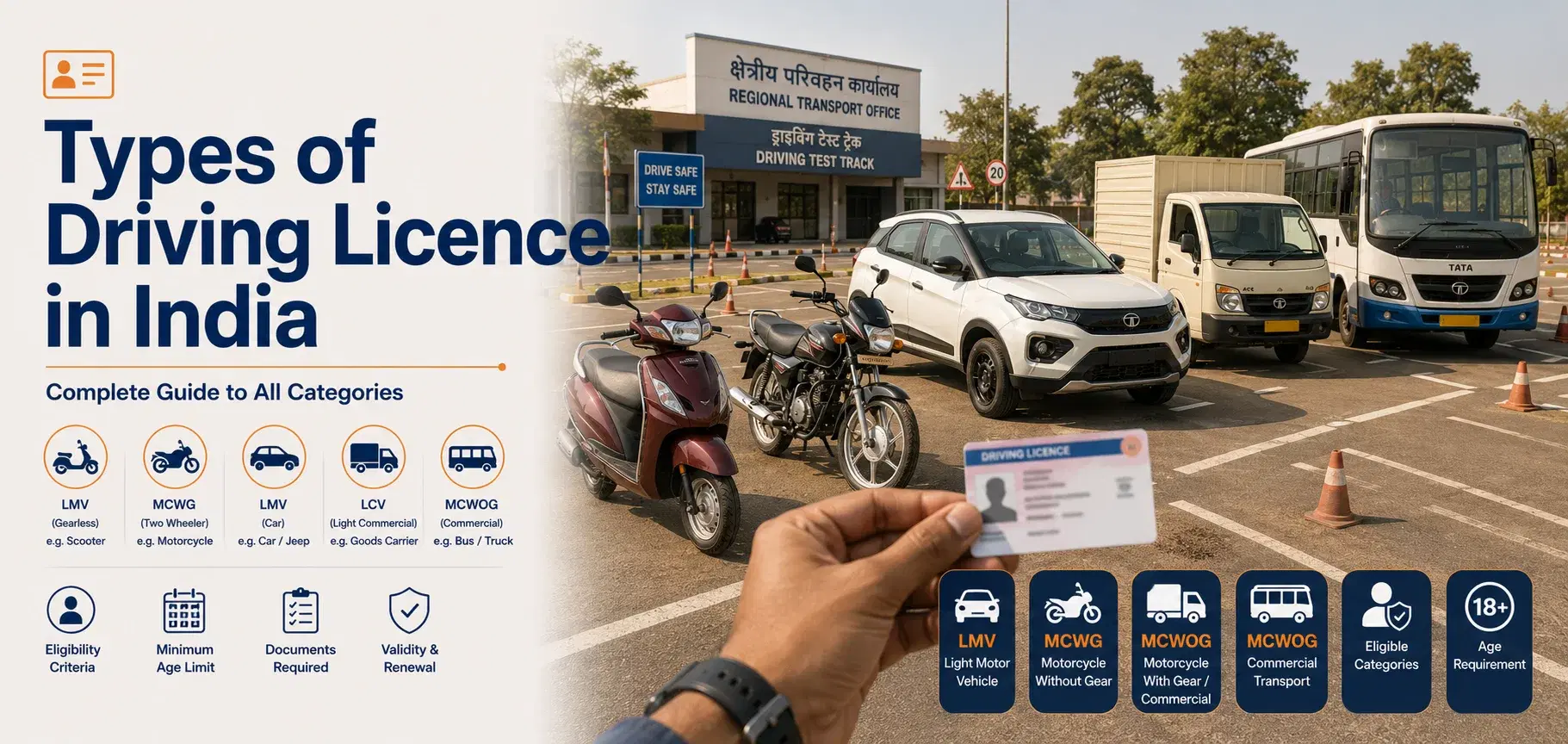
India has over 21.1 crore driving licence records in the national Sarathi registry as of December 2024 — making it one of the largest driver databases in the world. Yet millions of drivers don't know which licence class they hold, or whether it actually covers the vehicle they're driving.
Using the wrong licence type can mean a rejected insurance claim, a hefty fine, or worse. This guide breaks down every type of driving licence in India — from Learner's Licence to International Driving Permit — decodes all category codes like LMV, MCWG, and HMV, and tells you exactly which licence you need for your vehicle.
What Are the Main Types of Driving Licence in India?
India issues four main types of driving licences: Learner's Licence (LL), Permanent Driving Licence (DL), Commercial Driving Licence (CDL), and International Driving Permit (IDP). Each serves a distinct purpose — from learning to drive legally to operating heavy transport vehicles or driving abroad.
Here's a quick breakdown of all types of driving licence:
Learner's Licence (LL): A temporary permit that allows you to practise driving under supervision. It's valid for 6 months and is mandatory before applying for a permanent DL.
Permanent Driving Licence (DL): Issued after passing the driving test at an RTO or accredited driving school. Valid for 20 years or until age 50, whichever comes first.
Commercial Driving Licence (CDL): Required to drive transport vehicles like trucks, buses, taxis, and auto-rickshaws for hire or reward. You must hold a non-transport DL for at least one year before applying.
International Driving Permit (IDP): Issued by the RTO for Indians who want to drive in foreign countries. It's valid for one year and must accompany your Indian DL.
Over 60% of Indian households own a motorcycle or scooter, compared to fewer than 10% who own a car. This explains why two-wheeler licences are the most commonly issued type across India.
Driving Licence Category Codes Explained (LMV, MCWG, HMV, and More)
The codes printed on your driving licence card tell you exactly which vehicles you're legally allowed to drive. LMV means Light Motor Vehicle (cars, jeeps, vans), MCWG means Motor Cycle With Gear (bikes above 50cc), and HMV means Heavy Motor Vehicle (trucks, buses). Knowing your code prevents fines and insurance rejections.
Here's a complete decoding table for all driving licence category codes in India:
Code | Full Form | Vehicles Covered |
|---|---|---|
MCWOG | Motor Cycle Without Gear | Scooters, mopeds up to 50cc |
MCWG | Motor Cycle With Gear | Motorcycles above 50cc, all geared bikes |
LMV | Light Motor Vehicle | Cars, jeeps, vans (non-transport) |
LMV-NT | LMV Non-Transport | Private cars and personal-use vehicles |
LMV-TR | LMV Transport | Taxis, cabs used commercially |
MGV | Medium Goods Vehicle | Trucks with GVW 7,500–12,000 kg |
HMV | Heavy Motor Vehicle | Large trucks, trailers above 12,000 kg GVW |
HPMV | Heavy Passenger Motor Vehicle | Buses with more than 7 seats |
PSV | Public Service Vehicle | All passenger vehicles for hire |
Invalid Carriage | — | Vehicles adapted for persons with disabilities |
Road Roller | — | Construction road rollers |
Pro tip: The codes A1, B, B1, and B2 are European-style classifications sometimes referenced in older Indian licences or international contexts. In India's current Sarathi system, the codes above (LMV, MCWG, HMV) are the standard. 'A1' broadly maps to MCWOG, 'A' to MCWG, and 'B' to LMV.
Vehicle Class to Licence Class: Which Licence Do You Need?
Your required licence class depends entirely on the vehicle you drive. A private car needs LMV-NT, a motorcycle needs MCWG, a taxi needs LMV-TR, and a truck needs HMV. Driving without the correct class is a traffic offence under the Motor Vehicles Act, 1988.
Use this quick-reference table to find your licence class:
Vehicle Type | Required Licence Class |
|---|---|
Scooter / Moped (up to 50cc) | MCWOG |
Motorcycle (geared, above 50cc) | MCWG |
Private Car / Jeep / Van | LMV-NT |
Taxi / Cab (commercial) | LMV-TR |
Auto-rickshaw | LMV-TR or PSV |
Mini-bus (up to 7 seats) | LMV-TR |
Bus (more than 7 seats) | HPMV / PSV |
Light Truck / Tempo | MGV |
Heavy Truck / Trailer | HMV |
Tractor (agricultural) | LMV |
Road Roller | Road Roller (separate endorsement) |
E-rickshaw | LMV-TR (with PSV badge) |
Is a tractor an LMV or HMV?
A tractor used for agricultural purposes is classified under LMV in India. However, if it's used to haul goods commercially, it may require a transport vehicle endorsement. Always confirm with your local RTO.
What is category 3 driving?
In India's domestic system, there's no official 'Category 3' label. This term is sometimes used informally to refer to HMV or transport vehicle licences, but the official classification uses the codes in the table above.
How to Check Your Driving Licence Type Online
You can check your driving licence type and all endorsed vehicle categories online in under two minutes using the Parivahan Sewa portal (parivahan.gov.in) or the mParivahan app, which has over 11.55 crore downloads as of December 2024.
Follow these steps to verify your licence class:
Visit parivahan.gov.in and click on 'Sarathi Services.'
Select your state from the dropdown menu.
Click on 'Driving Licence' and then 'DL Status.'
Enter your DL number and date of birth.
Click 'Submit' — your licence details, including all endorsed vehicle categories, will appear on screen.
Alternatively, open the mParivahan app on your phone, tap 'Virtual RC & DL,' and enter your DL number. Your licence class and validity are displayed instantly.
Important: The Sarathi system shows each vehicle class endorsed on your licence separately. If you see 'LMV' and 'MCWG' listed, you're authorised to drive both private cars and geared motorcycles. If only 'MCWG' appears, you cannot legally drive a car.
Eligibility and Age Criteria for Each Licence Type
You can't get a permanent DL without first holding a Learner's Licence for at least 30 days. The minimum age is 16 for gearless vehicles up to 50cc, 18 for private LMV and MCWG licences, and 20 for commercial transport licences.
Here's the full eligibility breakdown:
Licence Type | Minimum Age | Additional Requirement |
|---|---|---|
MCWOG (gearless, up to 50cc) | 16 years | Parental consent if under 18 |
MCWG / LMV (private) | 18 years | Valid LL for 30+ days |
Commercial / Transport DL | 20 years | Non-transport DL held for 1 year |
International Driving Permit | 18 years | Valid Indian permanent DL |
Can you get a DL without an LL? No. Under the Motor Vehicles Act, 1988, a Learner's Licence is mandatory before applying for a permanent driving licence. The LL must be held for a minimum of 30 days before the driving test. There are no exceptions for private or commercial licences.
Road accident data adds urgency to these rules: 60% of road accident fatalities in India are aged 18–34, the exact cohort applying for their first licence.
Private vs Commercial Driving Licence: What's the Difference?
A private (non-transport) licence covers personal-use vehicles like your own car or bike. A commercial (transport) licence is required whenever you drive a vehicle for hire, reward, or to carry goods. Using a private licence for commercial driving can void your insurance and attract penalties under the Motor Vehicles Act.
Here's what sets them apart:
Non-Transport (NT) Licence: Covers LMV-NT, MCWG, MCWOG for personal use. No badge or permit required beyond the DL itself.
Transport Licence: Covers LMV-TR, HMV, HPMV, PSV, MGV. Requires a separate PSV or goods carriage badge issued by the RTO.
Insurance implication: If you drive a taxi or delivery vehicle on a non-transport DL and meet with an accident, the insurer can legally reject your claim. This is one of the most common reasons for claim disputes in India.
Upgrade path: Hold a non-transport DL for one year → apply at your RTO for a transport endorsement → pass the commercial vehicle driving test.
India recorded 1.77 lakh road accident deaths in 2024 — a 2.3% rise year-on-year. Driving with the wrong licence class contributes directly to enforcement gaps that fuel these numbers.
Step-by-Step Process to Apply for a Driving Licence in India
Apply for your driving licence entirely online through the Parivahan Sewa portal (parivahan.gov.in/sarathi) or visit your nearest Regional Transport Office (RTO). The process has two stages: first get your Learner's Licence, then apply for the permanent DL after 30 days.
Stage 1: Apply for Learner's Licence (LL)
Visit sarathi.parivahan.gov.in and select your state.
Click 'Apply for Learner Licence' and fill in Form 1 (medical self-declaration) and Form 2 (LL application).
Upload documents: Aadhaar card (address proof), age proof (birth certificate or Class 10 marksheet), and passport-size photographs.
Pay the LL fee (typically ₹150–₹200, varies by state).
Book a slot for the online theory test (road signs, traffic rules).
Pass the test — your LL is issued digitally and valid for 6 months.
Stage 2: Apply for Permanent Driving Licence (DL)
After holding your LL for at least 30 days, return to the Sarathi portal.
Fill Form 4 (DL application) and select your vehicle class (MCWG, LMV, HMV, etc.).
Upload your LL, documents, and fee payment receipt (typically ₹200–₹500 depending on vehicle class and state).
Book a driving test slot at your RTO or an accredited driving school.
Pass the practical driving test — your DL is dispatched to your registered address via Speed Post.
Pro tip: Under the June 2024 MoRTH reforms, accredited private driving schools can now conduct both training and the final driving test. However, RTO officials still monitor tests to prevent misconduct, as confirmed by Maharashtra Transport Commissioner Vivek Bhimanwar.
Conclusion
Understanding the types of driving licence in India isn't just a formality — it's the difference between legal protection and a rejected insurance claim. India's 21.1 crore licence holders span every category from MCWOG for scooters to HMV for heavy trucks, and each class carries specific legal rights and responsibilities.Know your code, verify it on Parivahan Sewa, and make sure your licence matches the vehicle you drive.
If you're applying fresh, start with your Learner's Licence on the Sarathi portal today — the entire process can be completed online without visiting an RTO. With a graded penalty-points regime proposed by Union Minister Nitin Gadkari in 2026 that could cancel licences of repeat offenders, there's never been a better time to get your licence class right.
Frequently Asked Questions
Based on 2 ratings

Tanushree (Author)
Tanushree is a dynamic business strategist with a knack for driving innovation in startups, especially in Fintech and Edtech. With 9 years of work-ex, an IT engineer from MIT Pune, & a MBA from IIM Bangalore (Marketing & Business Strategy), she’s got the mix of analytical and creative problem-solving.
Read more
Related Blogs
Popular articles are selected from the same backend blog feed.

Best Bikes Under 1 Lakh in India: Price, Mileage & Low-Maintenance Commuters
Compare the best bikes under ₹1 lakh in India by price, real-world mileage, maintenance and safety — from sub-₹60k commuters to 125cc options near ₹1 lakh.
Best Bikes Under 2 Lakh in India: Streetfighters, Cruisers & All-Rounders
Compare the best bikes under ₹2 lakh in India: verified ex-showroom prices, real-world mileage, ABS and hardware, and which model fits your budget.
Best Sports Bikes Under 5 Lakh in India: Track Bikes, Supersports & Top Speed Comparison
Compare the best sports bikes under ₹5 lakh in India by 0–100 km/h, GPS top speed, track ability, electronics, mileage and ownership costs.
Best Electric Scooters Under 1 Lakh in India: Real-World Range, Subsidy & Price List
Compare the best electric scooters under ₹1 lakh by real-world range, battery size, charging, PM E-DRIVE benefits, running cost, build quality and family practi
Best Low-Cost Electric Scooters Under ₹40,000–₹50,000: Non-RTO & Budget Commuters
Compare low-cost electric scooters under ₹40,000–50,000 by price, range, battery type, charging, non-RTO rules, running cost and practical ownership risks.
Best 110cc–125cc Family Commuter Scooters in India: Mileage, Comfort & Price Comparison
Compare the best 110cc and 125cc scooters in India by price, real-world mileage, comfort, storage, braking, running cost and the value of upgrading to 125cc.
Best 150cc–160cc Bikes in India: Mileage, Price, Specs & Performance
Compare India's best 150cc–160cc bikes on mileage, price, power, braking and comfort — Pulsar N160, Apache RTR 160 4V, Xtreme 160R, FZ-S and more.
Best 200cc–250cc Performance Bikes in India: Power, Mileage & Highway Cruising
Compare India's best 200cc–250cc bikes on power-to-weight, real-world mileage, highway cruising and price, with the 200cc and 250cc classes covered together.