BS3 Ban in Delhi: Complete Guide to Banned Vehicles, Fines & What to Do Next
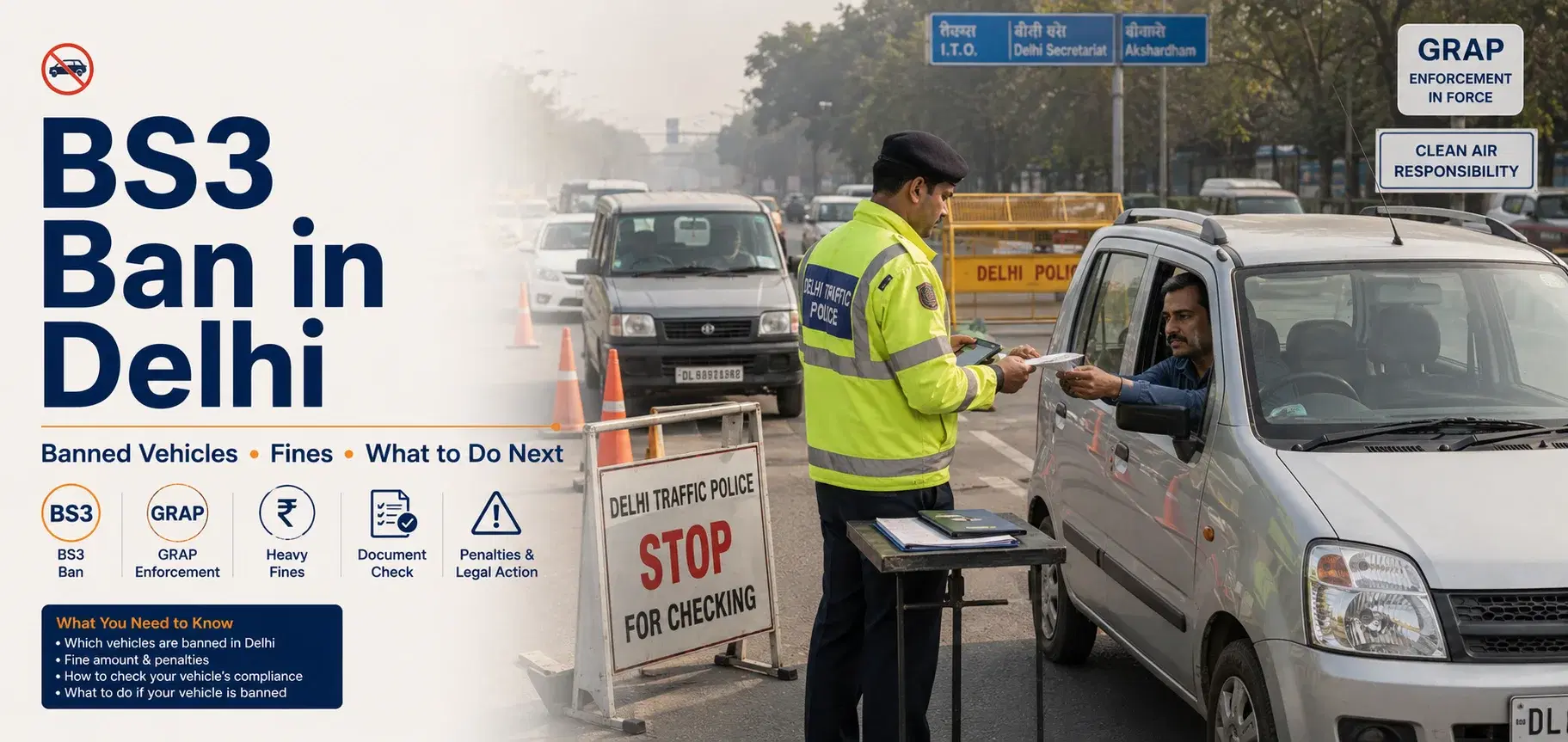
If you own a BS3 or BS4 vehicle and drive in Delhi-NCR, you need to read this before you start your engine. Delhi's vehicle ban isn't a single rule — it's a layered system combining permanent age-based restrictions, pollution-triggered GRAP bans, and Supreme Court orders. Violating any of these can cost you ₹20,000 on the spot.
Vehicles contribute 51–53% of Delhi's local PM2.5 pollution during winter peaks, making transport the single biggest target for enforcement. This guide cuts through the confusion — covering which vehicles are banned, how to check your BS norm, what fines apply, and exactly what to do if your vehicle is affected.
Current BS3 Ban Status in Delhi: What You Must Know Today
BS3 petrol vehicles and BS4 diesel vehicles face a dual-layer ban in Delhi-NCR — a permanent age-based restriction (10-year diesel, 15-year petrol) enforced year-round, plus a GRAP-triggered temporary ban activated when AQI crosses 400. From November 1, 2025, non-Delhi registered BS-III commercial goods vehicles are permanently barred from entering Delhi.
The Delhi Transport Department's public notice confirms that petrol vehicles older than 15 years and diesel vehicles older than 10 years cannot ply on Delhi roads regardless of their BS norm. This is a permanent, year-round rule — not linked to AQI.
On top of that, when GRAP Stage III or Stage IV is declared, BS-III petrol and BS-IV diesel vehicles face an additional temporary ban across the entire NCR. During November 2025, when Delhi's PM2.5 hit 215 µg/m³ — the highest monthly average of the year — both GRAP Stage III and Stage IV were in force simultaneously.
Pro tip: Check the CAQM website or Delhi government's Sameer app daily during October–January to know the active GRAP stage before driving.
Complete List of Banned Vehicles in Delhi-NCR (BS3, BS4, Age Rules)
The ban covers BS-III petrol cars and bikes, BS-IV diesel vehicles, and all petrol vehicles over 15 years or diesel vehicles over 10 years old — regardless of emission standard. BS-VI, CNG, LNG, and electric vehicles are exempt. From December 18, 2025, even non-Delhi registered BS-III and BS-IV private vehicles were barred from entering the city.
Here's the full breakdown:
Permanently Banned (Year-Round):
Petrol vehicles older than 15 years (any BS norm)
Diesel vehicles older than 10 years (any BS norm)
Non-Delhi registered BS-III commercial goods vehicles (from Nov 1, 2025)
Banned During GRAP Stage III/IV:
BS-III petrol cars, SUVs, and two-wheelers
BS-IV diesel cars and SUVs
Non-Delhi registered BS-III and BS-IV private vehicles (from Dec 18, 2025)
Always Permitted:
BS-VI petrol and diesel vehicles
CNG, LNG, and electric vehicles
Emergency, essential services, and government vehicles
Approximately 37% of Delhi-NCR's 2.88 crore registered vehicles are BS-III or older. In Noida alone, over 4 lakh of 10 lakh registered vehicles became ineligible to enter Delhi after the December 2025 non-BS-VI entry ban.
Vehicle Category | Fuel Type | Ban Type | Permitted? |
|---|---|---|---|
BS-III, any age | Petrol | GRAP III/IV + Permanent if 15+ yrs | No (during GRAP) |
BS-IV | Diesel | GRAP III/IV | No (during GRAP) |
BS-IV | Petrol | Age-based only | Yes (if under 15 yrs) |
BS-VI | Petrol/Diesel | None | Yes |
CNG/Electric | Any | None | Yes |
Diesel, 10+ years | Any BS norm | Permanent | No |
How to Check if Your Car or Bike is BS3, BS4, or BS6
You can find your vehicle's emission standard on your Registration Certificate (RC). Look for 'Emission Norms' or 'BS Norm' field. If it's not listed, use the manufacturing year: BS3 vehicles were made between 2005–2010, BS4 between 2010–2020, and BS6 from April 2020 onwards.
Here's a step-by-step method:
Check your RC book — The emission standard is printed under vehicle specifications. It may read 'BSIII', 'BSIV', or 'BS6/VI'.
Use the Vahan portal — Visit https://vahan.parivahan.gov.in and enter your registration number to pull up full vehicle details including emission norm.
Check manufacturing year — If your RC doesn't specify, use this chart:
BS2 or older: manufactured before April 2005
BS3: April 2005 – March 2010
BS4: April 2010 – March 2020
BS6: April 2020 onwards
Look at your insurance document — Some insurers list the emission standard in the vehicle description field.
Important: A BS3 diesel vehicle older than 10 years emits approximately 11 times more particulate matter than the BS-VI limit. This is why even a well-maintained BS3 vehicle doesn't get an exemption.
GRAP Stages and AQI Triggers: How the Ban Gets Activated
GRAP (Graded Response Action Plan) is a pollution emergency framework managed by the Commission for Air Quality Management (CAQM). It has four stages triggered by Delhi's AQI. BS-III petrol and BS-IV diesel bans kick in at Stage III, when AQI crosses 400 (severe-plus category).
Here's how the stages work:
Stage I (AQI 201–300 – Poor): Basic restrictions, no vehicle ban
Stage II (AQI 301–400 – Very Poor): Construction restrictions, no vehicle ban
Stage III (AQI 401–450 – Severe): BS-III petrol and BS-IV diesel vehicles banned
Stage IV (AQI 450+ – Severe+): All Stage III rules plus additional restrictions; non-Delhi BS-III/BS-IV vehicles barred at borders
Delhi's annual average AQI in 2025 stood at 201 with 8 'severe' days, down from 17 severe days in 2024 — a sign of gradual improvement. However, CAQM revoked Stage III restrictions on January 22, 2026, after AQI dropped below threshold levels.
The key difference: GRAP bans are temporary and lift when AQI improves. Age-based bans are permanent and don't lift regardless of AQI.
Supreme Court Orders and Legal Timeline for BS3 Vehicles
The Supreme Court reinstated the ban on BS-III and older vehicles in Delhi-NCR in late 2025, reversing a temporary August 2025 interim relief it had granted. The bench, led by CJI Surya Kant, directed strict enforcement of both age-based and emission-norm-based restrictions across the NCR.
Key legal milestones:
August 12, 2025: Supreme Court granted interim relief, temporarily staying the blanket ban on 10-year-old diesel and 15-year-old petrol vehicles
December 2025: Supreme Court reinstated the ban following CAQM recommendations and worsening AQI
November 1, 2025: CAQM direction barred non-Delhi BS-III commercial goods vehicles permanently
December 18, 2025: Delhi extended the ban to all non-Delhi registered BS-III and BS-IV private vehicles
January 22, 2026: CAQM revoked GRAP Stage III after AQI improvement
The court's position is clear: even if a BS3 vehicle is mechanically sound, Delhi-NCR does not permit high-emission vehicles regardless of condition. Ongoing litigation continues around the age-based ban's blanket application.
Penalties and the 'No PUC, No Fuel' Rule: What It Costs to Ignore the Ban
Driving a banned BS3 or BS4 vehicle in Delhi during a restriction period attracts a fine of up to ₹20,000. Petrol pumps can also deny fuel to vehicles without a valid PUC (Pollution Under Control) certificate under the 'No PUC, No Fuel' rule enforced across Delhi.
Here's what enforcement looks like in practice:
₹20,000 challan issued under the Motor Vehicles Act for violating GRAP-linked bans
Fuel denial at petrol pumps if your PUC certificate is expired — over 500 petrol stations in Delhi were fitted with ANPR cameras to automate checks
Border turning back — non-Delhi registered non-BS-VI vehicles are turned away at Delhi's entry points during GRAP Stage III/IV
Towing of vehicles found parked or driven in violation zones
Amit Bhatt, Managing Director at the International Council on Clean Transportation (ICCT), notes: "The key limitation of the existing PUC system is that it is a stationary test and does not capture emissions under real-world driving conditions." Despite this, PUC compliance remains legally mandatory.
Key point: Renew your PUC certificate every 6 months at any authorised testing centre. Costs typically range from ₹60–₹100.
What to Do with Your Banned BS3 or BS4 Vehicle
If your vehicle is permanently banned in Delhi, you have four practical options: sell it to a buyer in a state where the ban doesn't apply, scrap it at an authorised Registered Vehicle Scrapping Facility (RVSF), obtain an NOC and re-register it in another state, or switch to a BS-VI, CNG, or electric alternative.
Here's what each option involves:
Sell to another state — BS3 vehicles aren't banned nationwide. A buyer in Rajasthan, UP (outside NCR), or MP can legally use your vehicle. Disclose the Delhi ban status honestly.
Scrap at an authorised RVSF — The government's Vehicle Scrapping Policy offers a scrapping certificate worth 4–6% of the ex-showroom price of a new vehicle as a discount incentive. Find your nearest RVSF at vahan.parivahan.gov.in.
Obtain an NOC — Apply at your RTO for a No Objection Certificate to re-register the vehicle in another state. This doesn't remove the age-based ban in Delhi but lets you use the vehicle elsewhere.
Upgrade to BS-VI or EV — Delhi offers road tax exemption and registration fee waiver on new electric vehicles. The Delhi EV Policy provides subsidies of up to ₹30,000 on two-wheelers and ₹1.5 lakh on four-wheelers.
Important: Converting a BS3 engine to BS6 is not technically or legally feasible. The emission systems are fundamentally different and no retrofit kit is approved for this conversion.
Conclusion
The BS3 ban in Delhi isn't going away — it's getting stricter. With the Supreme Court reinstating restrictions, CAQM tightening GRAP enforcement, and the December 2025 extension barring all non-BS-VI out-of-state vehicles, the direction is clear: Delhi is moving firmly toward BS-VI, CNG, and electric vehicles.
If you're driving a BS3 or BS4 vehicle, don't wait for a ₹20,000 challan to force your hand. Check your vehicle's emission norm on the Vahan portal today, verify your PUC certificate is valid, and explore scrapping incentives or EV subsidies available under Delhi's current policies. The sooner you act, the more options — and money — you'll have.
Frequently Asked Questions
Based on 0 ratings

Tanushree (Author)
Tanushree is a dynamic business strategist with a knack for driving innovation in startups, especially in Fintech and Edtech. With 9 years of work-ex, an IT engineer from MIT Pune, & a MBA from IIM Bangalore (Marketing & Business Strategy), she’s got the mix of analytical and creative problem-solving.
Read more
Related Blogs
Popular articles are selected from the same backend blog feed.

Best Bikes Under 1 Lakh in India: Price, Mileage & Low-Maintenance Commuters
Compare the best bikes under ₹1 lakh in India by price, real-world mileage, maintenance and safety — from sub-₹60k commuters to 125cc options near ₹1 lakh.
Best Bikes Under 2 Lakh in India: Streetfighters, Cruisers & All-Rounders
Compare the best bikes under ₹2 lakh in India: verified ex-showroom prices, real-world mileage, ABS and hardware, and which model fits your budget.
Best Sports Bikes Under 5 Lakh in India: Track Bikes, Supersports & Top Speed Comparison
Compare the best sports bikes under ₹5 lakh in India by 0–100 km/h, GPS top speed, track ability, electronics, mileage and ownership costs.
Best Electric Scooters Under 1 Lakh in India: Real-World Range, Subsidy & Price List
Compare the best electric scooters under ₹1 lakh by real-world range, battery size, charging, PM E-DRIVE benefits, running cost, build quality and family practi
Best Low-Cost Electric Scooters Under ₹40,000–₹50,000: Non-RTO & Budget Commuters
Compare low-cost electric scooters under ₹40,000–50,000 by price, range, battery type, charging, non-RTO rules, running cost and practical ownership risks.
Best 110cc–125cc Family Commuter Scooters in India: Mileage, Comfort & Price Comparison
Compare the best 110cc and 125cc scooters in India by price, real-world mileage, comfort, storage, braking, running cost and the value of upgrading to 125cc.
Best 150cc–160cc Bikes in India: Mileage, Price, Specs & Performance
Compare India's best 150cc–160cc bikes on mileage, price, power, braking and comfort — Pulsar N160, Apache RTR 160 4V, Xtreme 160R, FZ-S and more.
Best 200cc–250cc Performance Bikes in India: Power, Mileage & Highway Cruising
Compare India's best 200cc–250cc bikes on power-to-weight, real-world mileage, highway cruising and price, with the 200cc and 250cc classes covered together.