India’s Embrace of E20 Fuel: Does It Signal The Future?
 Share
Share
2025 has been an upfront year for India in terms of its sustainable revolution, with an increased emphasis by the government to reduce costs and boost manufacturing. However, it has been just as active in starting critical movements geared towards its goals in the fuel vehicle categories.
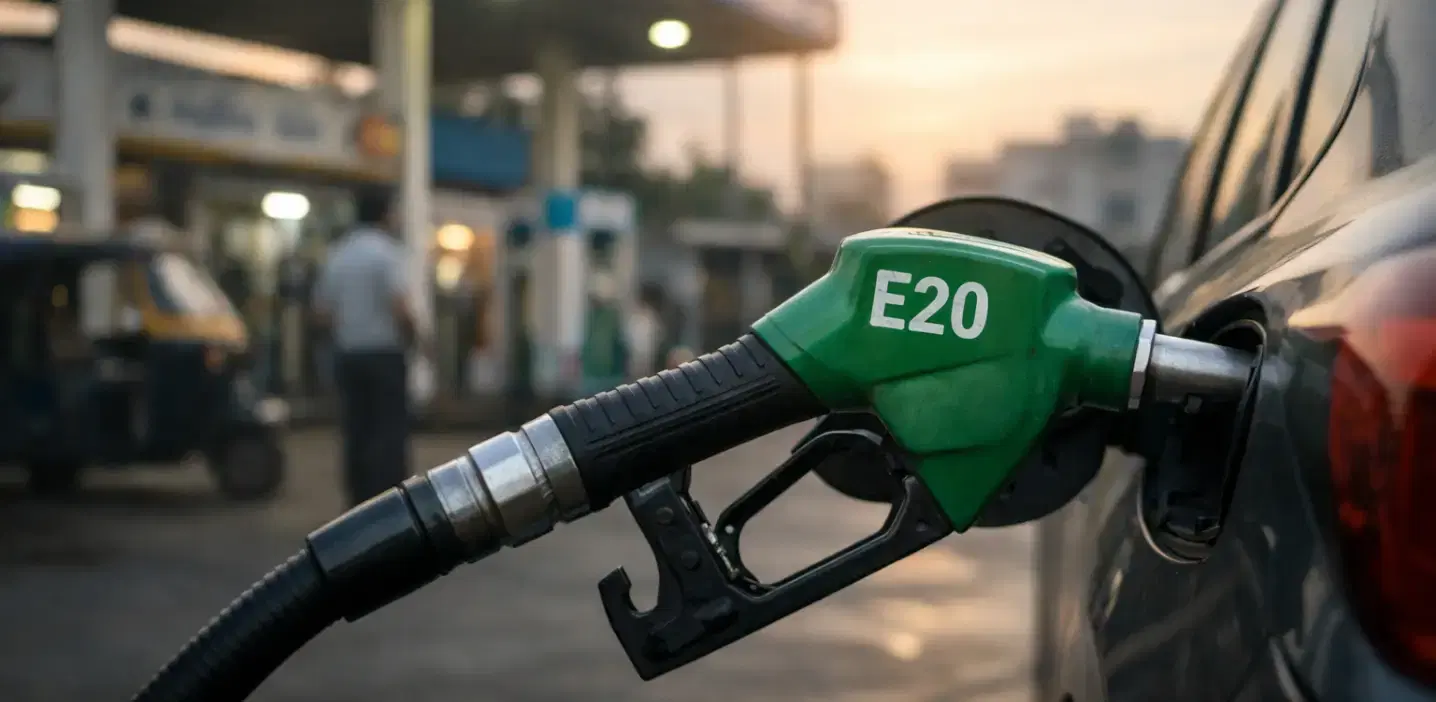
As has been noted throughout the year 2025, the country is rapidly embracing E20–a fuel blend that is composed of 80% conventional petrol and 20% ethanol. Originally, targeted for a 2030 mass rollout, the E20 rollout for formally accelerated to 2025 to boost energy security, reduce import dependence, and strengthen the domestic biofuel value chain.
In fact, public sector oil marketing companies began selling E20 from the year it was made widely available, aka 2023, according to the Press Information Bureau.
Hence, not only is this “fuel blend” proposed to be a key component of solving India’s energy-security puzzle, but it is also being positioned as a relatively seamless transition step for petrol vehicles in the short term. As reported by the Times of India, the government remains committed to making E20 available across all of India by 2025. Not only that, but other lower blends of Ethanol fuel solutions (E10, aka 10%) will be phased out.
However, is it going to be an essential element of India’s march towards a sustainable future? Read on to find out.
What are the Advantages of E20? Explore the Upsides
1. It is Lighter on the Environment–Lower Emissions, Cleaner Air
Without a doubt, one of the primary motivations for E20 adoption is environmental. Why is that? Ethanol-blended fuels reduce certain harmful emissions compared to pure petrol. That’s why.
For instance, the use of ethanol blends typically lowers carbon monoxide (CO), hydrocarbon (HC) emissions, which helps improve air quality, a big consideration for Indian cities.
According to biofuel programme advocates, E20 can lead to a significant drop in greenhouse gases and can help India meet its climate change and clean energy targets.
2. Boosts Energy Security and Domestic Economy – Less Reliance on Imported oil, More Support for Farmers
By blending ethanol (which is mainly produced from domestically grown crops) with petrol, India can reduce its dependence on imported crude oil, which typically represents a major drain on foreign exchange. In fact, Ethanol blending has reportedly saved India approximately ₹1.55 lakh crore over the last 11 years, as reported by The Economic Times.
What’s also great is that Ethanol production also supports local agriculture: farmers supplying sugarcane or grain for ethanol feedstock gain a stable additional source of income. In fact, as reported by Reuters, E20 is expected to add $4.6 billion to farmers’ incomes in 2025.
This is something that is definitely much needed and a real win-win situation for all parties. In this sense, E20 is not just a fuel policy, but part of a broader strategy for energy independence and rural economic support.
3. Higher Octane Rating – Potential for Better Engine Performance (in E20 Compatible Vehicles)
How this works is this way: Ethanol has a higher octane rating compared to conventional petrol.
Hence, this means that E20 can potentially allow engines, especially modern high-compression engines, to operate more smoothly, with less knocking, better combustion efficiency, and possibly improved throttle response or smoother drive quality (assuming the engine and fuel system are designed for E20 fuel).
Some experts have even suggested that ethanol’s high heat of vaporization can lower intake-air temperatures, which can increase the density of the air-fuel mixture, aiding combustion efficiency.
As a result, it can offer potentially significant performance and combustion-related benefits over older, unoptimzed petrol vehicles.
4. Strategic Transition Fuel – A “Bridge” Towards Cleaner Mobility
For a country like India, transitioning directly to fully electric vehicles (EVs) everywhere is a long-term challenge due to infrastructure, affordability, and energy-production constraints. Here, E20 can offer a solid middle ground.
It can provide a cleaner fuel that is more feasible today, leverage domestic resources, and buy time for gradual electrification or adoption of more sustainable mobility solutions. Policymakers often call E20 a “bridge fuel.” And this is the reason for that.
By reducing crude-oil imports, cutting emissions, and helping agrarian supply chains, E20 fits into a multipronged national strategy. Essential for India’s sustainable future.
What Can Be the (Possible) Disadvantages of E20? Consider the Potential Downsides
While E20 offers many theoretical and policy-level benefits, the ground-level reality is….more nuanced (as it always is). Especially when you consider India’s large population of older vehicles, as well as sometimes volatile driving conditions.
How so? Let’s explore.
1. Compatibility Concerns – Not all Vehicles are E20-ready
Here’s the biggest caveat: many existing vehicles, especially those built before April 2023, were not designed for E20.
Most older cars/bikes were engineered expecting E0 or up to E10 (10% ethanol) petrol. And most of India’s roads are made up of these older vehicles for both personal and commercial use cases.
Using E20 in such vehicles can lead to degradation of components like rubber seals, gaskets, fuel lines, injectors, or even metal parts, due to the hygroscopic (absorbing moisture) nature of Ethanol. In fact, it can be downright corrosive to parts that are not made ethanol-resistant.
This wear and tear over time can lead to leaks, injector clogging, fuel pump failures, or even engine problems. And this can make long-term maintenance more frequent and costly. Which is a strict “no-no” in the parlance of vehicle maintenance.
Many automakers across India have reportedly cautioned against using E20 in older cars. There is also concern that such use might void warranties or insurance coverage, though messages from manufacturers and insurers have varied. Including the drivers themselves.
Hence, unless the vehicle is explicitly “E20-certified” (or “E20-ready”), motorists risk accelerated wear, maintenance hassles, and possible mechanical issues. An important point to note.
2. Reduced Fuel Efficiency – Higher Fuel Consumption Per Km
Ethanol has a lower energy density per liter compared to pure petrol.
What does that mean? That means to cover the same distance, the engine must burn more volume when running on E20.
What this translates to: a drop in real-world fuel efficiency (mileage). Estimates can vary wildly.
Many sources suggest a 5–7% drop in mileage for compatible modern vehicles. Some older vehicles (including my own BS6 Stage 1 car) have reportedly experienced even larger drops, sometimes up to 20%, depending on driving style, conditions, and how badly the fuel system tolerates ethanol.
A drop in fuel economy translates into more frequent refuels, which may offset any per-litre cost benefit (if any), thereby increasing overall running costs.
3. Maintenance Burden – Increased Wear and Tear for Older Vehicles
As noted, ethanol can degrade rubber hoses, seals, gaskets, fuel lines, and injectors. Especially in older vehicles with components not rated for ethanol.
Over extended use, users may need to replace these parts every 20,000–30,000 km or so (or even sooner), depending on local climate (humidity, moisture), usage patterns, and maintenance habits.
Fuel pumps, injectors, and fuel lines may require more frequent servicing or replacement, raising the maintenance cost. In worst cases, improper handling might even result in fuel leaks or poorer engine reliability.
From a consumer standpoint, this means that unless you run an E20-ready vehicle, switching to E20 may incur hidden costs over time, impacting the overall economics of owning such a vehicle. This can be a deal breaker for many.
4. Practical issues: Availability of Compatible Fuel, Loss of Choice, and Potential Fuel-quality Irregularities
As mentioned before, with the rollout of E20, many fuel stations are reportedly phasing out lower-ethanol or “pure petrol” (E0/E5/E10).
This means that owners of older or non-E20-ready vehicles may find it increasingly difficult to source “clean” petrol.
As per reports, lower-ethanol fuels are currently only accessible in higher-priced high-octane petrol variants like XP100 or Power 100 (97+ Octane petrol)
Furthermore, there’s some concern that in the rush to blend and distribute fuel, quality control could suffer. Ethanol is hygroscopic (absorbs moisture), which can make fuel more prone to water absorption, leading to phase separation or water contamination in the fuel tank, especially when vehicles are idle for long periods (storage, parking), a greater risk in humid or coastal climates. This would lead to fuel tank rusting/corrosion over time.
Also, there are economic/price paradoxes: despite ethanol being cheaper and domestically available, consumers do not always enjoy lower pump prices, because fuel taxation and pricing regimes treat E20 essentially the same as petrol.
According to some industry observers, the benefit (if any) largely accrues to oil marketing companies or governments, not necessarily to end consumers.
Finally, as E20 gradually becomes the “default,” people with older or incompatible vehicles may feel forced to adapt or upgrade, even if their vehicle manual explicitly discourages E20.
Do All BS6 Stage 2 (Post-April 2023) Vehicles Guarantee E20 Compatibility?
As circumstances would have it, India’s push for E20 fuel directly coincides with the country’s tightening vehicle emission norms and stringent sustainability checks.
Vehicles certified under BS6 Stage 2 (i.e., those manufactured post April 2023) are subject to stricter emissions and fuel-system standards. Hence, they are commonly referred to as “E20-ready”.
With all that being said, here’s a critical caveat: “BS6 Stage 2 certified” does not automatically guarantee E20 compatibility.”
A lot of owners and enthusiasts have noted that the vehicle owner’s manuals/specs don’t explicitly mention ethanol blending tolerance or E20 compliance.
Hence, before confidently relying on E20, it is advisable for vehicle owners to:
- Check the user manual or manufacturer’s official documentation for “E20 compatibility” or “ethanol-blended fuel usage permitted.”
- Confirm with the service center or dealership if the fuel system (hoses, seals, injectors) uses ethanol-resistant components.
- If in doubt, avoid long-term use of E20 or consider periodic inspection and maintenance of fuel system components.
Thus, while BS6 Stage 2 is a good indicator of modern fuel-system design, it does not replace explicit manufacturer confirmation of E20 readiness.
Broader Challenges: Sustainability, Agriculture, and Equity
Beyond vehicle-level technicalities, adoption of E20 raises some larger questions and trade-offs for society as a whole. Ones that are important to take into account:
1. Food vs Fuel and Resource Use
Producing ethanol at scale requires significant agricultural feedstock: often sugarcane, maize, or grains. Prioritizing fuel production over food (or even water use) can raise concerns about food security, agricultural resource allocation, and water consumption.
Some critics argue that diverting large amounts of crops to fuel may impact food supply, food prices, and environmental sustainability in the long term.
For a country like India, balancing food security, water scarcity (in many regions), and energy needs, this can often be a serious challenge.
2. Infrastructure and Distribution Challenges
Widespread adoption of E20 requires infrastructure changes – storage facilities, pipelines, transport logistics, and pump-station retrofitting to handle ethanol-blended fuel safely and consistently.
Until such infrastructure and consistent supply quality are ensured across urban and rural areas alike, some consumers may face intermittent supply, inconsistent ethanol concentrations, or even long-term degradation of vehicles due to poor fuel quality.
3. Equity – Who benefits, who risks bearing the cost?
In theory, E20 should benefit everyone: lower import bills for the country, job creation in rural/agricultural sectors, cleaner air, and reduced emissions.
But in practice, the costs (reduced fuel efficiency, maintenance burden, risk to older vehicles) are borne by individual vehicle owners, especially those with older or budget vehicles, who may not afford frequent part replacements, or may face warranty/insurance problems.
Meanwhile, the economic gains (cheaper ethanol inputs, government subsidies, foreign-exchange savings) may accrue to producers, oil companies, or the state. Without careful regulatory oversight, this could mean the burden falls disproportionately on the “small guy.”
So, Is E20 a “Net Win”? Or Still a Risky Gamble?
This is an interesting question, to which the logical answer remains: It’s complicated.
E20, in many aspects, holds real promise: in terms of environmental benefits, energy security, rural economic upliftment, and as a transitional strategy towards cleaner mobility. For the newer, “E20-ready” vehicles that are designed and certified for the fuel blend, switching to it can be a simple, safe, and beneficial decision. For these cases, the advantages outweigh the drawbacks.
However, for the many pre-BS6 Stage 2 cars and two-wheelers on Indian roads, E20 adoption introduces risks: accelerated component wear, reduced fuel economy, and higher maintenance burden. Not to mention, possible warranty and insurance complications. For these vehicles, E20 adoption isnt a “win”, not unless they are fully upgraded.
Furthermore, the broader trade-offs regarding agriculture, water use, food security, infrastructure, and equitable distribution of benefits vs costs remain real and uncertain.
E20 may indeed be a “bridge”, but whether it leads to a more sustainable, fair, long-term future. Of course, a lot of it depends on policy design, infrastructure investment, not to mention external social and environmental factors.
What are the Dos and Dont’s for Vehicle Owners in India?
If I were an average vehicle owner in Bengaluru (or anywhere in India), here’s what I’d do:
- Check compatibility first: Before filling up with E20, I’d carefully check my car/bike’s manual or with the dealer if the vehicle is officially sanctioned as “E20-ready.” Don’t assume BS6 Stage 2 always equals E20 compatibility.
- If not certified, avoid regular use: If my car isn’t explicitly certified, I’d avoid using E20 as a routine, especially for long-term driving. Occasional use might be manageable, but repeated use may increase maintenance costs. Going for higher octane fuel remains the only choice in the current circumstances.
- Watch maintenance carefully: If using E20 (in a certified or older vehicle), I’d keep a closer eye on fuel system components, fuel lines, seals, injectors, and service them more frequently. Maybe even do periodic fuel-system cleaning, and avoid leaving the tank half-filled or idle for long durations (to reduce moisture build-up).
- Budget for real fuel costs (not just per-litre price): Factor in that reduced fuel efficiency and potential extra maintenance may offset any savings, maybe even make running costs higher.
- Monitor local fuel quality/pump sources: Ensure that the fuel station supplies properly blended ethanol-petrol (not adulterated or water-contaminated fuel). If possible, prefer reputed and well-maintained pumps.
For those contemplating buying a new vehicle, it might make sense to prioritize models explicitly marketed as “E20-ready / flex-fuel capable,” especially if you intend to run the vehicle over many years in an India increasingly dominated by ethanol blends.
Conclusion
So, does “E20 signal the future?”
The answer? It is, in essence, a bridge.
It is a transitional fuel that connects the present of Indian mobility to its future–and the world of cleaner, more sustainable mobility. But like any bridge, it only works if it is built carefully, maintained properly, and used responsibly.
E20 petrol (20% ethanol blended with petrol) represents a bold, strategic move for India: toward energy security, reduced fossil imports, rural economic upliftment, and cleaner emissions. For new, E20-ready vehicles (generally post-April 2023 BS6 Stage 2 models), the switch can be reasonably smooth, with potential benefits in combustion efficiency, emissions, and overall national gains.
Yet the transition is imperfect. For the many older cars, bikes, and vehicles not designed for ethanol blends, E20 can bring real risks: from decreased fuel efficiency and higher maintenance to potential engine issues, warranty complications, and long-term component wear
As a vehicle owner (or a prospective buyer), it is important to be informed, cautious, and pragmatic: understand your vehicle’s readiness, account for real running costs, and make decisions that balance short-term convenience with long-term sustainability.
Based on 1 rating

Abhishek Nair (Author)
With 8+ years of experience across manufacturing, banking, and sustainable e-commerce, he brings a sharp business lens to every conversation. An MBA with a love for football, motorsports, and all things fast—on the field or on two wheels.
Read more
Related Blogs
Popular articles are selected based on the number of readers