Bajaj Freedom 125 CNG Review & 2026 On-Road Price Guide (Top Cities)
 Share
Share
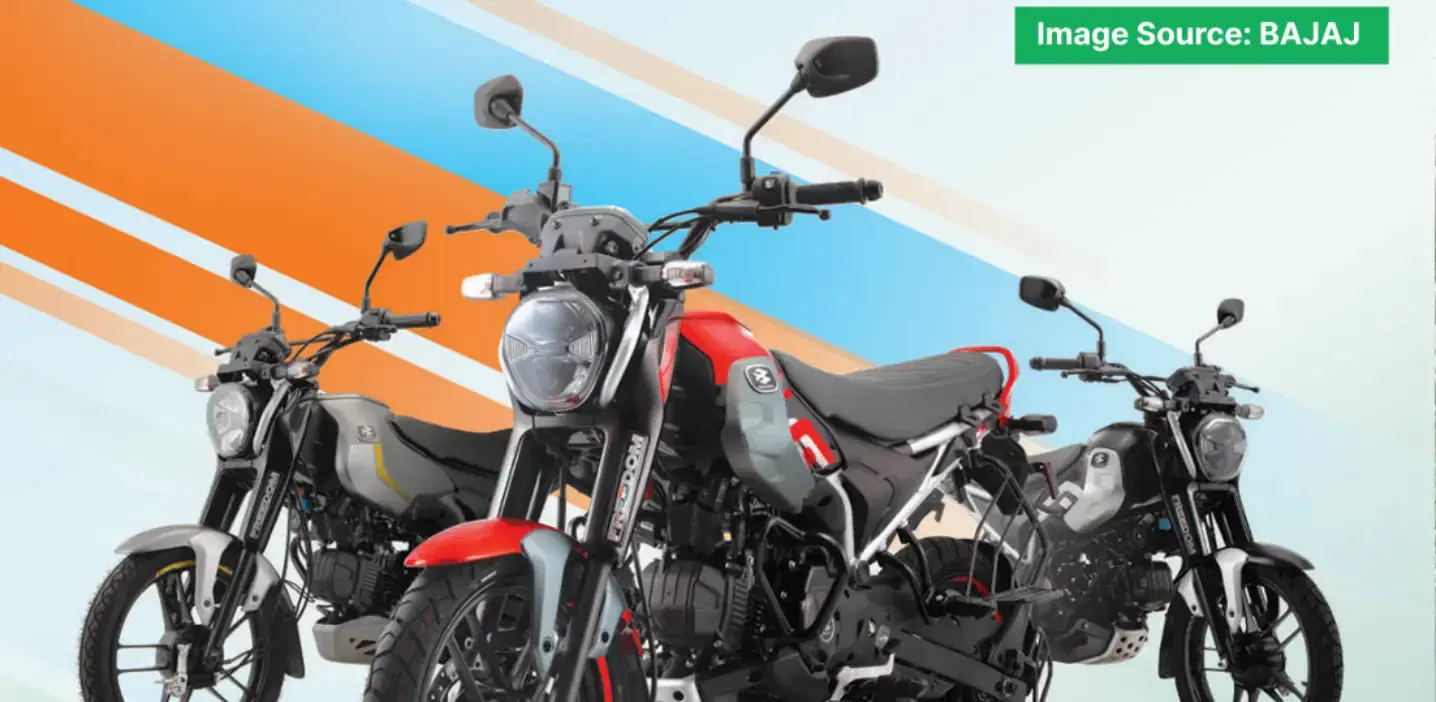
If there’s one bike that really shook up India’s 125 cc segment recently, it’s the Bajaj Freedom 125 CNG.
Marketed as the world’s first CNG-powered motorcycle with a backup petrol tank, it offers riders easy respite from rising fuel prices. It also offers an interesting middle ground between a regular petrol bike and a full-blown EV. Bajaj officially calculates the Freedom 125 to save 50% of the operation costs for riders.
Hence, it’s time for you to know about it. In this guide, we’ll break down:
- What makes the Bajaj Freedom 125 CNG special
- Its mileage, tank capacity and real-world range
- On-road prices in major cities like Mumbai, Delhi, Bangalore, Pune, Hyderabad, Kolkata, Ahmedabad, Surat, Jaipur, Patna & Kanpur
- Who this bike actually makes sense for (and who should skip it)
Why Does the Bajaj Freedom 125 CNG Matter?
Here’s the math: The Freedom 125 isn’t just another 125 cc commuter. Bajaj has built it from the ground up as a bi-fuel motorcycle that can run on both CNG and petrol, with a dedicated CNG tank and a small petrol tank for backup.
Key reasons it’s getting so much attention:
- CNG is significantly cheaper than petrol in most Indian cities, so your per-km running cost drops sharply.
- Bajaj claims the CNG setup can reduce operating cost by up to 50% versus similar petrol bikes and cut toxic emissions by around 80% (Source: Bajaj Auto)
- For riders who don’t want to jump fully to EVs, this is a familiar ICE bike with lower running costs and no charging anxiety. It just gives them great value.
Think of it as a “fuel economy specialist” aimed at daily riders, gig workers, and families who rack up kilometres and really feel every rupee at the fuel pump.
What are the Key Specifications and Features?
Here’s a quick look at the Bajaj Freedom 125 CNG core specifications and features you need to be on top of:
For city riders doing 30–70 km a day, the range + low running cost is exactly what makes the Freedom 125 CNG stand out.
What are the Ex-Showroom and On-Road Prices?
What is the ex-Showroom price? How are the variants positioned?
Bajaj officially lists the NG04 Disc LED variant for the Freedom 125 around ₹1.10 lakh ex-showroom, with the Drum and Drum LED variants positioned lower.
There has also been a limited-period price cut on the base NG04 Drum variant, bringing it down from ₹90,976 to ₹85,967 ex-showroom for a promo window in 2025.
So, depending on when someone is reading this, pricing may be slightly different, but the on-road ballpark stays in the ₹1.0–1.3 lakh range in most big cities.
What is the city-wise on-road price?
Approximate starting on-road price for Bajaj Freedom 125 CNG (NG04 Drum) as of 2025, as compiled through prominent Indian bike aggregators:
| City | Approx. On-Road Price* |
|---|---|
| Delhi | ₹1,10,500 |
| Mumbai | ₹1,07,260 |
| Pune | ₹1,07,260 |
| Bangalore | ₹1,09,400 |
| Hyderabad | ₹1,08,170–1,08,900 |
| Kolkata | ₹1,05,400–1,07,000 |
| Ahmedabad | ₹1,02,900–1,00,900 |
| Surat | ₹1,02,900–1,00,800 |
| Jaipur | ₹1,07,000–1,07,400 |
| Patna | ₹1,05,400–1,18,300 |
| Kanpur | ₹1,06,300–1,08,200 |
*Prices are indicative for the base variant, and vary by insurance package: RTO charges, local offers and the limited-period discount Bajaj announced. Always cross-check on the Bajaj website, dealer or price portals on the date of purchase.
What is the Real-World Mileage of the Freedom 125? What are its Running Costs?
The Freedom 125 CNG is all about how far you go for every rupee.
Here are Bajaj’s official claims regarding mileage and range:
- ARAI-claimed mileage (petrol mode): around 65 kmpl
- Claimed CNG-only range: 202 km on a full 2 kg tank
From the CNG range and tank size, the implied CNG efficiency is roughly calculated as the same: 100 km/kg (202 km ÷ 2 kg). All of these under ideal test conditions of course (light load, steady speeds).
Other articles talk about these bikes having 90 km/kg CNG in more real-world usage, which matches what you’d expect once you factor in traffic, load and riding style. Either way, these are very impressive numbers.
So, what does that mean in terms of costs?
If CNG in your city is ₹80/kg and petrol is ₹100/litre (example values):
- At 90–100 km/kg of CNG, your per-km cost can drop to ₹0.80–₹0.90/km.
- In petrol mode at 65 kmpl, even at ₹100/litre you’re at roughly ₹1.54/km.
Bajaj’s own press note claims up to 50% lower running cost vs similar petrol bikes, which roughly lines up with these numbers. (Source: Bajaj Auto )
For high-kilometre riders (delivery partners, long commutes), this is where the bike begins to make solid financial sense.
What about the Tank Capacity & Real-World Range?
Your two fuel tanks are really the heart of the Bajaj Freedom 125 CNG story:
- CNG tank: 2 kg / 12.5 L water capacity
- Petrol tank: 2 L “limp-home” tank – meant for backup, not primary use
With claimed ranges:
- 202 km on CNG + 130 km on petrol = 330+ km total per combined fill.
How Does the Freedom 125 CNG Work in Daily Usage?
From a rider’s point of view, the bike behaves like a normal 125 cc commuter with an added fuel-mode advantage.
Here’s what happens:
- You start and ride in CNG mode most of the time.
- There’s an on-the-go switch to change between CNG and petrol without stopping, so if your CNG is about to run out, you simply flick to petrol and keep riding. (Source: Bajaj Auto )
- Refuelling CNG is similar to what you’ve seen in CNG cars – you go to a CNG station, connect the nozzle and fill by kg.
Things to keep in mind:
- CNG stations are still city-clustered: presence is strong in metros and certain states, weaker in tier-3/tier-4 towns.
- CNG filling usually takes slightly longer than topping up petrol, and you might face queues depending on the time of day.
- The CNG tank is mounted in a trellis frame with added shielding and PESO-certified, so safety has been heavily tested (impact tests, roll-over, etc.).
From a usability angle, it’s built to feel like a regular Bajaj commuter, not a science experiment.
Pros & Cons: Is the Freedom 125 the Right Choice For You?
Let us put it this way: Just like everything in life, there are pros and there are cons. Let’s take the time to explore all of them.
Here are the Pros (The Advantages) of the Freedom 125
- Massive savings on fuel if you ride daily and have good CNG availability.
- Lower emissions than a comparable petrol bike – good for city air and your conscience.
- Very long range with CNG + petrol combined – great if you hate frequent fuel stops.
- Backed by Bajaj’s network, so spares and service are relatively easy to access.
Here are the Cons (The Limitations) of the Freedom 125
- CNG infrastructure is still patchy in many smaller cities and rural pockets – petrol backup helps, but you lose the economic edge if you run mostly on petrol.
- The CNG hardware adds complexity and some weight; if you’re a pure performance-focused rider, a standard 125 or 150 cc petrol bike may feel more “fun”.
- Boot/under-seat utility is naturally impacted by packaging the CNG hardware and trellis frame.
So the Freedom 125 CNG shines as a cost-efficient workhorse, not a sporty weekend toy. As a buyer, make sure to know how to make the distinction. More importantly, know what your needs are.
How Does It Compare Against Regular 125 cc Petrol Bikes?
When you compare Bajaj Freedom 125 CNG with popular 125 cc petrol bikes like Pulsar 125, Hero Super Splendor, Xtreme 125R, Raider 125 etc., a pattern emerges
- Ex-showroom prices are in the same ballpark or slightly higher for the Freedom.
- Traditional 125s may feel lighter, a touch peppier and simpler (no CNG hardware).
- But on city running cost, the Freedom 125 CNG beats them comfortably if you use CNG regularly.
For someone who rides mostly within a CNG-friendly city, the Freedom can undercut the total cost of ownership of a standard petrol 125 over a few years – especially if you’re clocking 15,000–20,000 km/year.
Freedom 125 Buyer Checklist
Here’s What to Ask Before You Book Your Freedom 125?
If you’re seriously considering the Bajaj Freedom 125 CNG, here’s a quick Ecozaar-style checklist:
- CNG network reality check
- How many CNG pumps are within 5–7 km of your home/office route?
- What are the usual queue times at peak hours?
- How many CNG pumps are within 5–7 km of your home/office route?
- Usage pattern
- Daily commute distance?
- Mostly city chores or occasional highway?
If you’re under 20 km/day, a standard petrol bike may be simpler; above that, the CNG advantage compounds faster.
- Daily commute distance?
- Variant choice
- Warranty & service
- Confirm CNG kit warranty, tank certification validity and service interval for valves/lines. (Source: Bajaj Auto )
- Confirm CNG kit warranty, tank certification validity and service interval for valves/lines. (Source: Bajaj Auto )
- Parking & safety
- Covered parking? Proper ventilation?
- Are you comfortable with basic CNG safety norms (no open flames near refuelling, etc.)?
- Covered parking? Proper ventilation?
If all of these check out, the Freedom 125 starts to look like a smart long-term tool, not just a novelty.
Frequently Asked Questions
1. What is the mileage of Bajaj Freedom 125 CNG?
A. Officially, Bajaj quotes about 65 kmpl in petrol mode and a CNG-only range of about 202 km from the 2 kg tank – translating to roughly 100 km/kg in lab conditions. Real-world numbers are usually a bit lower depending on load and traffic.
2. What is the Bajaj Freedom 125 CNG tank capacity?
A. The bike gets a 2 kg CNG tank (12.5 L water capacity) plus a 2 L petrol tank used as an emergency/backup fuel source.
3. What is the on-road price of Bajaj Freedom 125 CNG in Mumbai / Delhi / Bangalore?
- Mumbai: starts around ₹1.07 lakh on-road for the base variant.
- Delhi: expect around ₹1.05–1.10 lakh on-road, depending on variant and insurance.
- Bangalore: roughly ₹1.09 lakh on-road for the base NG04 Drum variant.
Other cities like Pune, Hyderabad, Kolkata, Ahmedabad, Surat, Jaipur, Patna and Kanpur broadly fall in the ₹1.02–1.12 lakh band for the base variant.
4. Is the Bajaj Freedom 125 safe as a CNG bike?
A. Bajaj has used a trellis frame that encloses and protects the CNG tank, plus an additional shield. The tank is PESO-certified, and Bajaj reports that the bike has passed multiple impact and extreme tests specific to the CNG kit.
5. Should I buy this instead of a 125 cc petrol bike?
If you:
- Live in a CNG-rich city,
- Ride daily and fairly long distances,
- And want to cut running cost without going full EV,
If you meet all these criteria, then the Bajaj Freedom 125 CNG is one of the most practical options in the 125 cc space.
If CNG is rare where you live and you ride less, a conventional 125 might be simpler.
Conclusion: Is the Bajaj Freedom 125 CNG Right for You?
From a customer-focused perspective, the Bajaj Freedom 125 CNG is exactly the kind of “bridge product” India needs right now:
- It lowers fuel bills without forcing you into charging infrastructure.
- It cuts emissions compared to pure petrol bikes, especially in dense urban corridors.
- And it keeps the familiar feel of a 125 cc commuter: clutch, gears, simple service.
To put it short: It’s the sort of biking model that can help accelerate EV adoption in India.
You’ll get the maximum value from this bike if:
- CNG pumps are easy to access on your daily routes
- You ride 30–70 km a day or more, and
- You’re okay with a practical, no-nonsense commuter rather than a flashy performance machine.
If that sounds like your use case, the Freedom 125 CNG is absolutely worth shortlisting. Want to explore other bikes and scooter models? Make sure to keep on exploring Ecozaar.
Based on 0 ratings

Abhishek Nair (Author)
With 8+ years of experience across manufacturing, banking, and sustainable e-commerce, he brings a sharp business lens to every conversation. An MBA with a love for football, motorsports, and all things fast—on the field or on two wheels.
Read more
Related Blogs
Popular articles are selected based on the number of readers