Bajaj Chetak vs Ather Rizta/450x vs TVS iQube: Price, Range & Features
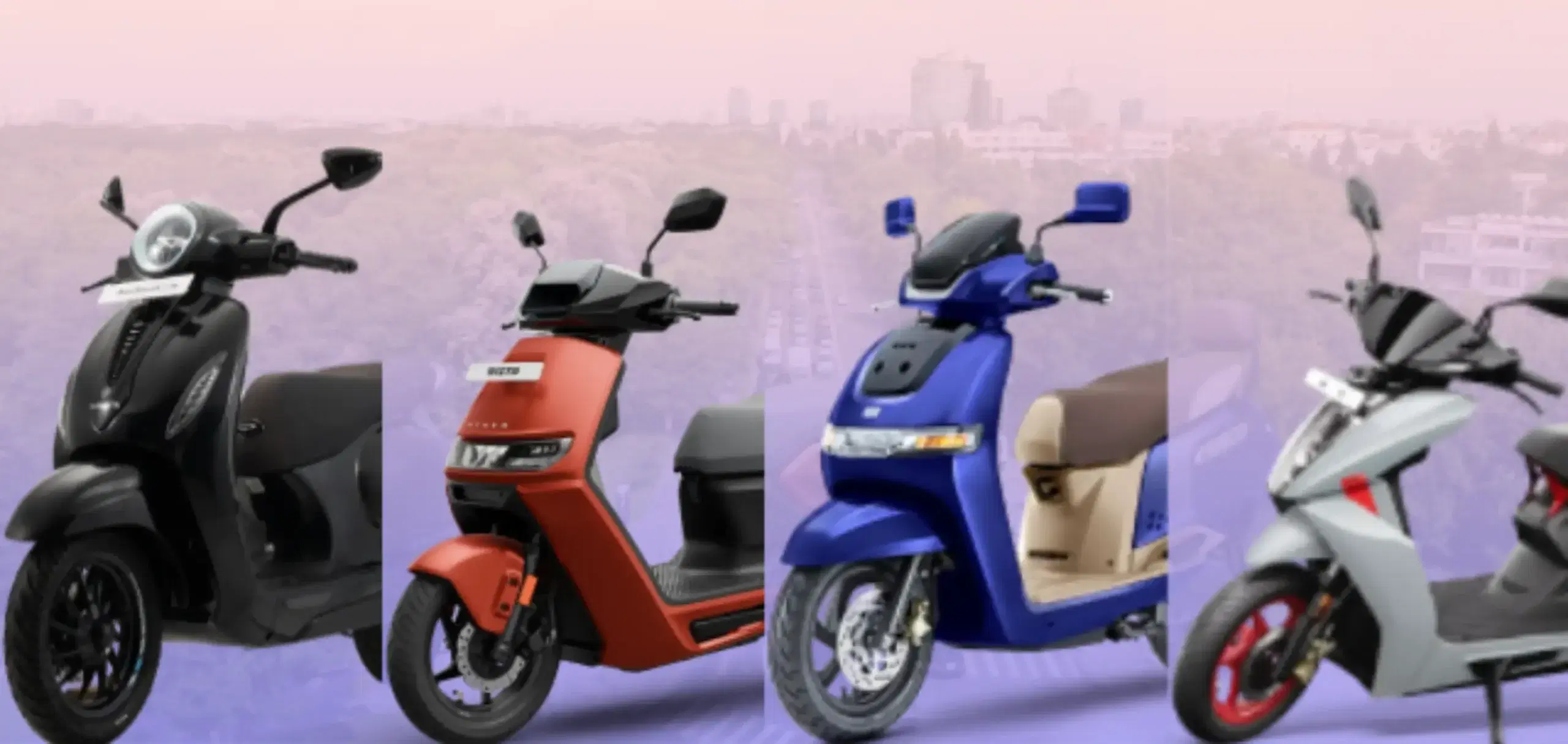
Ather, Bajaj, and TVS. These are three of India’s most trusted electric scooter brands. And three very different answers to city commuting.
Well, if you are torn between these popular EV options, this guide lays out exactly what you need to know. You might be looking into a broad Chetak vs Ather match-up. Or perhaps you need a specific Bajaj Chetak vs Ather Rizta breakdown.
You might also want to know if the metal build wins in an Ather vs Chetak comparison. Thankfully, we’ve covered every angle so you can easily find your perfect ride among the brands’ various offerings.
What Makes Each Brand Different — Know Before You Compare
Before diving into the specs, it helps to understand what these brands actually stand for.
| Brand | Identity | Best For |
| Bajaj Chetak | Premium metal build, comfort, refinement, trust | Family commuters, comfort-first riders |
| Ather Energy | Tech-first, performance, range accuracy, fast charging | Tech-savvy, performance-oriented riders |
| TVS iQube | Range efficiency, BaaS flexibility, biggest battery option | Value seekers, high-mileage commuters |
All Scooters at a Glance (2026)
Here is a quick look at how the entry and top variants stack up across the board.
| Spec | Bajaj Chetak 3501 | Ather Rizta Z | Ather 450X | TVS iQube ST 5.3 kWh |
| Ex-Showroom Price | ~₹1.50 lakh | ~₹1.60 lakh | ~₹1.49 lakh | ~₹1.70 lakh |
| Battery Capacity | 3.5 kWh | 3.7 kWh | 3.7 kWh | 5.3 kWh |
| Claimed Range | 153 km | 123 km | 126 km | 212 km |
| Real-World Range | ~120 km | ~140 km | ~110–115 km | ~160–170 km |
| Top Speed | 73 kmph | 80 kmph | 90 kmph | 82 kmph |
| Motor Power | 4.08 kW | 4.3 kW | 6.4 kW | 4.4 kW |
| Body Type | Steel monocoque | Plastic | Plastic | Plastic |
| Fast Charging | No | Yes (Ather Grid) | Yes (Ather Grid) | No |
| User Rating | 4.6/5 (BikeDekho) | 4.6/5 (BikeDekho) | 4.8/5 (BikeDekho) | 4.6/5 (BikeDekho) |
Bajaj Chetak vs Ather Rizta — Head to Head
This is the most common buying dilemma right now. Let’s break down exactly what you get for your money.
Price Comparison
The Chetak entry price sits at ₹87,100 for the C250i/3001 models, making it highly accessible. The Rizta entry starts higher at ₹1,15,435.
Looking at the top variants, the Chetak 3501 comes in at around ₹1.50L, while the Rizta Z will cost you roughly ₹1.60L. That leaves a price gap at entry of about ₹28,000 in Chetak’s favour. Saving that money with the Chetak keeps your upfront costs extremely low while still giving you a durable metal body and a refined ride, essentially paying for years of home charging.
Range — Claimed vs Real World
On paper, the claimed range is 127–153 km for the Chetak and 123 km for the Rizta. In the real world, however, the Rizta leads at around 140 km compared to the Chetak at roughly 120 km in top-spec real use.
One big plus for Bajaj is that Chetak’s range estimation accuracy is consistently praised. Owners say the dashboard meter is highly reliable and not overly optimistic. But when weighing Ather Rizta vs Bajaj Chetak, the Rizta’s 3.7 kWh battery is physically larger, giving it a real-world edge despite the lower claimed number.
Performance & Speed
Top speed is 80 kmph for the Rizta and 73 kmph for the Chetak. Motor power also leans toward the Rizta at 4.3 kW versus the Chetak’s 4.08 kW. As a result, the Rizta has faster acceleration in its performance mode, while the Chetak feels smoother and more refined at lower city speeds.
Features & Tech
The Rizta packs fast charging via the Ather Grid, a superior tech dashboard, OTA updates, and 4 ride modes. The Chetak fights back with practical daily features like reverse assist, IP67 waterproofing, a steel body, and hill hold. Ather gives you 20 customisation variants for the Rizta, while the Chetak keeps it simple with 4.
Build Quality & Comfort
The Chetak has a massive, unique advantage: a full steel monocoque body versus the Rizta’s plastic shell. For comfort, both receive identical 4.6/5 user ratings on BikeDekho. Buyers praise the Chetak for its premium feel and upright, family-friendly riding posture, while the Rizta gets high marks for its sporty refinement and spacious seat.
Chetak Vs Rizta: The Verdict
Here is the final Chetak vs Ather breakdown for this category to help you decide.
| Prefer Chetak if… | Prefer Rizta if… |
| Budget is under ₹1.5L | You prioritise real-world range |
| You want metal body durability | You want fast charging via Ather Grid |
| You ride mostly within 100 km/day | You want a higher top speed |
| Brand trust and service familiarity matter | You’re tech-forward and want OTA features |
Bajaj Chetak vs Ather 450X — Performance Meets Premium
If you are stepping up the budget, the choice splits into two distinct identities: the 450X is a performance machine, and the Chetak is a comfort commuter.
Price Gap
You will pay around ₹1.49L for the 450X. The Chetak ranges from ₹1.07–1.50L depending on the variant. While they overlap in price at the higher end, they offer completely different riding experiences.
Performance Difference
The 450X boasts a powerful 6.4 kW motor and a 90 kmph top speed. The Chetak maxes out at 4.08 kW and 73 kmph. The 450X holds a stellar user rating of 4.8/5—the highest in this group. It is built for riders who want near-petrol acceleration, whereas the Chetak is tuned for smooth, quiet city riding.
Range
BikeWale reports both deliver a claimed range of around 126–127 km at their respective top variants. Real-world 450X range tends to hover around 110–115 km due to higher power consumption when riding aggressively.
The Verdict
Buy the 450X if performance, thrill, tech, and highest user satisfaction matter more to you. Buy the Chetak if build quality, comfort, service confidence, and a smooth urban ride matter more.
iQube vs Chetak vs Ather — Three-Way Showdown
If you are keeping all your options open, let’s look at how the TVS iQube disrupts the mix.
Three-Way Price Comparison
| Variant Tier | TVS iQube | Bajaj Chetak | Ather Rizta |
| Entry | ₹1,13,245 (base) | ₹87,100 (C250i) | ₹1,15,435 |
| Mid | ₹1.30–1.50L | ₹1.27–1.39L | ₹1.30–1.45L |
| Top | ₹1.71L (ST 5.3 kWh) | ₹1.50L (3501) | ₹1.60L (Rizta Z) |
Three-Way Range Comparison
For real-world numbers, the Rizta Z gives you about 140 km. The iQube ST hits an impressive 160–170 km, and the Chetak 3501 sits near 120 km. The iQube ST wins on absolute range with its massive 5.3 kWh battery, but it is also the most expensive.
Features Face-Off
Ather models bring fast charging through the Ather Grid, the best dashboard tech ecosystem, and regular OTA updates. The TVS iQube stands out by offering a Battery-as-a-Service (BaaS) plan for ₹839/month, making it a great pick for high-mileage riders. The Bajaj Chetak is the only one with a steel body, providing top-tier comfort, IP67 protection, and reverse assist.
Ownership & Service
Bajaj operates the largest dealer and service network in India, offering unmatched peace of mind. TVS has a solid pan-India service reach and provides a 3-year warranty plus extended plans. Ather is tech-forward with a growing network, but currently has fewer service touchpoints in Tier 2 and Tier 3 cities.
Three-Way Verdict
| Priority | Best Pick |
| Lowest entry price | Bajaj Chetak (₹87,100) |
| Best real-world range | TVS iQube ST 5.3 kWh |
| Best tech & fast charging | Ather Rizta Z / Ather 450X |
| Best build quality | Bajaj Chetak (steel body) |
| Best performance | Ather 450X |
| Best for high mileage | TVS iQube (BaaS plan) |
| Strongest service network | Bajaj Chetak |
Which Should YOU Buy — Decision Guide by Rider Type
- The Family Commuter: Bajaj Chetak. You get a metal body, refinement, IP67 protection, reverse assist, and heavy brand trust.
- The Tech-Forward Rider: Ather Rizta Z. Enjoy fast charging, range accuracy, OTA updates, and solid everyday performance.
- The Performance Seeker: Ather 450X. This is the fastest option, holds the highest user rating, and hits a 90 kmph top speed.
- The High-Mileage Rider: TVS iQube ST 5.3 kWh. You get the best range in its class and a handy BaaS option to lower upfront costs.
- The Budget-Conscious Buyer: Bajaj Chetak C250i/3001. It starts at a highly accessible ₹87,100 while still delivering a solid, durable build.
Frequently Asked Questions
Q1: When looking at a general Chetak vs Ather comparison, which is better?
It depends on your daily commute priority. The Chetak wins on solid build quality, pillion comfort, and an accessible price point. Ather wins on raw performance, smart tech, fast charging, and superior real-world range. Chetak suits family commuters perfectly, while Ather is built for tech-forward and performance-oriented riders.
Q2: Bajaj Chetak vs Ather Rizta — which is better?
The Chetak is significantly cheaper, starting from ₹87,100, features a durable steel body, and offers a highly refined riding experience. The Rizta leads on real-world range at around 140 km, provides fast charging, and has a higher top speed. Chetak offers better value, while Rizta is the better performer.
Q3: What is the main difference between Ather Rizta vs Bajaj Chetak?
The Chetak features a classic steel monocoque body, a lower starting price, and a softer character tuned for city comfort. The Rizta uses a modern plastic body, delivers a higher top speed, supports fast charging via the Ather Grid, and provides better real-world range for longer commutes.
Q4: Bajaj Chetak vs Ather 450X — which to choose?
The 450X wins on sheer performance thanks to its 6.4 kW motor, 90 kmph top speed, and a top-tier 4.8/5 user rating. The Chetak wins on build quality, riding comfort, and overall value. Choose the 450X for a thrilling ride, or the Chetak for a relaxed, refined daily commute.
Q5: iQube vs Chetak vs Ather — which is the best electric scooter?
The TVS iQube wins on long-range capability with its 212 km claimed range and 5.3 kWh battery. Ather wins heavily on smart tech and fast charging infrastructure. Chetak wins on premium metal build quality and entry price. Your best choice ultimately depends on prioritising range, performance, or overall value.
Q6: For an Ather vs Chetak daily commute, which has better range?
Looking at claimed figures, the Chetak leads at 153 km versus the Rizta’s 123 km. However, in the real-world, the Ather Rizta actually leads at about 140 km versus the Chetak’s 120 km. Meanwhile, the iQube ST dominates both competitors by delivering a 160–170 km real-world range.
Based on 4 ratings

Najmus (Author)
Najmus leads content and SEO at Ecozaar, building trustworthy guides on electric two-wheelers, RTO processes, and green finance in India. With 8+ years in technical and editorial SEO, he turns complex regulations and specs into practical, citation-backed explainers. His work combines schema, CWV, and clear sourcing to help readers make confident, real-world decisions.
Read more
Related Blogs
Popular articles are selected from the same backend blog feed.


Best Bikes Under 1 Lakh in India: Price, Mileage & Low-Maintenance Commuters
Compare the best bikes under ₹1 lakh in India by price, real-world mileage, maintenance and safety — from sub-₹60k commuters to 125cc options near ₹1 lakh.
Best Bikes Under 2 Lakh in India: Streetfighters, Cruisers & All-Rounders
Compare the best bikes under ₹2 lakh in India: verified ex-showroom prices, real-world mileage, ABS and hardware, and which model fits your budget.
Best Electric Scooters Under 1 Lakh in India: Real-World Range, Subsidy & Price List
Compare the best electric scooters under ₹1 lakh by real-world range, battery size, charging, PM E-DRIVE benefits, running cost, build quality and family practi
Best Low-Cost Electric Scooters Under ₹40,000–₹50,000: Non-RTO & Budget Commuters
Compare low-cost electric scooters under ₹40,000–50,000 by price, range, battery type, charging, non-RTO rules, running cost and practical ownership risks.
Best 110cc–125cc Family Commuter Scooters in India: Mileage, Comfort & Price Comparison
Compare the best 110cc and 125cc scooters in India by price, real-world mileage, comfort, storage, braking, running cost and the value of upgrading to 125cc.
Best 150cc–160cc Bikes in India: Mileage, Price, Specs & Performance
Compare India's best 150cc–160cc bikes on mileage, price, power, braking and comfort — Pulsar N160, Apache RTR 160 4V, Xtreme 160R, FZ-S and more.
Best 200cc–250cc Performance Bikes in India: Power, Mileage & Highway Cruising
Compare India's best 200cc–250cc bikes on power-to-weight, real-world mileage, highway cruising and price, with the 200cc and 250cc classes covered together.
Best 350cc–500cc Bikes in India: Royal Enfield, Triumph & Mid-Capacity Classics
Compare Royal Enfield, Triumph, Harley-Davidson, KTM and Bajaj bikes from 349cc to 452cc on real price, power, mileage and highway comfort in India.