500 Watt Solar Panel Price in India : Guide with Brands, Subsidy & ROI
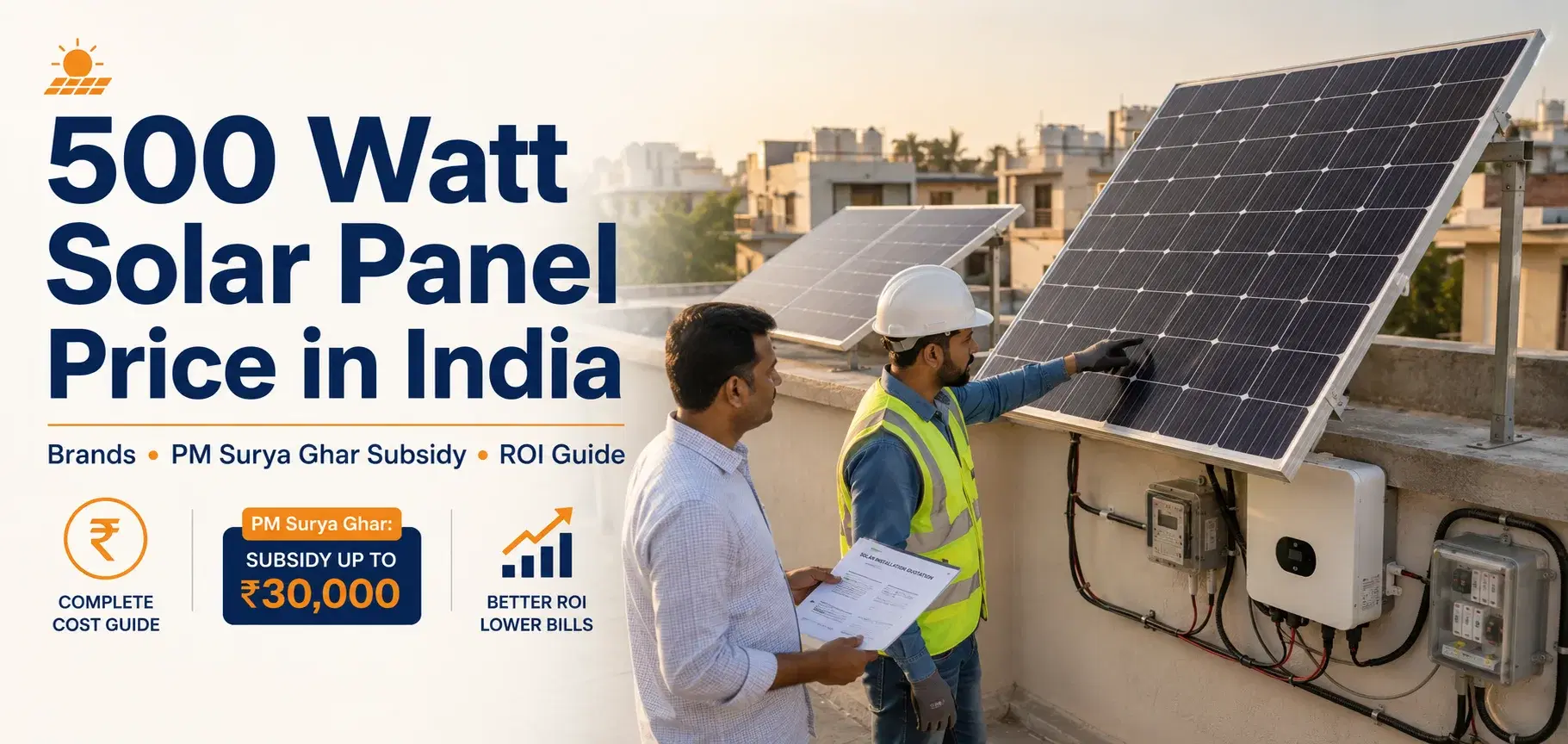
Thinking about going solar but not sure where to start? A 500 watt solar panel is one of the most popular choices for Indian homes and small businesses right now — and for good reason. It hits a sweet spot between power output and cost. The retail price of a standalone 500W solar panel in India ranges from ₹12,000 to ₹18,000 in 2026, depending on the technology and brand. But that's just the panel. Once you factor in inverters, batteries, installation, and government subsidies under the PM Surya Ghar Yojana, the real numbers look very different.
This guide covers everything — brand-wise prices, system setup costs, what appliances it can run, ROI calculations, and how to claim your subsidy. Let's get into it.
500 Watt Solar Panel Price in India 2026 – Brand-wise Comparison
A 500W solar panel in India costs between ₹12,000 and ₹18,000 per panel in 2026, with monocrystalline DCR modules priced at ₹13,500–₹16,500 and bifacial panels starting at ₹12,000. Prices vary significantly by brand, technology, and whether the panel qualifies for government subsidy.
Here's a quick brand-wise comparison to help you decide:
Brand | Panel Type | Price (₹) | Efficiency | Warranty |
|---|---|---|---|---|
Waaree | Mono PERC | ₹13,500–₹16,000 | 20–21% | 25 years |
Tata Solar | Monocrystalline DCR | ₹14,000–₹17,000 | 20–21.5% | 25 years |
Loom Solar | Mono PERC | ₹12,500–₹15,500 | 19–21% | 25 years |
Adani Solar | Bifacial | ₹13,000–₹16,500 | 20–22% | 25 years |
RenewSys | Polycrystalline | ₹11,000–₹13,500 | 17–18% | 25 years |
Vikram Solar | Mono PERC DCR | ₹14,500–₹17,500 | 20–21% | 25 years |
Pro tip: Solar panel prices in India range from ₹15 to ₹35 per watt, with Mono PERC panels costing ₹18–₹26 per watt. At 500W, that puts your per-panel cost right in the ₹9,000–₹18,000 range depending on quality tier.
You can also find 500W panels on Flipkart and Amazon India, where prices fluctuate with seller discounts. Waaree's MonoPerc flexible panel, for instance, has been listed at around ₹18,096–₹19,049 on Flipkart. Always verify the panel carries a valid BIS certification before purchasing online.
What Is a 500W Solar Panel? Types, Specs & Voltage Options
A 500W solar panel is a high-capacity photovoltaic module that generates 500 watts of peak power under standard test conditions (STC). It's available in monocrystalline, polycrystalline, bifacial, and DCR variants, with voltage configurations of 24V (standard) or 12V for specific off-grid setups.
Panel Types Explained
Monocrystalline (Mono PERC): Highest efficiency (19–22%), best for limited roof space. Most popular choice in 2026.
Polycrystalline: Lower efficiency (17–18%), cheaper, but needs more space. Good for open rooftops.
Bifacial: Captures sunlight from both sides, boosting output by 5–15% in reflective environments like white-painted terraces.
DCR (Domestic Content Requirement): Made with Indian-manufactured cells. Mandatory for PM Surya Ghar subsidy eligibility.
12V vs 24V: Which One Do You Need?
Most 500W panels are configured at 24V, which is standard for home systems. A 500 watt 12 volt solar panel exists but is less common — it's mainly used for specific off-grid applications like caravans or agricultural pumps. For home use with a standard inverter, go with 24V.
Key specs to know:
Dimensions: Approximately 2,100mm × 1,050mm × 35mm
Weight: 25–28 kg
Lifespan: 25–30 years with less than 0.5% annual degradation
Operating temperature: –40°C to +85°C
A quality 500W panel from brands like Tata Solar or Waaree will retain over 80% of its rated output even after 25 years.
Government Subsidy on 500W Solar Panels – PM Surya Ghar Yojana 2026
Under the PM Surya Ghar Muft Bijli Yojana, Indian homeowners can claim subsidies of ₹30,000 for 1 kW, ₹60,000 for 2 kW, and up to ₹78,000 for systems of 3 kW and above. This scheme directly reduces your net panel cost.
How Subsidy Works for a 500W System
A single 500W panel doesn't qualify for the full subsidy on its own — the scheme is designed for complete rooftop systems. Here's what you need to know:
Eligibility: You must be a residential consumer with a valid electricity connection from your DISCOM.
DCR Requirement: Only panels made with Indian-manufactured solar cells (DCR panels) qualify. Brands like Tata Solar, Waaree, and Vikram Solar offer DCR-certified 500W panels.
Application Process: Register on the National Portal (pmsuryaghar.gov.in), get a DISCOM-approved installer, and submit documents after installation.
Net Metering: Once connected, excess power is exported to the grid and credited to your electricity bill.
Net Cost After Subsidy (Example)
System Size | Panels Needed | Gross Cost (₹) | Subsidy (₹) | Net Cost (₹) |
|---|---|---|---|---|
1 kW | 2 × 500W | ₹85,000–₹1,10,000 | ₹30,000 | ₹55,000–₹80,000 |
2 kW | 4 × 500W | ₹1,50,000–₹1,90,000 | ₹60,000 | ₹90,000–₹1,30,000 |
3 kW | 6 × 500W | ₹2,10,000–₹2,60,000 | ₹78,000 | ₹1,32,000–₹1,82,000 |
Important: Subsidy amounts are credited directly to your bank account after successful installation and inspection by your DISCOM.
500 Watt Solar Panel System Setup Price: Panel + Inverter + Battery
A complete 500W solar system in India — including panel, inverter, battery, charge controller, and installation — costs between ₹55,000 and ₹1,20,000 depending on whether you choose an off-grid or grid-tied setup.
Here's a realistic cost breakdown:
Off-Grid System (with Battery Backup)
Component | Specification | Estimated Cost (₹) |
|---|---|---|
500W Solar Panel | Mono PERC, DCR | ₹13,000–₹17,000 |
Solar Inverter | 1 kVA, 24V | ₹8,000–₹15,000 |
Battery | 150Ah, 12V × 2 | ₹18,000–₹28,000 |
Charge Controller | MPPT 40A | ₹3,000–₹6,000 |
Mounting Structure | GI/Aluminium | ₹3,000–₹5,000 |
Wiring & Installation | — | ₹5,000–₹8,000 |
Total | ₹50,000–₹79,000 |
Grid-Tied System (No Battery)
A grid-tied 500W setup skips the battery entirely, reducing cost significantly. Expect to pay ₹35,000–₹55,000 for a complete grid-tied system with net metering.
Key point: The 500W inverter price in India ranges from ₹5,000 to ₹15,000 depending on brand and features. UTL, Luminous, and Su-Kam are popular choices. A 500 watt inverter with battery price (combo pack) typically starts at ₹22,000–₹35,000.
For a 3 kW home solar system, total costs before subsidies run ₹1,65,000–₹2,25,000. With the PM Surya Ghar subsidy of ₹78,000, your net investment drops considerably.
What Can a 500W Solar Panel Run? Appliance Load Guide
A single 500W solar panel generates roughly 2–2.5 units (kWh) of electricity per day in Indian conditions, which is enough to run fans, LED lights, a TV, and a small refrigerator — but not a standard air conditioner on its own.
Appliance Load Chart
Appliance | Wattage | Can 500W Panel Run It? |
|---|---|---|
LED Lights (5 × 10W) | 50W | ✅ Yes, easily |
Ceiling Fan | 75W | ✅ Yes |
LED TV (32 inch) | 60W | ✅ Yes |
Refrigerator (165L) | 150W | ✅ Yes (with battery) |
Desktop Computer | 200W | ✅ Yes |
1 Ton Inverter AC | 900–1,100W | ❌ Not alone |
1.5 Ton AC | 1,500W | ❌ No |
Can a 500W Panel Run an AC?
Not on its own. A 1-ton inverter AC draws 900–1,100W at startup. You'd need at least 2–3 × 500W panels (a 1.5–2 kW system) to run a 1-ton AC comfortably. For a 2-ton AC, a 3 kW solar system is the minimum.
Here's the catch: Even with a battery bank, a single 500W panel can't sustain AC operation through the night. It's best used for daytime cooling with a grid-tied system.
A 500W panel can absolutely run a 165-litre refrigerator — it draws only 150W on average and cycles on and off, making it very manageable.
ROI & Payback Period: Is a 500W Solar Panel Worth It in India?
A 500W solar panel in India typically pays for itself in 4–6 years, after which it generates free electricity for another 20+ years. At an average electricity tariff of ₹7–₹9 per unit, monthly savings range from ₹420–₹675.
Quick ROI Calculation
Daily generation: 2–2.5 units (based on 4–5 peak sun hours in India)
Monthly generation: 60–75 units
Monthly savings (at ₹7/unit): ₹420–₹525
Annual savings: ₹5,040–₹6,300
Panel cost (net after subsidy): ~₹10,000–₹14,000
Full system payback (off-grid): 5–7 years
Full system payback (grid-tied): 4–5 years
How much is 500 watts for 1 hour? Running a 500W load for 1 hour consumes 0.5 units (kWh). At ₹8/unit, that's ₹4 worth of electricity — which your panel generates for free during peak sun hours.
Solar panels degrade at less than 0.5% per year, so even after 25 years, your panel still produces over 87% of its original output. With electricity tariffs rising 5–7% annually in India, the savings compound significantly over time.
Net metering makes grid-tied systems even more attractive — unused daytime power is exported to the grid and credited against your night-time consumption, effectively making your meter run backwards.
Common Myths About 500W Solar Panels in India
Myth 1: A 500W solar panel can power your entire home.
This is the most common misconception. A single 500W panel generates just 2–2.5 units per day. The average Indian household consumes 4–8 units daily. You'd need 4–6 panels minimum for a typical 2BHK home. One panel is a starting point, not a complete solution.
Myth 2: Higher wattage always means better value.
Not necessarily. A 500W bifacial panel might cost ₹15,000 but deliver 10–15% more output than a standard mono panel in the right environment (reflective rooftop). Efficiency per rupee matters more than raw wattage. Always calculate cost per watt (₹/W) before buying.
Myth 3: You can claim subsidy on any 500W panel.
Actually, only DCR (Domestic Content Requirement) panels qualify for the PM Surya Ghar Yojana subsidy. Non-DCR panels — even from reputable brands — don't qualify. Always confirm DCR certification before purchasing for a subsidised installation.
Top 5 Best 500 Watt Solar Panel Brands in India (2026)
The best 500W solar panel brands in India in 2026 are Waaree, Tata Solar, Loom Solar, Adani Solar, and Vikram Solar — ranked on efficiency, warranty, after-sales service, and value for money.
Waaree Solar – India's largest solar manufacturer. Their 500W Mono PERC panels offer 20–21% efficiency with a solid 25-year performance warranty. Widely available on Flipkart and through authorised dealers. Price: ₹13,500–₹16,000.
Tata Solar – Most trusted brand for residential buyers. Tata's 500W DCR panels are subsidy-eligible and backed by Tata's pan-India service network. Price: ₹14,000–₹17,000. Tata Solar Panel 500 Watt price in India is often the first benchmark buyers check.
Loom Solar – Best for online buyers. Strong e-commerce presence, good warranty support, and competitive pricing. Their Shark series 500W panel is popular. Price: ₹12,500–₹15,500.
Adani Solar – Premium bifacial panels with higher output in reflective conditions. Best for commercial or large residential rooftops. Price: ₹13,000–₹16,500.
Vikram Solar – Export-quality panels available domestically. High efficiency (20–21%), DCR-certified, and excellent degradation warranty. Price: ₹14,500–₹17,500.
Pro tip: Always buy from an authorised dealer or directly from the brand's website to ensure warranty validity and genuine DCR certification.
Frequently Asked Questions
What is the cost of a 500 watt solar panel in India in 2026?
A 500W solar panel in India costs between ₹12,000 and ₹18,000 in 2026, depending on the brand and technology. Monocrystalline DCR panels range from ₹13,500–₹16,500, while bifacial panels start at ₹12,000. Premium brands like Tata Solar and Vikram Solar sit at the higher end (₹14,000–₹17,500), while Loom Solar offers budget-friendly options from ₹12,500.
How much will a 500 watt solar panel run?
A 500W solar panel can run LED lights, ceiling fans, a TV, a desktop computer, and a small refrigerator simultaneously. It generates 2–2.5 units per day under Indian sun conditions. It cannot power a standard 1-ton AC on its own. For AC operation, you'd need at least a 1.5–2 kW system (3–4 panels). It's ideal for basic household loads and small offices.
How long will a 500-watt solar panel last?
A quality 500W solar panel lasts 25–30 years with minimal performance loss. Most reputable brands like Waaree, Tata Solar, and Vikram Solar guarantee less than 0.5% annual degradation, meaning the panel retains over 87% of its rated output after 25 years. The physical panel rarely fails — inverters and batteries typically need replacement every 5–10 years.
Can I install 500W solar panels myself (DIY)?
Basic mounting and wiring is possible DIY, but professional installation is strongly recommended for safety and subsidy eligibility. DIY installation voids most warranties and disqualifies you from the PM Surya Ghar Yojana subsidy, which requires a DISCOM-approved installer. If you're technically skilled, you can handle panel mounting — but always hire a licensed electrician for inverter and grid connections.
What is the total price of a 500W solar panel system with battery and inverter in India?
A complete off-grid 500W solar system with battery and inverter costs ₹50,000–₹79,000 in India. This includes the panel (₹13,000–₹17,000), a 1 kVA inverter (₹8,000–₹15,000), two 150Ah batteries (₹18,000–₹28,000), charge controller, mounting structure, and installation. A grid-tied system without batteries is cheaper at ₹35,000–₹55,000. After PM Surya Ghar subsidy, net costs reduce significantly.
Is there a 750W or 1000W solar panel available in India?
Yes, both 750W and 1000W solar panels are available in India, primarily for commercial and industrial use. Brands like Waaree and Adani Solar offer high-wattage panels above 600W. However, they're bulkier, heavier, and require stronger mounting structures. For residential rooftops, 400W–550W panels remain the practical sweet spot due to standard roof dimensions and inverter compatibility.
What is the payback period for a 500W solar panel in India?
A 500W solar panel system in India typically pays back its investment in 4–6 years. At ₹7–₹9 per unit and 2–2.5 daily units generated, monthly savings are ₹420–₹675. A grid-tied system (no battery) recovers costs faster (4–5 years) than an off-grid setup (5–7 years). With electricity tariffs rising annually, the actual payback period is often shorter than projected.
Conclusion
A 500W solar panel is one of the smartest investments an Indian homeowner can make in 2026. With panel prices ranging from ₹12,000 to ₹18,000, government subsidies of up to ₹78,000 under the PM Surya Ghar Yojana, and a payback period of just 4–6 years, the financial case is hard to ignore.
Whether you're looking at a simple grid-tied setup or a full off-grid system with battery backup, the key is choosing a DCR-certified panel from a reliable brand like Tata Solar, Waaree, or Loom Solar. Don't just compare panel prices — factor in the full system cost, subsidy eligibility, and long-term savings.
A ₹15,000 panel that qualifies for ₹30,000 in subsidy is a far better deal than a ₹12,000 panel that doesn't. Start by checking your monthly electricity bill, calculating how many units you need, and getting quotes from at least two DISCOM-approved installers in your area.
Based on 1 rating

Tanushree (Author)
Tanushree is a dynamic business strategist with a knack for driving innovation in startups, especially in Fintech and Edtech. With 9 years of work-ex, an IT engineer from MIT Pune, & a MBA from IIM Bangalore (Marketing & Business Strategy), she’s got the mix of analytical and creative problem-solving.
Read more
Related Blogs
Popular articles are selected from the same backend blog feed.


Best Bikes Under 1 Lakh in India: Price, Mileage & Low-Maintenance Commuters
Compare the best bikes under ₹1 lakh in India by price, real-world mileage, maintenance and safety — from sub-₹60k commuters to 125cc options near ₹1 lakh.

Best Bikes Under 2 Lakh in India: Streetfighters, Cruisers & All-Rounders
Compare the best bikes under ₹2 lakh in India: verified ex-showroom prices, real-world mileage, ABS and hardware, and which model fits your budget.

Best Sports Bikes Under 5 Lakh in India: Track Bikes, Supersports & Top Speed Comparison
Compare the best sports bikes under ₹5 lakh in India by 0–100 km/h, GPS top speed, track ability, electronics, mileage and ownership costs.

Best Electric Scooters Under 1 Lakh in India: Real-World Range, Subsidy & Price List
Compare the best electric scooters under ₹1 lakh by real-world range, battery size, charging, PM E-DRIVE benefits, running cost, build quality and family practi
Best Low-Cost Electric Scooters Under ₹40,000–₹50,000: Non-RTO & Budget Commuters
Compare low-cost electric scooters under ₹40,000–50,000 by price, range, battery type, charging, non-RTO rules, running cost and practical ownership risks.

Best 110cc–125cc Family Commuter Scooters in India: Mileage, Comfort & Price Comparison
Compare the best 110cc and 125cc scooters in India by price, real-world mileage, comfort, storage, braking, running cost and the value of upgrading to 125cc.

Best 150cc–160cc Bikes in India: Mileage, Price, Specs & Performance
Compare India's best 150cc–160cc bikes on mileage, price, power, braking and comfort — Pulsar N160, Apache RTR 160 4V, Xtreme 160R, FZ-S and more.

Best 200cc–250cc Performance Bikes in India: Power, Mileage & Highway Cruising
Compare India's best 200cc–250cc bikes on power-to-weight, real-world mileage, highway cruising and price, with the 200cc and 250cc classes covered together.