1kW Solar Panel Price in India 2026 | Specs & Savings
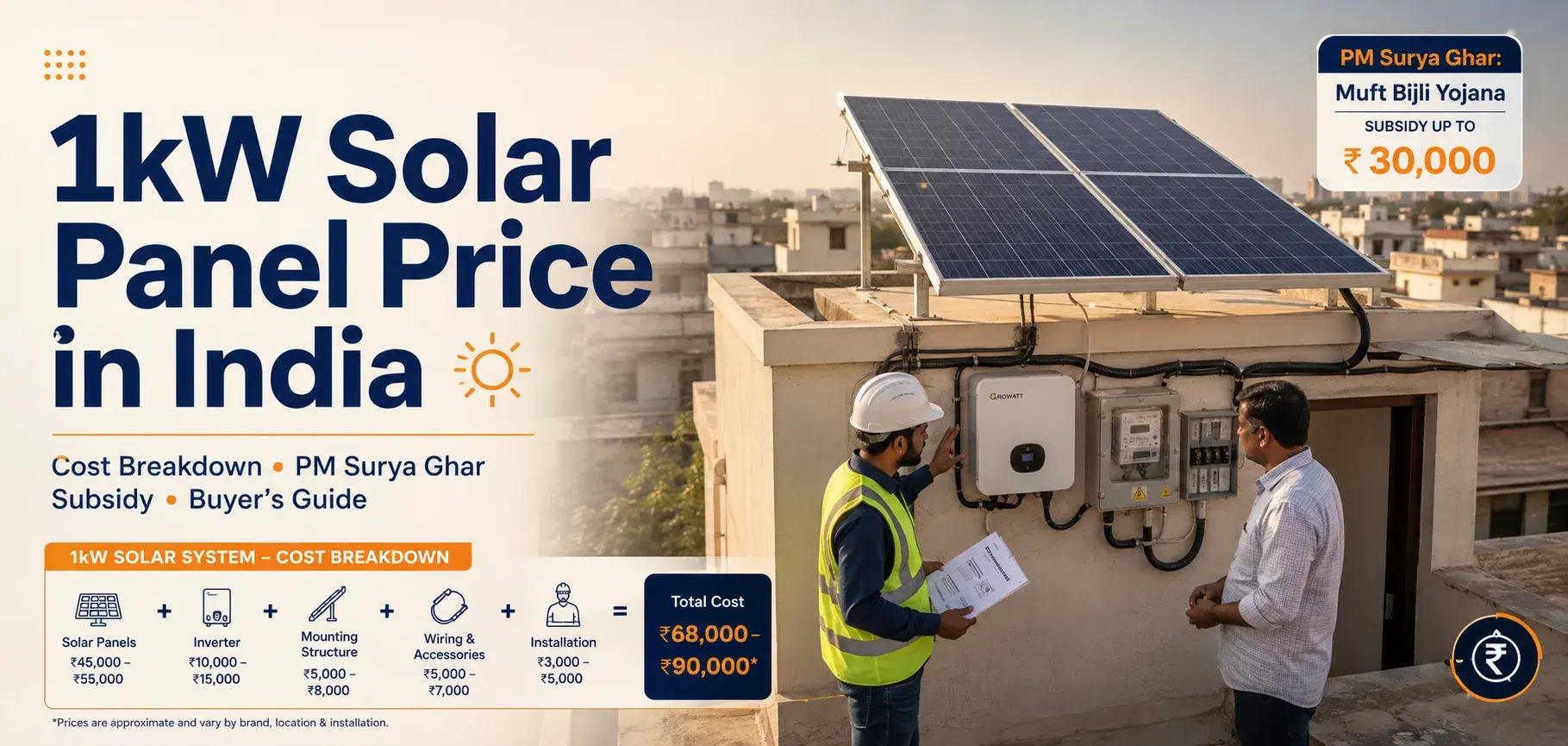
Thinking about going solar but not sure if a 1kW system fits your budget or your home? You're not alone. Thousands of Indian homeowners search for the 1kW solar panel price every month — and the answers they find are often confusing, outdated, or incomplete. Here's the short version: a 1 kilowatt solar panel system in India costs between ₹45,000 and ₹1,50,000 depending on the system type, brand, and city. After the PM Surya Ghar Muft Bijli Yojana subsidy, your net cost can drop to as low as ₹25,000–₹45,000 for an on-grid setup.
This guide covers everything — on-grid vs off-grid vs hybrid pricing, government subsidy details, appliance load capacity, space requirements, payback period, and city-wise pricing for Bengaluru, Chennai, Mumbai, Delhi, and more. No fluff. Just the numbers and facts you need to make a smart decision.
What Is a 1kW Solar System and Who Is It For?
A 1kW solar system is a rooftop power setup that generates roughly 4–5 units (kWh) of electricity per day under good sunlight conditions, making it ideal for small homes with monthly consumption up to 120–150 units.
1kW Solar Panel Price in India 2026 – On-Grid, Off-Grid & Hybrid
The 1kW solar panel price in India ranges from ₹43,000 to ₹1,50,000 before subsidy, depending on whether you choose an on-grid, off-grid, or hybrid system. On-grid systems are the most affordable; hybrid systems cost the most due to battery storage.
Here's a clear breakdown of the 1kw solar system price across all three types:
System Type | Price Range (Before Subsidy) | Price After Subsidy | Best For | Key Components |
|---|---|---|---|---|
On-Grid | ₹43,000 – ₹75,000 | ₹25,000 – ₹45,000 | Grid-connected homes | Panels + Inverter + Net Meter |
Off-Grid | ₹65,000 – ₹95,000 | ₹35,000 – ₹65,000 | Areas with power cuts | Panels + Inverter + Battery |
Hybrid | ₹85,000 – ₹1,50,000 | ₹55,000 – ₹1,20,000 | Best of both worlds | Panels + Hybrid Inverter + Battery |
On-Grid (Budget Brand) | ₹43,000 – ₹52,000 | ₹25,000 – ₹32,000 | Cost-conscious buyers | Basic panels + string inverter |
Off-Grid (24V with Battery) | ₹83,199 | ₹53,000 – ₹65,000 | Rural/semi-urban homes | 24V battery bank + panels |
Pro tip: On-grid systems qualify for the PM Surya Ghar subsidy most easily. Off-grid systems with batteries may have limited subsidy eligibility — always confirm with your local DISCOM.
On-Grid 1kW System Cost (₹43,000 – ₹75,000)
On-grid solar is the most popular choice in cities like Bengaluru and Mumbai. You stay connected to the grid, export surplus power, and earn credits. Bluebird Solar lists its on-grid 1kW system at ₹43,000, while Vikram Solar estimates the average at ₹45,000–₹75,000.
Off-Grid 1kW System Cost with Battery (₹65,000 – ₹95,000)
Off-grid systems include a battery bank, making them ideal for areas with frequent power cuts. Kenbrook Solar prices a 24V off-grid 1kW system at ₹83,199. The battery adds ₹20,000–₹30,000 to the base cost.
Hybrid 1kW System Cost (₹85,000 – ₹1,50,000)
Hybrid systems combine grid connectivity with battery backup. They're the most expensive but offer maximum flexibility. Bluebird Solar lists its hybrid 1kW system at ₹76,675, while other vendors quote up to ₹1,50,000 for premium configurations.
Government Subsidy on 1kW Solar System – PM Surya Ghar Muft Bijli Yojana
The PM Surya Ghar Muft Bijli Yojana offers a central government subsidy of ₹30,000 for a 1kW residential rooftop solar system. This directly reduces your upfront cost and is available to homeowners across India through their local DISCOM.
The MNRE (Ministry of New and Renewable Energy) launched this scheme to make solar accessible to every Indian household. Here's what you need to know:
Subsidy Amount & Eligibility
1kW system: ₹30,000 subsidy
2kW system: ₹60,000 subsidy
3kW and above: Capped at ₹78,000
Eligibility: Residential consumers with a valid electricity connection and rooftop ownership
The subsidy applies primarily to on-grid systems connected to the grid via net metering
Step-by-Step Application Process
1. Visit the PM Surya Ghar National Portal (pmsuryaghar.gov.in)
2. Register with your electricity consumer number and DISCOM details
3. Apply for rooftop solar installation
4. Get a site survey done by an MNRE-empanelled installer
5. Complete installation and connect to the grid
6. Apply for net metering through your DISCOM
7. Subsidy is credited directly to your bank account after inspection
Documents Required
Aadhaar card
PAN card
Electricity bill (latest)
Roof ownership proof or NOC from landlord
Bank account details for subsidy transfer
Important: Processing time is typically 30–90 days after installation. Always use an MNRE-approved installer to ensure subsidy eligibility.
1kW Solar Panel Price After Subsidy – Net Cost with Real Examples
After applying the ₹30,000 PM Surya Ghar subsidy, a 1kW on-grid solar system effectively costs ₹25,000–₹45,000 net. This makes it one of the most affordable entry points into solar energy for Indian homeowners.
The average cost of a 1kW solar system in India ranges from ₹50,000 to ₹70,000 before subsidy. Here's how the subsidy changes the math:
Example 1 – Budget On-Grid Setup (Bengaluru):
System cost: ₹55,000
PM Surya Ghar subsidy: –₹30,000
Net cost: ₹25,000
Example 2 – Mid-Range On-Grid Setup (Mumbai):
System cost: ₹70,000
PM Surya Ghar subsidy: –₹30,000
Net cost: ₹40,000
Example 3 – Off-Grid with Battery (Chennai):
System cost: ₹85,000
Subsidy (if applicable): –₹20,000
Net cost: ₹65,000
Key point: The subsidy is fixed at ₹30,000 for 1kW regardless of what you pay. So buying a cheaper system maximises your savings percentage.
1kW Solar Panel Price in Top Indian Cities
Solar panel prices vary by city due to differences in installation labour costs, local DISCOM policies, and logistics. Here's a city-wise price guide for a complete 1kW solar system in 2026.
City | On-Grid Price (Before Subsidy) | After Subsidy | Local Brands/Installers |
|---|---|---|---|
Bengaluru, Karnataka | ₹50,000 – ₹70,000 | ₹20,000 – ₹40,000 | Loom Solar, local BESCOM-approved vendors |
Chennai, Tamil Nadu | ₹40,000 – ₹70,000 | ₹10,000 – ₹40,000 | JSS Solar, Bluebird Solar |
Mumbai, Maharashtra | ₹55,000 – ₹80,000 | ₹25,000 – ₹50,000 | Waaree Solar, Tata Solar |
Delhi NCR | ₹50,000 – ₹75,000 | ₹20,000 – ₹45,000 | Loom Solar, UTL Solar |
Kolkata, West Bengal | ₹45,000 – ₹65,000 | ₹15,000 – ₹35,000 | Waaree Solar (₹8,580 per 330Wp panel) |
Hyderabad, Telangana | ₹48,000 – ₹72,000 | ₹18,000 – ₹42,000 | Vikram Solar, local TSSPDCL vendors |
For HSR Layout, Bengaluru specifically, prices from local BESCOM-empanelled installers typically range from ₹52,000–₹68,000 before subsidy. Always get at least 3 quotes from MNRE-approved vendors in your area.
How Many Appliances Can a 1kW System Run? Realistic Load Calculation
A 1kW solar system can comfortably run fans, LED lights, a TV, and a small refrigerator simultaneously — but it cannot power a standard 1.5-ton AC, which alone draws 1,200–1,500W.
Daily Unit Generation & Savings
A 1kW system generates approximately 4–5 units per day (1,400–1,825 units per year) depending on your location's solar irradiance. In sunny states like Rajasthan or Tamil Nadu, you'll hit the higher end.
Monthly generation: 120–150 units
Monthly savings: ₹800–₹1,500 (at ₹6–₹10 per unit)
Annual savings: ₹10,000–₹18,000
Can 1kW Run an AC, Fridge, TV, Fans? (Truth Table)
Appliance | Power Draw | Can 1kW Run It? |
|---|---|---|
LED Lights (5 × 10W) | 50W | ✅ Yes |
Ceiling Fans (3 × 75W) | 225W | ✅ Yes |
LED TV (40-inch) | 80W | ✅ Yes |
Refrigerator (165L) | 150W | ✅ Yes |
Laptop + Phone Charging | 100W | ✅ Yes |
1.5-Ton AC | 1,200–1,500W | ❌ No |
1-Ton AC | 900–1,100W | ⚠️ Borderline |
Total safe load for 1kW system: 800W running simultaneously. You can run a 1-ton AC only if no other heavy appliances are on — and only during peak sunlight hours (10am–3pm) on an on-grid system.
Space & Panels Required for a 1kW Solar Installation
A 1kW solar system requires 80–100 square feet of shadow-free rooftop space and typically uses 2–4 solar panels depending on the wattage per panel.
Here's how panel count breaks down by wattage:
250W panels: 4 panels needed (older polycrystalline type)
330W–335W panels: 3 panels needed (standard monocrystalline)
500W–545W panels: 2 panels needed (high-efficiency mono PERC)
1kW solar panel size for a standard 330W monocrystalline panel is approximately 1.7m × 1.0m (about 17 sq.ft. per panel). Three such panels need roughly 51–60 sq.ft. of panel area, but with spacing and mounting, plan for 80–100 sq.ft. total.
Pro tip: South-facing rooftops with a 15–30° tilt angle get maximum sunlight in India. Avoid shading from water tanks, trees, or adjacent buildings — even partial shade can cut output by 20–40%.
Return on Investment – Payback Period & Savings Over 25 Years
A 1kW solar system in India typically pays for itself in 4–6 years. Over its 25-year lifespan, it can save you ₹2,50,000–₹4,50,000 in electricity costs — a strong return on a ₹25,000–₹45,000 net investment after subsidy.
Here's a simple ROI snapshot for a Bengaluru homeowner:
Net system cost (after subsidy): ₹30,000
Annual electricity savings: ₹12,000
Payback period: 2.5 years
Savings over 25 years: ₹3,00,000 (accounting for 5% annual tariff increase)
Even without the subsidy, at ₹60,000 total cost and ₹12,000 annual savings, payback is 5 years — still excellent.
Key point: Solar panel efficiency degrades by about 0.5–0.7% per year. Most quality panels from brands like Waaree Solar, Vikram Solar, or Tata Solar come with a 25-year performance warranty guaranteeing at least 80% output at year 25.
Common Myths About 1kW Solar Panels
Myth 1: A 1kW solar system can run your AC all day. This is the most common misconception. A standard 1.5-ton AC draws 1,200–1,500W — more than the system's entire capacity. You'd need at least a 2kW–3kW system to run an AC reliably. A 1kW system is designed for lights, fans, TV, and a small fridge.
Myth 2: Solar panels don't work on cloudy days. Actually, modern monocrystalline panels still generate 10–25% of rated output on overcast days. In cities like Mumbai or Kolkata with monsoon seasons, your annual generation will be lower, but the system still produces meaningful power year-round.
Myth 3: The government subsidy is automatic. It isn't. You must apply through the PM Surya Ghar national portal, use an MNRE-empanelled installer, complete net metering, and pass a DISCOM inspection. Skipping any step means losing the ₹30,000 benefit.
Conclusion
A 1kW solar system is a smart, affordable entry into solar energy for small Indian homes — especially after the PM Surya Ghar Muft Bijli Yojana subsidy brings your net cost down to as little as ₹25,000. It won't run your AC, but it'll handle your fans, lights, TV, and fridge with ease, saving you ₹10,000–₹18,000 annually. With a payback period of just 4–6 years and a 25-year panel lifespan, the ROI is hard to argue with.
Here's what to do next: check your monthly electricity bill, estimate your load, get 3 quotes from MNRE-approved installers in your city, and apply for the subsidy online. The sooner you install, the sooner you start saving.
Frequently Asked Questions
Based on 1 rating

Tanushree (Author)
Tanushree is a dynamic business strategist with a knack for driving innovation in startups, especially in Fintech and Edtech. With 9 years of work-ex, an IT engineer from MIT Pune, & a MBA from IIM Bangalore (Marketing & Business Strategy), she’s got the mix of analytical and creative problem-solving.
Read more
Related Blogs
Popular articles are selected from the same backend blog feed.


Best Bikes Under 1 Lakh in India: Price, Mileage & Low-Maintenance Commuters
Compare the best bikes under ₹1 lakh in India by price, real-world mileage, maintenance and safety — from sub-₹60k commuters to 125cc options near ₹1 lakh.

Best Bikes Under 2 Lakh in India: Streetfighters, Cruisers & All-Rounders
Compare the best bikes under ₹2 lakh in India: verified ex-showroom prices, real-world mileage, ABS and hardware, and which model fits your budget.

Best Sports Bikes Under 5 Lakh in India: Track Bikes, Supersports & Top Speed Comparison
Compare the best sports bikes under ₹5 lakh in India by 0–100 km/h, GPS top speed, track ability, electronics, mileage and ownership costs.

Best Electric Scooters Under 1 Lakh in India: Real-World Range, Subsidy & Price List
Compare the best electric scooters under ₹1 lakh by real-world range, battery size, charging, PM E-DRIVE benefits, running cost, build quality and family practi
Best Low-Cost Electric Scooters Under ₹40,000–₹50,000: Non-RTO & Budget Commuters
Compare low-cost electric scooters under ₹40,000–50,000 by price, range, battery type, charging, non-RTO rules, running cost and practical ownership risks.
Best 110cc–125cc Family Commuter Scooters in India: Mileage, Comfort & Price Comparison
Compare the best 110cc and 125cc scooters in India by price, real-world mileage, comfort, storage, braking, running cost and the value of upgrading to 125cc.

Best 150cc–160cc Bikes in India: Mileage, Price, Specs & Performance
Compare India's best 150cc–160cc bikes on mileage, price, power, braking and comfort — Pulsar N160, Apache RTR 160 4V, Xtreme 160R, FZ-S and more.

Best 200cc–250cc Performance Bikes in India: Power, Mileage & Highway Cruising
Compare India's best 200cc–250cc bikes on power-to-weight, real-world mileage, highway cruising and price, with the 200cc and 250cc classes covered together.